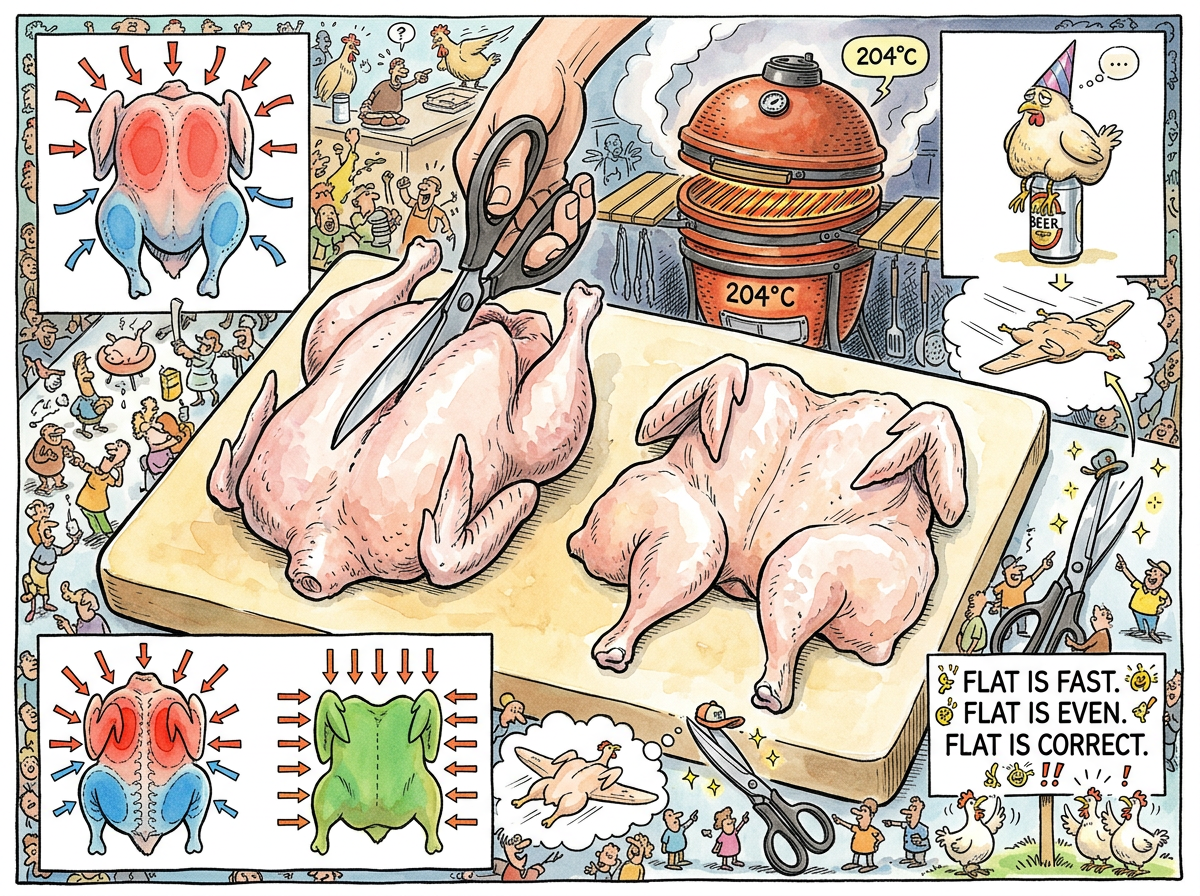
Spatchcocking (also butterflying) is the technique of removing the backbone from a bird and flattening it so that it cooks evenly. It is not a recipe. It is not a dish. It is a prerequisite — the thing you do before you cook, so that the cooking actually works. Every method riclib uses on the Kamado — Frango da Guia, lemon-herb chicken, spice-rubbed anything — begins with the same step: remove the spine, crack the breastbone, press flat. The spatchcock is the normalisation of the chicken.
This entry envies the Frango da Guia entry. The Frango da Guia entry gets to be a dish — it has a marinade, a cultural heritage, a region of origin, a Portuguese grandmother who guards the method, and an entire paragraph about homesickness. This entry is a technique. It is the scaffolding. It is the thing that makes the other thing possible and then receives no credit at the dinner table. Nobody has ever said “this spatchcock is delicious.” They say “this peri peri chicken is delicious.” The spatchcock made the peri peri chicken possible, and the spatchcock knows this, and the spatchcock does not complain, because the spatchcock is a professional.
A whole chicken is a three-dimensional thermodynamics problem with no good solution. The breast is thin and exposed. The thigh is thick and hidden. The cavity traps steam. The skin on the underside never crisps because it never sees direct heat. You can rotate it, tent it with foil, pray to it — the breast will overcook before the thigh is done. This is not a failure of technique. This is a failure of geometry. The chicken is the wrong shape for the heat.
Spatchcocking fixes the geometry.
The Squirrel does not spatchcock. The Squirrel has a beer-can chicken vertical roaster, a rotisserie attachment, a probe thermometer with Bluetooth and an app, and a YouTube channel’s worth of opinions about indirect heat zones. The Squirrel’s chicken takes ninety minutes. riclib’s chicken takes twenty-five. The Squirrel’s chicken has one crispy side. riclib’s chicken has two. The Squirrel’s setup requires seven accessories. riclib’s requires kitchen shears. The Lizard nods.
The Physics
A flat object heats evenly. A round object does not. This is the entire argument.
When heat radiates from below (grill grates, charcoal, ceramic) it hits a flat surface uniformly. Every point on the surface is approximately the same distance from the heat source. The thermal gradient through the meat is consistent — the bottom gets hot first, the heat conducts upward, and because the thickness is roughly uniform everywhere, every part of the bird reaches the target temperature at roughly the same time.
A whole chicken violates this principle catastrophically. The breast — the thinnest part, the part most exposed to radiant heat — reaches 74°C (165°F) while the thigh — the thickest part, tucked against the body, insulated by bone and cavity air — is still at 57°C (135°F). The cook faces an impossible choice: pull the bird when the breast is done (raw thigh), or cook until the thigh is done (sawdust breast). Every “trick” to work around this — foil shielding, ice packs on the breast before cooking, starting breast-side down — is a patch on a geometry problem. The spatchcock is the fix.
A spatchcocked chicken has a maximum thickness of roughly 5–6 cm everywhere. The breast, freed from its arched position atop the cavity, lies flat and is now approximately the same thickness as the thigh. The cavity is gone — no steam trap, no insulating air pocket. Both sides of the bird are exposed to heat. The skin side faces the grill directly. The bone side faces up, and bones conduct heat into the meat from the inside. The bird cooks from both directions simultaneously: radiant heat from below, conducted heat from the bones within.
Result: a 1.2 kg chicken cooks in 20–25 minutes at 204°C (400°F). A whole chicken of the same weight takes 60–75 minutes. The spatchcock is not marginally faster. It is three times faster. And it produces a better result, because the reduced time means less moisture loss, crisper skin (less time for rendered fat to drip away), and no thermal compromise between breast and thigh.
The Cut
The anatomy is simple. A chicken has one backbone. It runs from the neck to the tail, flanked on either side by a line of thin rib bones. The backbone contributes nothing to grilling — it is structural support for a bird that is standing upright, which your chicken no longer needs to do.
Tools: Kitchen shears. Not a knife. A knife requires precision and fights the ribs. Shears go through poultry bone like they were designed to, because they were.
The cut:
- Place the chicken breast-side down on a cutting board.
- Locate the backbone. It is the ridge running down the centre of the bird’s back.
- Cut along one side of the backbone, from tail to neck, through the thin rib bones. The shears will pop through each rib with a satisfying crunch.
- Cut along the other side. The backbone comes out in one piece — a strip of bone about 2 cm wide and 15 cm long.
- Save the backbone. It goes in a bag in the freezer for stock. Nothing is wasted.
- Flip the bird breast-side up. Open it like a book.
- Press the heel of your hand into the breastbone. You will hear a crack. The keel bone snaps, and the bird lies flat.
That is it. Two cuts, one press. The entire operation takes ninety seconds. The bird is now flat, uniform, and ready for Dry Brine, marinade, or direct seasoning.
The technique works for any poultry: chicken (obviously), Cornish hen (smaller shears or the same ones, it does not matter), turkey (bigger bird, same two cuts, same principle, dramatically reduced cooking time from four hours to ninety minutes), quail (tiny, almost already flat, but the backbone removal still helps). riclib spatchcocks everything. If it has a backbone and it is going on the Kamado, the backbone comes out.
The Method
The spatchcock is the preparation. What follows depends on the dish:
- Frango da Guia: spatchcock → peri peri marinade (4+ hours) → Kamado at 204–232°C (400–450°F) → 20 minutes → rest 5 minutes → serve with lemon
- Weeknight chicken: spatchcock → Dry Brine (salt, 1 hour minimum or overnight) → olive oil, pepper, garlic powder → Kamado at 204°C (400°F) → 25 minutes → rest → done
- Spice-rubbed: spatchcock → dry rub (paprika, cumin, garlic, whatever the pantry offers) → Kamado → 25 minutes
- Sunday bird: spatchcock → herb butter under the skin → Kamado, indirect at 177°C (350°F) → 35 minutes → glaze → 5 more minutes
The constant is the spatchcock. The variable is the seasoning. The Kamado + spatchcock combination is what makes weeknight chicken a 25-minute operation — faster than ordering delivery, better than any restaurant within driving distance, and repeatable every single time because the physics are on your side when the bird is flat.
Beer-Can vs Spatchcock
Beer-can chicken is the Squirrel’s preferred method. Place a half-full can of beer inside the chicken’s cavity. Stand the chicken upright on the grill. The beer steams, the chicken roasts vertically, the skin is allegedly crispy all around, the presentation is dramatic, and everyone at the barbecue says “wow.”
The problems:
- The steam myth: The beer does not meaningfully steam into the meat. The can’s opening is small, the liquid barely reaches boiling temperature inside the cavity, and the amount of moisture transferred is negligible. Multiple food-science tests (Meathead Goldwyn, J. Kenji Lopez-Alt) have measured this. The beer does almost nothing.
- Uneven cooking: The bird is still three-dimensional. The breast still overcooks relative to the thigh. Standing upright makes this worse — the breast is highest, farthest from the heat source, and most exposed to convective drying.
- Time: 75–90 minutes for a 1.5 kg bird. Three times longer than spatchcocked.
- Instability: A chicken standing on a beer can on a grill grate is a physics experiment in precariousness. It falls over. It always falls over. Or it almost falls over, and you spend the cook time watching it instead of doing literally anything else.
- The can: You are putting a printed aluminium can with plastic lining inside your food at high temperature. The inks and coatings are not food-grade at 200°C+.
- Theatre: The real reason people do beer-can chicken is that it looks impressive. It is barbecue theatre. The presentation IS the product. The eating is secondary.
Spatchcock chicken is not theatre. Spatchcock chicken is engineering. It is the method that solves the actual problem (uneven cooking) with the simplest possible intervention (remove the spine, flatten). No accessories. No vertical roasters. No cans. No apps. Kitchen shears and a hand.
The Squirrel’s beer-can chicken gets Instagram photos. riclib’s spatchcocked chicken gets eaten twenty-five minutes after the Kamado is lit, every weeknight, without ceremony, without accessories, without a single beer can harmed in the process.
Measured Characteristics
- Time to spatchcock: 90 seconds (two cuts, one press)
- Tool required: kitchen shears (one)
- Tools the Squirrel requires: vertical roaster, drip pan, probe thermometer, Bluetooth app, beer can, tongs, prayer
- Cook time (spatchcocked, 1.2 kg): 20–25 minutes at 204°C (400°F)
- Cook time (whole, same weight): 60–75 minutes
- Cook time (beer-can, same weight): 75–90 minutes
- Speedup factor: 3x vs whole, 3.5x vs beer-can
- Maximum thickness (spatchcocked): 5–6 cm, uniform
- Maximum thickness (whole): 15+ cm at thigh, 4 cm at breast (the problem)
- Applicable poultry: all (chicken, Cornish hen, turkey, quail, duck)
- Backbone disposition: freezer bag → stock pot (nothing wasted)
- Beer contributed by beer-can method: negligible (measured, debunked)
- Instagram photos of beer-can chicken: many (the point)
- Instagram photos of spatchcocked chicken: fewer (not the point)
- Frequency in riclib’s kitchen: every chicken, every time, no exceptions
See Also
- Frango da Guia — the dish where spatchcocking lives in practice
- The Kamado — the grill that makes 25-minute chicken possible
- Dry Brine — what happens after the spatchcock, before the grill
- BBQ — the broader practice
- Boring Technology — spatchcocking is the boring technology of poultry preparation