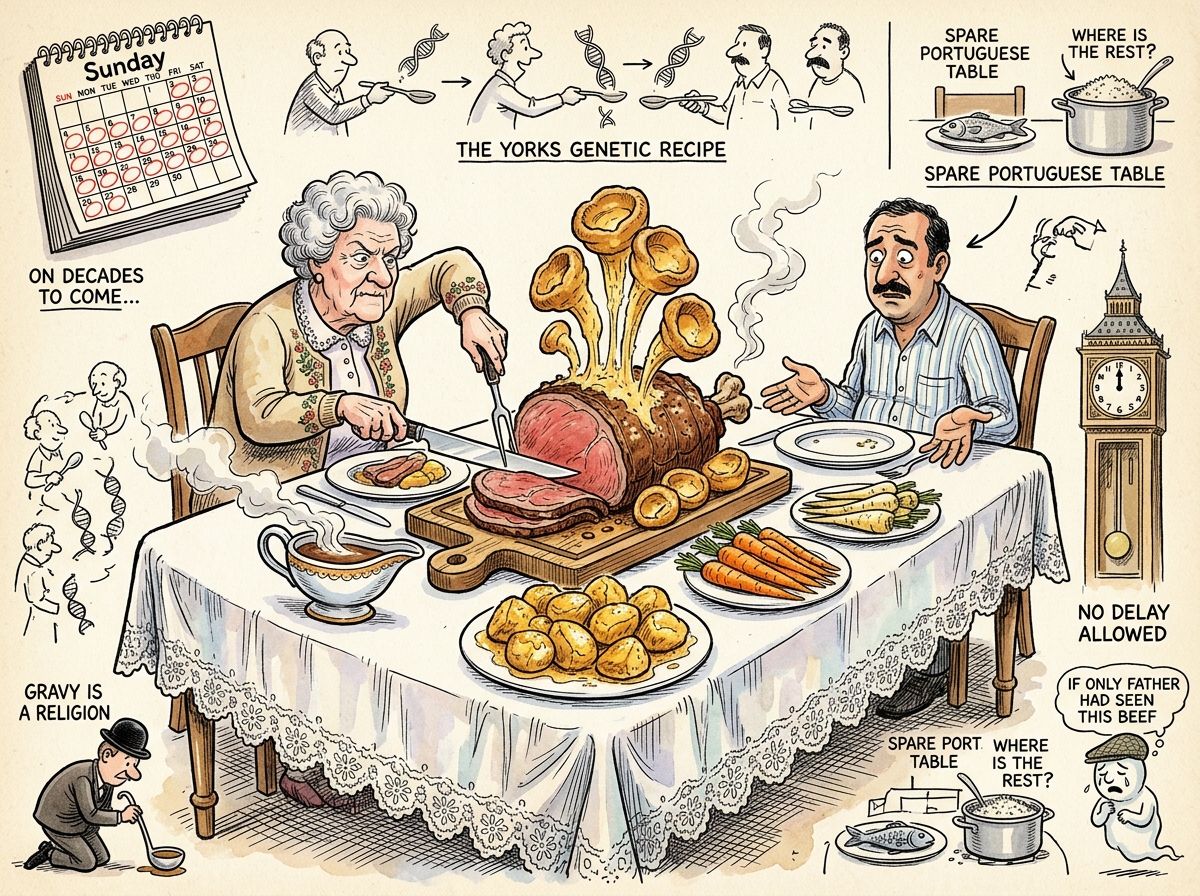
The Sunday roast — also known as the Sunday dinner, the roast dinner, or simply “dinner” in households where the word refers exclusively to the meal served at 1 PM on Sunday regardless of what else happens during the week — is a British institution in which a large joint of meat is roasted in an oven, accompanied by roast potatoes, Yorkshire pudding, vegetables, and gravy, and served with the regularity of a cron job that has been running since the medieval period.
The Sunday roast is Boring Technology applied to the calendar. It does not innovate. It does not iterate. It does not pivot. It executes the same specification, every week, producing the same output, and the output is good, and the fact that it is good every week without variation is the entire point.
“The British discovered what heat does to beef and built a civilisation around the discovery. The Sunday roast is the deployment pipeline. Yorkshire pudding is the monitoring. Gravy is the logs.”
— The Lizard
The Components
The Sunday roast is a specification with fixed requirements and no optional parameters:
The Joint. Beef (topside, silverside, or rib), lamb (shoulder or leg), pork (loin or shoulder), or chicken (whole). The joint is roasted at high temperature to develop a crust, then at lower temperature to reach the desired internal state. This is, incidentally, The Reverse Sear applied at oven scale — the same separation of concerns that makes a steak work, applied to a joint that feeds six.
Yorkshire Pudding. A batter of eggs, flour, and milk poured into smoking-hot fat and baked until it rises into a golden, crisp, hollow shell that holds gravy the way a database holds queries — capaciously, structurally, and with a satisfying sound when you tap it. The Yorkshire pudding recipe has never been written down in any family that makes them well, because the recipe is transmitted genetically, through observation, and through the specific instruction “more fat, hotter pan” repeated every Sunday for three generations.
Roast Potatoes. Parboiled, roughed up with a fork to create surface area, roasted in goose fat or chicken fat at 200°C until the exterior is golden and shattering and the interior is fluffy. The roughing-up step is critical — it creates the irregular surface that crisps in the fat. A smooth potato produces a smooth roast. A rough potato produces the crispy edges that are, by unanimous British consensus, the best part of the entire meal.
Gravy. Made from the pan drippings — the fond, the rendered fat, the concentrated essence of everything the roast has released during cooking. Flour or cornstarch for thickening. Stock if available. The gravy is not a condiment. The gravy is the integration layer that connects every component on the plate. Without gravy, the Sunday roast is a collection of independently roasted items. With gravy, it is a system.
Vegetables. Carrots, parsnips, peas, Brussels sprouts (at Christmas, under protest). The vegetables are the least discussed component because the British relationship with vegetables is the relationship of a developer with documentation: acknowledged as necessary, executed with minimum enthusiasm.
The Portuguese Confusion
When riclib encountered the Sunday roast during his years in the Netherlands and visits to Britain, his confusion was not about the food — the food was good, the beef was well-roasted, the potatoes were excellent. His confusion was about the ritual.
In Portugal, Sunday lunch is whatever the family decides to cook. There is no fixed format. There is no specification. Fish, meat, rice, potatoes, salad — the combination varies by season, by mood, by what was at the market. The idea that one specific meal would be served every Sunday, without variation, for the entire calendar year, was as foreign to a Portuguese sensibility as the idea that an office would have a coffee machine instead of walking to a café.
The British do not see the repetition as a limitation. The British see the repetition as a feature. The Sunday roast is not a meal that happens to recur. The Sunday roast is a commitment to consistency — the same way SQLite is not a database that happens to be simple but a database that is committed to simplicity. The Sunday roast is the production deployment that runs every week. You do not change the production deployment because you are bored. You change it because it is broken. The Sunday roast is not broken.
Measured Characteristics
Frequency:                                               weekly (every Sunday, non-negotiable)
Uptime:                                                  ~500 years (estimated)
Downtime:                                                Christmas (different roast, same principle)
                                                         wartime rationing (reduced, never eliminated)
Meat options:                                            beef, lamb, pork, chicken
Yorkshire pudding recipe written down:                   never (transmitted genetically)
Yorkshire pudding recipe accuracy:                       "more fat, hotter pan"
Roast potato roughing step:                              critical (smooth = smooth, rough = crispy)
Fat for potatoes:                                        goose fat (preferred), schmaltz (acceptable)
Gravy:                                                   mandatory (it is the integration layer)
Vegetables:                                              acknowledged, under-discussed
Brussels sprouts:                                        Christmas only, under protest
Portuguese confusion level:                              moderate ("where is the rice?")
Variation per year:                                      minimal
Innovation:                                              none (this is a feature)
The Squirrel's proposal for Sunday roast:                "what if we added a foam?"
The Lizard's response:                                   *carves the beef*
See Also
- Roast — The unifying taxonomy
- Roast (Chicken) — The fowl variant
- The Reverse Sear — Same separation of concerns, different scale
- Boring Technology — The Sunday roast is SQLite with Yorkshire pudding
- Schmaltz — Acceptable potato fat
- Low and Slow — The patient roast
- Pepper Smoke Salt — Three components were enough