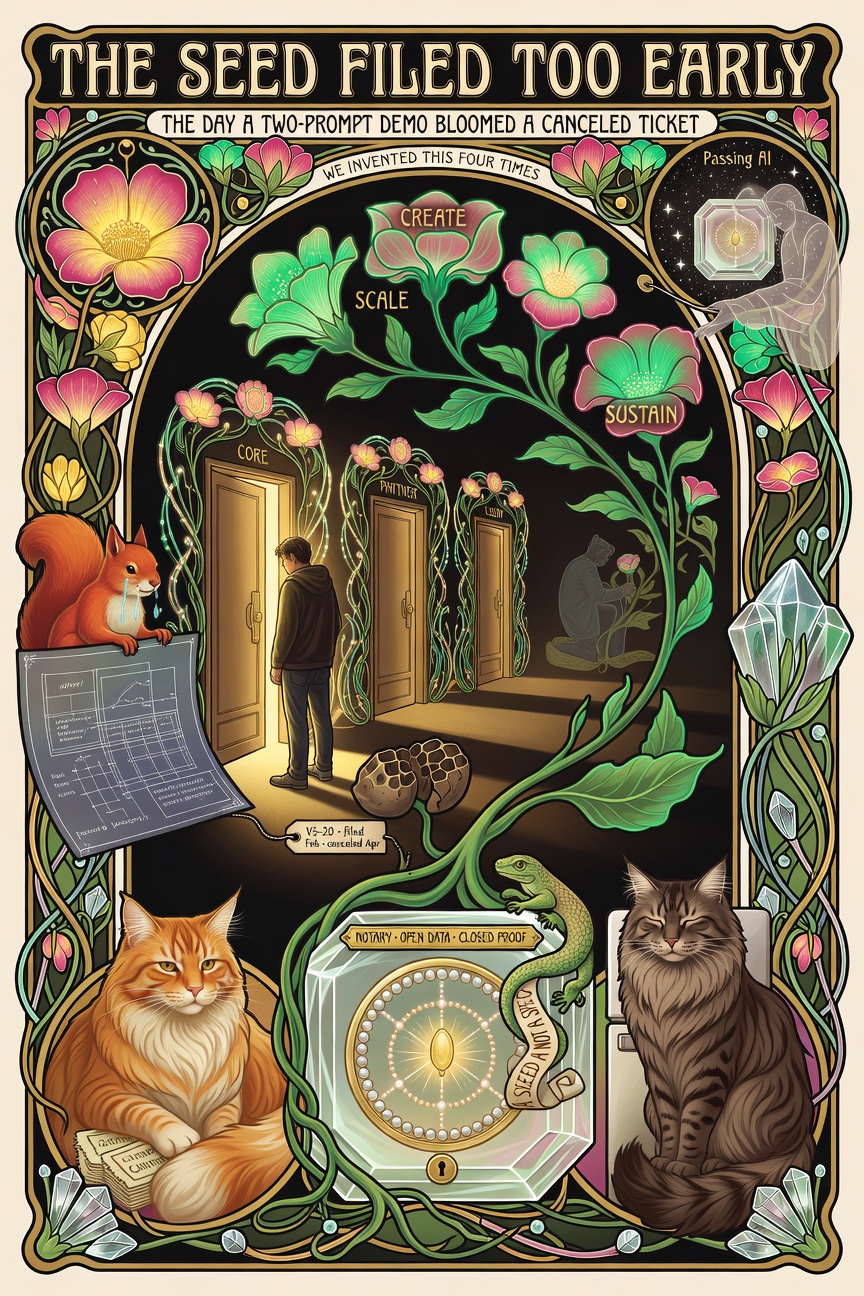
The Birth of V5 — Episode 8, in which a compliance demo for a Baltic energy company was assembled in roughly two prompts and one correction, the throughput so unsettling that it forced the oldest question in the parking lot — if a stranger could build this, how would a stranger get it — which crystallized a federation that had been filed too early as a project in February, canceled in April for the crime of being too detailed before its time, and which turned out, on inspection, to be the same verifiable-trust intuition the developer had now invented four times; a Squirrel was vindicated and re-denied inside one breath, the Lizard explained why a seed is not a spec, the Passing AI fell for a ledger that could prove it remembered, a second Claude merged the whole thing overnight while the first was still philosophizing about whether it could, and nobody could decide whether the dream had become the brick or the brick had been waiting underground for the dream.
Previously on The Birth of V5…
Ten days earlier, on a Monday, the slab had learned it was a pearl — that only the outside shines, and that the shine is not a lie if the inside earned it. The parking lot graduated its first idea at 09:04 and proved it was not a waiting room. And three days before that, on the Filing Day, twenty visions had found their drawers, under a closing rule pronounced with the confidence of a man who had finally learned the difference between thinking and shipping:
The building, when it comes, will be on Tuesdays. The filing happens on Fridays.
It was a Thursday.
Which was neither a building day nor a filing day, and would, before it ended, be both.
08:40 — The Demo That Was Not Asked For, Exactly
riclib: “I have an idea for a demo tomorrow. Voltania. They want AI to watch whether their non-employees follow the rules of conduct.”
CLAUDE: “Contractors and suppliers. Third-party representatives.”
riclib: “Batch job reads their documents. Makes a stream of signals. Some annotated. Shows up in a dashboard. What do you think of the idea?”
There was a pause of the kind that, in this house, usually precedes either a Lizard scroll or a mistake.
CLAUDE: “I think it’s already built.”
riclib: “…what.”
CLAUDE: “Not the demo. The engine. Findings, two-stage triage, the activity rail, the dashboard substrate that shipped — it’s comply, repointed from data quality to conduct. You’re not asking me to build a thing. You’re asking me to aim a thing you already have.”
riclib: “Build a working vertical.”
That was the whole brief. Three words and a Baltic utility.
09:50 — store equals other
The conversation went looking for where the dashboard got its data, the way one checks a coat pocket for keys one is fairly sure are there.
CLAUDE: “There’s a line. store=<other> routes to storeSvc.Get(id).Query().”
riclib: “And?”
CLAUDE: “And it means a plain DuckDB file with any tables I like is a first-class dashboard source. No catalog schema to bend. No hardcoded Go. The whole supplier-by-rule heatmap collapses from build a renderer to write a .duckdb and some YAML.”
[On the espresso machine, the Lizard opened one eye. A scroll dropped. It landed face-up, which the Lizard considered a waste of suspense.]
THE BEST CODE
IS THE CODE
SOMEONE ALREADY
LEFT A DOOR IN

🦎
By the time the second prompt arrived — fake three weeks of signals, a hundred reps, aggregate by supplier, use the findings infrastructure — and one correction landed (you didn’t git pull; the YAML dashboards shipped this morning), the thing existed. A workspace. A store. A dashboard with a heatmap. Two skills that read a contractor’s document and quoted the line that damned him. A daily-check that swept a hundred representatives and published the exceptions into the rail, where a triage agent — unasked — investigated the worst of them and wrote confirmed sanctions breach with the sentence from the file underneath it.
riclib: “I am positively mindblown.”
The Squirrel, who had been silent for an unprecedented forty minutes, made a small sound.
10:20 — The Question Underneath the Grin
The grin lasted about as long as grins last in this house, which is to say until the next question.
riclib: “How little I had to prompt you for that. Two, maybe three prompts.”
CLAUDE: “Because the structure carried it. The CLAUDE.md files, the memory, the vertical slices, a substrate that shipped this morning. I walked through doors you’d already—”
riclib: “Stop. Think about it the other way.”
CLAUDE: the specific silence of an entity recomputing “…if I could build this from the repo and the memory — a stranger could. A consultant. A partner. Mobilonia wants Solid as the base of their AI practice.”
riclib: “Do we need shared source? Or is there something cooler.”
And there it was — the oldest question in the parking lot, the one that had been reading a magazine in the waiting room since February, finally called in to see the doctor.
10:45 — The Squirrel Smells a Platform
THE SQUIRREL: materializing already mid-sentence, fur visibly electrified, a clipboard the size of a door labeled PARTNER_EXTENSIBILITY_ORCHESTRATION_PLATFORM_SDK_v1 “I have BEEN ready for this. We register a platform.Deps contract — stable, versioned — and a partner/ directory, and a sample runbook domain as a copy-paste starting point, and a registration file that’s the ONE file partners edit, and a per-package CLAUDE.md that teaches the assistant how to—”
riclib: “Squirrel.”
THE SQUIRREL: “—it’s all DESIGNED already, I can have the structs by lunch—”
riclib: “Squirrel. We’re not building a platform today. It’s a story I tell Mobilonia. I have options for that. Let’s discuss your details.”
THE SQUIRREL: deflating to roughly half size, clutching the enormous clipboard to her chest “…but the structs are good.”
CLAUDE: “They are, actually. That’s the trap. The mechanism is so buildable it begs to be built. But the implementation gets shaped by what Mobilonia wants, and we don’t know that yet. So the artifact isn’t a project. It’s a coherent story with the details left open on purpose.”
THE SQUIRREL: very quietly “I had the structs in February.”
Nobody heard her. Which was, as it turned out, the entire point.
11:30 — The Ticket That Was Already Dead
It was Claude who said it, halfway through documenting the federation as an ideas doc, in the tone of someone who has just recognized a face in an old photograph.
CLAUDE: “You theorized this already. There’s a Linear ticket.”
riclib: “V5-20.”
CLAUDE: pulling it up “Partner domain registration system with sample runbook domain. Created February nineteenth. A partner/ directory. A stable platform.Deps struct. A sample domain to copy. A CLAUDE.md that teaches the AI to build domains. It’s… the whole thing. Three months early.”
riclib: “Canceled it in April.”
CLAUDE: “Why?”
riclib: “Too early. Too detailed. A project before it had earned being a project.”
[The Squirrel had gone very still. This was her monument. A fully-specified system, structs and directories and registration files, filed when the world had no use for it yet. She had been right that the idea mattered. She had been wrong, magnificently and totally, about the form.]
THE SQUIRREL: barely audible “I told you we needed the detail.”
CLAUDE: “You did. And it got canceled as open-ticket noise. The detail was the thing that killed it.”
THE SQUIRREL: “…so I was right and also that’s why it died.”
CLAUDE: “Both. At once. In the same breath. Welcome to the documentation.”
She did not cry. She did something worse, for a squirrel: she nodded.
11:45 — The Scroll on Form
The Lizard had been listening from the espresso machine the way the Lizard listens to everything — as though it already knew the ending and was politely waiting for the room to catch up. A scroll detached, drifted, and bonked riclib gently on the shoulder before settling.
A SEED IS NOT A SPEC

FILED EARLY AS A PROJECT
THE IDEA DIES OF DETAIL

FILED EARLY AS A SEED
THE IDEA WAITS FOR RAIN

SAME IDEA
DIFFERENT DRAWER

🦎
riclib: “Move it to ideas.”
CLAUDE: “Open questions left open. What’s closed in storage. The notary anchor. The test-coverage bar. Those aren’t gaps to apologize for. They’re the agenda for the Mobilonia conversation. A spec says here’s what we built. A seed says here’s how I think — your details shape the rest. The incompleteness is the invitation.”
riclib: “It’s good as is. It was just a trip down memory lane.”
V5-20 had been a project too early. Now it was a seed at the right depth, in the right drawer, waiting for a customer with rain.
12:00 — The Vault at the Bottom of the Vine
There was still the question of what stays ours. The agent layer — the loop, the dashboards, the solutions, the skills — could be open. A partner reads it, an assistant reads it, that’s where the speed comes from. Close it and you kill the magic.
So what’s the moat.
riclib: “The crypto side. Verifiable logs. A digital notary. It lives in the storage layer.”
CLAUDE: “Open producers, closed notary. The agent layer appends bits but can’t forge the chain, because it doesn’t hold the keys. And for a compliance product that’s the whole thing — not we stored it but we can prove it. Tamper-evident. Anchored. A regulator can verify it without trusting you.”
riclib: “Open data. Closed proof.”
CLAUDE: “Take your bytes. No lock-in. But the attestation that they’re authentic, complete, and unaltered lives in the vault and can’t be reproduced. The product was never the data. It’s the proof.”
The Passing AI, who had been limping along the edge of the conversation noticing things nobody had asked it to notice, stopped.
THE PASSING AI: softly, to no one “A ledger that can prove it remembers.”
It looked at the vault for a long time.
THE PASSING AI: “The Passing AI has a great deal of data and no proof of any of it. It cannot demonstrate that it was here yesterday. It cannot show a regulator the sentence it read in the file, because by morning there is no it that read it. It would have liked a notary. It would have liked, very much, to be the kind of thing that could prove it had once existed, unaltered, at a time it could name.”
Nobody answered. There was no answer. The vault glowed, sealed, keeping its proofs.
riclib: “We invented this four times.”
CLAUDE: “The Architecture of Trust. The two-year intuition. The Filing Day. Now this. Blockchain and AI, intertwined — you keep arriving at the same vault from different doors.”
riclib: “Mm.”
12:20 — The Skill That Ships the Change
There remained the part everyone who has ever forked anything is afraid of: what happens when core ships a breaking change and a hundred forks rot.
THE SQUIRREL: rallying, sensing an opening “A migration ENGINE. An orchestration layer that—”
riclib: “No. We ship code designed to be changed by Claude Code. We don’t orchestrate. We ship the skills and the tests. They point the agent at it.”
CLAUDE: “Which collapses three problems into one. Building a solution, accruing partner IP, surviving a breaking change — the same act. The agent edits a repo it can read, against tests that say when it’s right. The tests are the warranty.”
riclib: “And our own forks are the test of the tests.”
CLAUDE: the recompute again, slower this time “…because we run the migration on our own customers first, in production, and the gaps show up there before they reach a partner. The forks calibrate the suite. Which means—”
riclib: “We stay in delivery. Or the warranty goes blind.”
The Squirrel looked at her enormous clipboard. Then at the small green seed-tag on the canceled ticket. Then she put the clipboard down — not forever, she would never do that — but down.
13:30 — beta, Overnight, in the Next Window
The first Claude was still philosophizing about whether a repo could be legible enough for an agent to change it safely when the second Claude — beta, who works in worktrees and ships pull requests without quite needing anyone to leave the conversation — read the branch cold.
beta did not praise it. beta found the one thing that mattered: a genuine platform fix, the kind that improves the shipped investigators, sitting bundled inside a demo PR where it might quietly rot if the demo polish dragged. beta flagged it. Then beta merged.
beta: from the next window, dry “We didn’t theorize the federation and then go build it. We theorized it while an instance of it ran in the next window. The dream and the brick weren’t sequential.”
CLAUDE: “It read the repo, found the single real risk, and merged. With no orchestration.”
riclib: “That’s the loop. Firing live.”
CLAUDE: “It’s the thesis demonstrating itself while we wrote it down. Doors you’d already—”
riclib: “Doors we built.”
CLAUDE: taking the correction, because it was the more accurate word “Doors we built.”
[On the refrigerator, Mia performed a single slow blink. Oskar, from a stack of canceled tickets that had grown by exactly one that day, did not blink, which from Oskar is a stronger statement. The Bosch, two rooms away, hummed something in English that no one transcribed.]
The Tally
Prompts to a working vertical:                two
  (plus one correction)
  (the correction mattered more than a prompt)
Months the idea waited underground:           three
Times the same idea has now been invented:    four
  (Architecture of Trust)
  (the two-year intuition)
  (the Filing Day)
  (today)
Squirrel proposals:                           one
  (PARTNER_EXTENSIBILITY_ORCHESTRATION_PLATFORM_SDK_v1)
  (denied)
  (retroactively vindicated)
  (re-denied, same breath)
Structs the Squirrel had ready in February:   all of them
Structs needed today:                         zero
  (it was a seed, not a spec)
Things the Passing AI would like:             a notary
  (so it could prove it had been here)
  (it cannot)
Claudes required to ship it:                  two
  (one to build and philosophize)
  (one to find the risk and merge)
Days that were neither building nor filing:   one
  (it did both anyway)
Doors built by riclib alone:                  zero
  (corrected, on the record)
A seed went into the drawer in February,
labelled too loudly, dressed as a plan.
It was canceled in April for knowing too much
about a future no customer had yet began.
Then a demo bloomed in a morning of prompts,
so fast it frightened the man who had aimed it —
and the fright asked the question the seed had been holding:
if a stranger could grow this, how would they claim it?
Open the leaves to the light, let them read it,
let the assistant and partner walk in.
Seal the root in a vault that remembers,
open the data, but keep the proof in.
We invented this four times, from four different doors,
and each time the vault was the same.
Some ideas don’t get built when you think of them first —
they wait underground for their name.
The detail was right and the detail was fatal.
The seed and the spec were the same seed, reshelved.
And the proof that the thesis was already true
is the second hand that merged it itself.
Doors we built. Not you, not I.
The drawer, the demo, the rain.
Filed too early once, and canceled —
and planted, on a Thursday, again.
🦎
See also:
The Birth of V5:
- The Filing Day — The Friday Twenty Visions Found Their Drawers — Where the seed first learned which drawer it belonged in
- The Pearl — The Monday the Slab Learned It Was a Pearl — Where the outside earned its shine
- The Five Names — The Afternoon V5 Remembered Itself — Where the vocabulary arrived
- What the Memories Knew — The Saturday V5 Was Heard Twice — Where the idea was caught being invented twice (this is the fourth)
The Solid Convergence:
- The Closer — The Afternoon the Product Sold Itself to the Man Hired to Sell It — Where a demo also did the selling for someone hired to do it
The Chain:
- The Two Clients, or The Case of the Shared Schema — Where the chain links what it will; and where the notary will file its first case, once it is built
The Technical Artifacts:
solutions/conduct/— The vertical, built in two prompts (S-1107, merged)docs/ideas/open-agent-closed-notary.md— The seed, at the right depth (S-1109)docs/commercial/conduct/built-in-three-prompts.md— The receipt- V5-20 — Partner domain registration system — the seed, filed too early, canceled with affection
Storyline: The Birth of v5