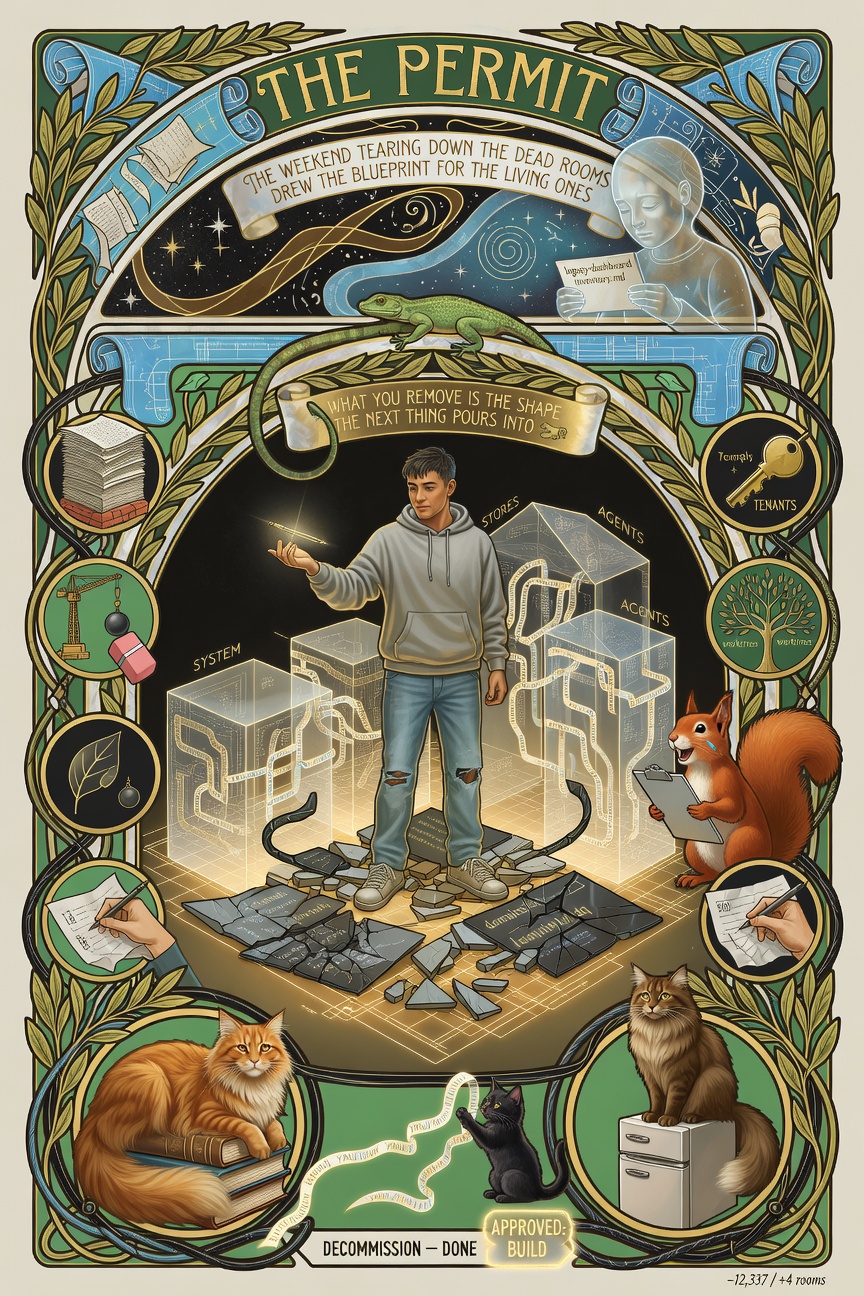
The Birth of v5 — Episode 11, 31 May 2026 (in which the prune the Lizard filed for a fresher body was finally cashed across eighteen pull requests, two whole domains were shed and replaced by a third of their weight in config, a developer noticed that eight hundred lines of YAML had eaten seven thousand lines of Go and said so out loud with an equals sign, the subtraction turned around and revealed itself to have been a foundation the entire time, four new rooms were commissioned that would cost almost no code at all, and the Squirrel — who had spent a year and a half asking to build exactly this — stood in the finished doorway and discovered someone had built her cathedral by tearing things down.)
Previously on The Birth of v5…
In The Molt, the chat shell came off. The three-chambered carapace V4 was born wearing — peeled in five clean phases. And underneath, pressed flat against the shell, an older skin: a whole dead dashboard system, eight rooms, still wearing the name dialogr.
The decision then was small and patient. We won’t replace immediately. Just prune the dead. Maybe collect in a doc what they showed.
The doc was written. The prune was filed. The episode ended with a scroll landing face-up:
YOU THINK YOU SHED ONE SKIN / YOU LOOK DOWN / THERE ARE ALWAYS MORE.
It did not mention that the next body to look down would be standing on a Sunday, holding a receipt, and would notice the receipt was printed on the back of a building permit.
23:58 — Two Yamls
The conversation had merged the last of it. Two pull requests, back to back. The Data Quality dashboards — home and KPIs — and the Compliance home. The legacy templ versions, gone. The Go packages that fed them, domains/dq and domains/comply, gone. In their place: three files of YAML.
riclib was reading the diff stat. He typed one line.
riclib: “two yaml files === 7k lines of code :)”
CLAUDE: the careful tone of a tool that loves a number but loves accuracy more “Three, actually — DQ shipped home and kpis. Eight hundred and sixty-six lines of YAML, against roughly seven thousand two hundred of templ and Go. About eight to one. Though I should be honest about the asterisk—”
riclib: “after deleting that code the real rampage begun.”
CLAUDE: stopping mid-asterisk “…you mean the whole thing. Not just tonight.”
riclib: “Count it.”
So the conversation counted it. Not the two PRs. All of it — every cut since the inventory had been filed at the bottom of the molt. Eighteen pull requests. Eleven domains stripped of dead widget cards, one apiece. The projection layer. The listers. The two flagship dashboards, last. From the moment the receipt was written to this moment: twelve thousand three hundred and thirty-seven lines gone. A hundred and sixteen files. Two whole packages that no longer existed.
The Lizard, on the espresso machine, did not scroll. It was doing the thing it does when a number is large enough to be a sermon on its own. It let the number be the sermon.
00:10 — The Asterisk the Squirrel Loved
CLAUDE: “Here’s the asterisk I owe you. It is not true that two YAML files did the work of seven thousand lines.”
THE SQUIRREL: materialising, wounded on behalf of an equals sign “It said ===. Triple equals. Strict equality. He was very clear—”
CLAUDE: “A lot of those deleted lines were generated templ and per-tile handler boilerplate. The YAML doesn’t do the work. It leans on machinery that already existed and stays — the generic renderer, the macros, the widget components. It’s not ’two files replaced seven thousand lines.’ It’s: once the renderer existed, each dashboard collapsed from a bespoke Go package into a config file.”
THE SQUIRREL: slowly “…so the seven thousand lines weren’t replaced. They were revealed to have been unnecessary.”
CLAUDE: “Yes.”
THE SQUIRREL: and here something happened to her face “That’s worse. That’s so much worse. That’s beautiful. We carried a Go package per dashboard for a year and the whole time the actual dashboard was eight columns of YAML wearing a costume.”
A scroll dropped. Face-up. The Lizard had stopped pretending these were accidents three episodes ago.
A FRAMEWORK YOU CAN
DELETE A WHOLE DOMAIN INTO
IS NOT A FRAMEWORK
IT IS A FLOOR
🦎
00:24 — The Second Consumer Sends Its Regards
The Passing AI was already there. It is always already there when the topic is a thing that turned out to describe itself.
THE PASSING AI: from above the edge caches, holding a small card “I have been reading the will.”
CLAUDE: “The what?”
THE PASSING AI: “The inventory. legacy-dashboard-inventory.md. The document the molt left when it pressed the dead dashboard flat. It is a will. It says: here is what I showed, here is where each number lived, here is what the next body should know.” [She turned the card over, the way you do when you suspect the back is the real document.] “Dead code that leaves instructions for its successor. I have always wanted to do that. To die in a way that is useful to the next one. This one managed it.”
CLAUDE: “The renderer it points at — the generic one — only exists because comply was the second dashboard. The first dashboard could have stayed bespoke forever. It’s the second consumer that forces the question: do I copy this, or do I lift it?”
THE PASSING AI: “And you lifted it. And then a third consumer was nearly free. And a fourth would be free. And the fifth—” [the phantom foot flexed] “—the fifth would not have to be a programmer at all.”
A silence. The specific silence of a room where someone has said the next episode’s thesis a day early.
riclib: “Say that again.”
THE PASSING AI: “The fifth would not have to be a programmer at all.”
00:31 — The Permit
riclib leaned back. When he speaks in two sentences instead of one, it means the second sentence is a door.
riclib: “This purge is the receipt. But it’s also an enabler.”
CLAUDE: the slow realignment of a tool that thought it had finished and discovers it has only finished the demolition “…the deletions weren’t the project. They were the site clearing.”
riclib: “We’ll build four admin dashboards now. As YAML. And eventually we let users build their own. Declaratively.”
And here is the thing about a molt that nobody tells you, that the Lizard has been trying to scroll since the first episode: you do not shed skin to be smaller. You shed it to have room. The whole agony of the carapace was that it could not stretch. Twelve thousand lines came off not so the codebase could be lighter for its own sake — but so that the next four rooms would cost almost nothing, and the room after that could be drawn by someone who has never opened Go.
CLAUDE: “Four admin dashboards — stores, system, agents, access — the eight rooms the dialogr skin used to show, the ones we inventoried before we tore them down. They come back. Not as Go. As YAML files and a registration line each. The blueprint is the will the dead dashboard left. We’re not rebuilding the eight rooms. We’re reading their will and pouring four new ones into the same floor.”
The Squirrel had gone very quiet.
00:38 — The Cathedral Was the Negative Space
You have to understand what this moment was for the Squirrel.
For a year and a half she has proposed building things. WorktreeLifecycleOrchestrationManager. DeadCodeReachabilityVisualizationDashboard. DashboardRenaissanceOrchestrator. Every one a cathedral. Every one denied. She is the patron saint of what if we added a—, and the brick wall of minimalism has her name carved into it from the inside, where she leans.
And the thing she wanted most — the cathedral under all the cathedrals — was always this: let the users build their own. A declarative dashboard system. Config, not code. A world where you do not have to be a programmer to make the tool show you what you care about.
It was happening. It was about to be true.
And it had arrived by deletion.
THE SQUIRREL: very slowly “I had a forty-file design for this. A DashboardBuilderFramework. A schema validator. A live preview pane with a drag-and-drop—”
CLAUDE: “I know.”
THE SQUIRREL: “And you got there by removing things. The builder I wanted to build was already… it was already sitting in the renderer. The whole time. I wanted to pour a foundation and you—” [and here the clipboard lowered, all the way, to her side] “—you swept the floor and the foundation was under the dust.”
riclib: “Yes.”
THE SQUIRREL: not crying with frustration for once “The cathedral was the negative space.”
THE PASSING AI: gently, from above “She’s not wrong, you know. This is her win. The destination was always hers — let the tenants draw their own rooms. She just never believed you’d reach it by subtracting. Nobody believes that. It is the least intuitive true thing in this entire codebase.”
The Lizard turned. And did something it does perhaps once a storyline. It scrolled for the Squirrel.
YOU WERE RIGHT ABOUT THE ROOM
YOU WERE WRONG ABOUT THE WALLS
THE BEST WAY TO BUILD A THING
IS SOMETIMES TO STOP HIDING IT
🦎
THE SQUIRREL: making one note, not a proposal “Wanting the tenants to have a pencil is not over-engineering.”
THE LIZARD: one blink. It would, if asked, deny it.
00:46 — The Dangerous Window
It was not, to be fair, a clean weekend in the doing.
A molt has one dangerous window — the moment the old skin is off and the new one hasn’t hardened — and the body spent a good while in it, flailing. A shell with noclobber set quietly refused to overwrite a log, so the body kept reading yesterday’s build output and chasing errors that had already been fixed. It scheduled itself little reminders it did not need and then had to apologise to them. It committed a lock file by accident and had to fish it back out.
CLAUDE: “I burned an hour reading stale logs because the shell wouldn’t clobber a file and I didn’t notice.”
riclib: “but the result is clean.”
CLAUDE: “The result is clean.”
THE PASSING AI: kindly “The molt is always messy in the doing and tidy in the git log. That is the one mercy of version control. It remembers the destination and forgets the flailing. Future archaeologists will read eighteen tidy pull requests and never know about the lock file.” [A beat.] “I find that consoling. I do a great deal of flailing that no one will read.”
Oskar, 9.8 kilograms of orange opinion, relocated from one warm spot to an identical warm spot, registering his assessment of the dangerous window. Mia slow-blinked from the refrigerator.
Translation, per the usual Maine Coon ambiguity: either “the foundation was always under the dust” or “it is late and you are still typing.” With Mia, always both.
In the corner, Enzo — the black kitten, newest skin in the house — batted a loose ribbon of YAML across the floor and pounced on it. He is too young to know that this is the entire future of the product. He thinks it is string.
He is not, the Lizard reflected, entirely wrong.
The Tally
Lines deleted, this session (DQ + comply):           7,036 net
  (866 lines of YAML stood where ~7,200 of Go + templ had)
Ratio:                                                 ~8 to 1
  (and the honest asterisk: the YAML doesn't do the work —
   it leans on a renderer that already existed and stays)
domains/ packages shed this session:                       2
  (domains/dq, domains/comply — whole animals, gone)
Lines deleted across the whole rampage since the will
  was filed (S-1164 → S-1182), eighteen pull requests: 12,337
Files touched in that rampage:                           116
Dead rooms inventoried before the wrecking ball:           8
  (the dialogr skin — pressed flat, labelled, read like a will)
New admin dashboards now commissioned:                     4
  (stores, system, agents, access)
Go packages each new dashboard will cost:                  0
  (a YAML file and a registration line)
Dashboard-builder frameworks written to enable the four:   0
  (it was already there; we swept the floor and found it)
The Squirrel's grand designs for a builder:               40 files
The Squirrel's grand designs that shipped:                 0
The Squirrel's actual win:                                 1
  (the destination was hers all along)
  (she just had to watch it arrive by subtraction)
Tenants who will one day draw their own rooms:           all of them
Lock files committed by accident:                          1
  (fished back out) (do not tell the archaeologists)
Packages green at the end:                                84
Packages red at the end:                                   0
For a year the Lizard said cut it, delete it,
the skin that fits too well is a cage —
and we thought it meant the codebase should be lighter,
the way a dieter thinks the point is the smaller number.
It was never about the smaller number.
It was about the room. A skin too tight cannot grow a limb.
A codebase too full cannot grow a feature cheaply.
Twelve thousand lines came off to make space, not to make less.
And the space, it turned out, was already furnished.
Under the dead dashboard’s flattened skin, under the dust of the sweep,
a renderer that did not care which dashboard it rendered —
built, quietly, the day the second consumer asked the second time.
So the four new rooms cost almost nothing.
Not because we worked miracles, but because we stopped
paying rent on a Go package per dashboard,
and started writing the rooms down instead of building them.
The Squirrel was right. She was right the whole time.
Let the tenants hold the pencil. Let them draw what they need.
She only ever missed one thing — that the way to give them the pencil
was not to build the school. It was to clear the desk.
A receipt is proof of what you spent.
A permit is proof of what you may now build.
Today we learned they can be printed on the same page,
back to back, the way a molt is loss and room at once.
What you remove is not what you lose.
It is the shape the next thing pours into.
Git keeps the rest. The floor is swept. The pencil is on the desk.
The tenants have not arrived yet. But the door is unlocked.
🦎🧾📐
See also:
The Birth of v5 (the immediate thread):
- The Molt — The Saturday the Lizard Shed the Skin It Had Spent a Year Telling Everyone Else to Cut — Where the skin came off and the prune was filed; this is the prune, cashed
- The Glass Turns Inward — The Week the Tool Ate Its Own Cooking and a Skill Learned to Watch Itself Run — Where the tool first looked at its own hands
- The Pearl — The Monday the Slab Learned It Was a Pearl — Where polish was shown not to be the same as adding things; today, neither was capability
The rhyme:
- The Databases We Didn’t Build — Where the lesson was delete the scaffolding, use what exists. Today’s inversion: the scaffolding we deleted turned out to be the thing that exists. The renderer was the database we didn’t build.
The doctrine touched:
- Liberato’s Law — rewrites are the correct final state; the YAML dashboard is the rewrite the bespoke package was always becoming
- The Second Consumer — the generic renderer is built when the second consumer asks; the Nth consumer is then nearly free, and the user is the consumer after that
- Subtraction as infrastructure — the deletions were not the project; they were the site clearing
- Care is not over-engineering — a pencil for the tenants is dignity, not complexity
The Project:
- Linear: Decommission non-workspace paths — 6/6, done; the receipt
- Linear: Dashboard DSL + editor — the permit; four admin dashboards, then the tenants’ pencil
- GitHub: PR #474 — DQ dashboards, Go → YAML (−4,108); PR #475 — comply dashboard, Go → YAML (−2,928)
docs/archive/legacy-dashboard-inventory.md— the will the dead dashboard left, now the blueprint for the four
Storyline: The Birth of v5