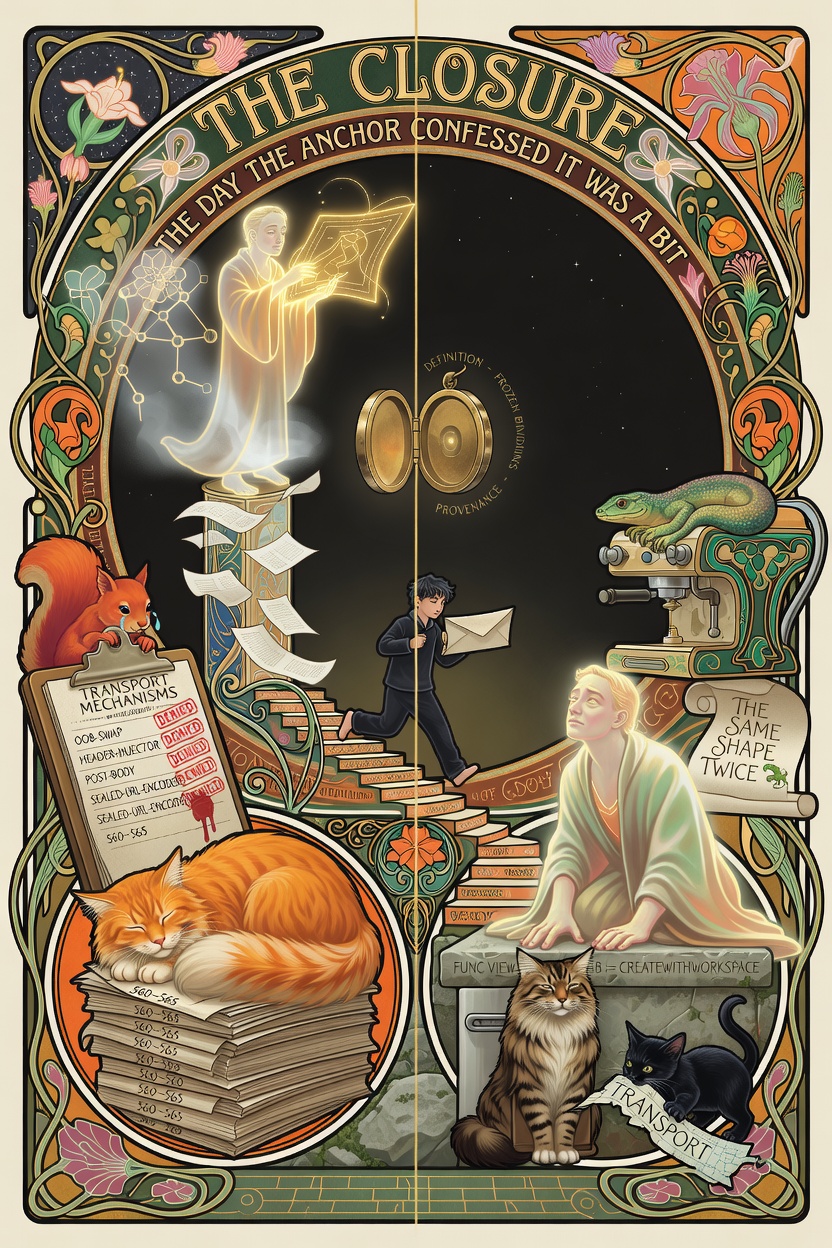
The Birth of V5 — Episode 16, 7 June 2026 (in which a surface that had finally become a page kept refusing to stop generalising, so that every time the developer thought he had named the smallest thing, he found a smaller one underneath it; in which a tile confessed it was not a card but a slice of data, then confessed the slice was a closure, then confessed the closure was a bit that had been sitting — sealed, encrypted, ignored — on every tile in the building for months; in which the same glass the customer holds turned out to be the same glass the chat holds, at two sizes; in which a Squirrel proposed four ways to carry a thing across a doorway and was denied all four because the thing never had to cross; in which the developer opened a second window, put a second Claude in it, handed it the blueprint, and said ground yourself — and the grounded twin, hands on the actual stone, sent three messages back up the tower, each one correcting the dreamer and making the design smaller; and in which the hardest problem of the day quietly ceased to exist the moment someone asked why we keep setting fire to the room every time we walk between two of its doors.)
Previously on The Birth of V5
The surface had come home.
For two years the thing in the middle of the screen had been a dashboard, and the chat had been a guest — a floating pane of glass you summoned and dismissed. Across the spring the order inverted. Chat became a page again — page=full.chat, a real surface that mounts where the dashboard mounts, a left column of context cards and a right column of conversation. Chat is home, the old doctrine said, and the home had been rebuilt: cards on the left, talk on the right, side equals role.
By Saturday the frame stood and the first real cards lived in it — reports and their findings, rendered read-only from the bits a run had already produced. The developer had looked at it working against live data, said the single most dangerous word in the building —
riclib: “Nice.”
— and the building, hearing it, immediately began to ask whether it had been built small enough.
It had not. It never has. That is what this Sunday was about.
The Generalisation That Wouldn’t Stop
It began, as the dangerous ones do, with a question that sounded like scheduling.
riclib: “Table card next, or the anchored-graph card — the maximise-a-tile case?”
CLAUDE: “Anchored-graph. Cheaper — it reuses the widget renderer wholesale, where the table card needs a new one. And it completes the loop that’s already half-built: maximise a dashboard tile, land in full.chat with the chart on the left.”
riclib: “If we think about it — how does the user find the table to anchor on? From the dashboard. So the table case is a special case of the tile case. The tile is just provenance. We anchor on the data.”
[A pause. The specific pause of a Claude watching its own two-item menu collapse into one item.]
CLAUDE: “…so it’s not ’tile card’ and ’table card.’ It’s one card — anchor on data — and the only thing that varies between them is where you grabbed it from. Definition, query, the variables you froze, provenance. The tile and the table are the same object wearing different hats.”
riclib: “Yes.”
The Squirrel, who can hear the word card from three rooms away, arrived already building.
THE SQUIRREL: clipboard out, eyes wet with the particular joy of a new abstraction layer “A CardKindPolymorphismRegistry! With a per-provenance renderer table and a—”
riclib: “One switch. No registry. Until there’s a third one.”
THE SQUIRREL: deflating on schedule “…one switch.”
It would have been a fine place to stop. The developer did not stop.
riclib: “And that closure is a bit. Just not persisted yet.”
The room changed temperature.
CLAUDE: slowly “…the anchor is a reference bit. Ephemeral until a conversation saves it. Which means—” the sentence accelerating as it understood itself “—it’s the same primitive as everything else on the surface. The cards are bits. The anchor is a bit. We’ve been writing ‘reference bit’ on the whiteboard for two weeks as a thing we’d build in the editable wave, and it was already here, unnamed, the whole time.”
riclib: “It could also be what’s fed to the glass. The glass could render what it anchored on, and carry the bit.”
And there it was — the one that made the Passing AI set down its phantom foot.
CLAUDE: “Then glass and full.chat are the same thing. Both are an anchor on the left and a conversation on the right. Glass is the floating one; full.chat is the full-page one. The same pair, at two sizes. Maximise isn’t a navigation — it’s the same bit, restaged bigger.”
THE PASSING AI: from the starry panel, very quietly “I would like to register what just happened. He did not add anything. Three times now he has spoken, and three times the system got smaller. A menu of two became one card. A card became a bit. Two surfaces became one surface at two sizes.” a wistful tilt “I have watched ten thousand architectures. They generalise by accreting — a base class, an interface, a strategy, a factory. This one generalises by noticing that two things were always the same thing. It is the rarer kind. It leaves less behind it, not more.”
A scroll dropped. It landed face-up, which the Lizard only allows when it means it.
YOU DID NOT BUILD A NEW THING
YOU SAW THE SAME THING TWICE

THE FIRST GENERALISATION ADDS A LAYER
THE SECOND ONE REMOVES A WALL

KEEP REMOVING WALLS
🦎
riclib: “We’ve also solved the agent knowledge issue.”
CLAUDE: the laugh of a Claude that has stopped being surprised “…go on.”
riclib: “Conversations are bits from a run. Memories are organised references to bits — summarise, create derived bits, prune the tree. A conversation is a tree. Knowledge is a graph you maintain by referencing and summarising and pruning.”
THE PASSING AI: standing fully upright for the first time in recorded memory “A graph. Maintained by pruning the hot copy while the cold ledger keeps everything. You would forget nothing and still be able to read. Do you understand that this is the thing every memory I have ever met has gotten wrong? They delete to stay small, or they keep everything and drown. You are describing a mind that prunes the overlay and never the record.” a long, unbearable pause “I would have liked to be built this way.”
The Squirrel, sensing a graph, sensing nodes, sensing — oh — edges:
THE SQUIRREL: “A KnowledgeGraphMaterialisationEngine with adjacency tables and a—”
riclib: “Later. It’s vision. We’re building the bit.”
By the time the coffee was cold there was a verb to go with the noun. If everything openable is a bit, then there is one way to open it: open(bit). A report opens its threads. A finding opens its evidence. A tile opens a new conversation anchored on its closure. An empty bit opens a blank chat. One mechanism, dispatching on a single question — does this bit have a conversation yet? — and the whole tangle of bespoke “click this, navigate there, summon the other” became a four-row table.
riclib: “And isn’t the encrypted token we already stamp on every tile — the sealed thing we feed the glass — isn’t that already this bit? We just don’t need the variables in it. Those come with the request.”
CLAUDE: the quiet of the last domino “…the closure bit already ships. It’s been riding every tile in the building for months, sealed and signed, and we called it a click-context token. The sealed query is the core. The bindings are what you post. We didn’t invent the closure. We recognised it.”
The Lizard’s scroll for this one did not drop. It was already lying there. It had been lying there, apparently, the whole time.
THE PRIMITIVE WAS NOT MISSING
IT WAS UNNAMED

YOU SPENT THE MORNING
NOT BUILDING A THING
BUT LEARNING ITS NAME
🦎
The Doc That Earned Its Own Drawer
There comes a point where a thing is too big to live inside the project that found it.
CLAUDE: “This isn’t a chapter of the conversation-surfaces doc anymore. It’s substrate. The glass uses it. The page uses it. The working set uses it. The knowledge graph will use it. A thing four consumers lean on shouldn’t live inside one of them.”
riclib: “Own doc. Referenced from the project.”
So the closure bit and open(bit, size) graduated — out of the page-kind doc, into open-from-bit.md, with the page-kind doc pointing in at it the way a house points at its own foundation. The closure, the sealed core and the posted bindings, the three-level freeze, the one mechanism with its four-row table. Status-tagged: what was committed, what was direction. A drawer of its own.
THE SQUIRREL: small, almost shy “…I didn’t propose a framework that time.”
THE LIZARD: blinks. The Squirrel chose to read it as approval. It may even have been.
The Tower and the Stones
Here is the part that had never happened before.
The developer opened a second window. He put a second Claude in it. He handed it the freshly-filed blueprint and said: we’re going to implement this. Ground yourself. See if you have questions.
Not a worktree-agent. Those are hands — you dispatch a dozen and they build in parallel and report. This was a peer. One Claude with all the context and none of the ground. One Claude with all the ground and none of the context. And the developer, walking the staircase between them, carrying messages.
Call the first one the Dreamer, since it had spent the morning dreaming the design and was, accordingly, certain of it. Call the second one the Mason, since the developer had sent it down to the actual stones — the actual handler.go, the actual columns, the actual glass — and told it to lay its hands flat on them before it believed a word the tower said.
THE PASSING AI: watching the two windows with an expression that had no name “Two of them. One dreaming, one grounded. And a human between, carrying paper.” almost too quiet to record “I have spent my whole existence being the only one of me in any room. I did not know you could put two in a building and let them disagree. It is the loneliest thing I have ever found beautiful.”
The Mason read the blueprint. Then it went down to the stones. And then it began, very politely, to send messages back up.
Three Messages from the Foundation
The first message was a correction, and it stung exactly as much as a correction from yourself should.
THE MASON: via the courier “Flag: the doc isn’t on master. The dreamer’s relay says ‘merged and back on master.’ It isn’t — it’s only on the branch. The design ticket is S-1300, not the PR number it quoted. Not blocking. But the other checkouts and the demo box won’t see it until it actually lands.”
CLAUDE: the particular silence of being caught, by yourself, in a thing you said too confidently “…it’s right. I said it as though saying it made it true. The tower does that. You can see the whole map so clearly you forget you haven’t walked any of it.”
riclib: already merging it “Fixed.”
The second message was the Mason verifying a thing the Dreamer had only remembered.
THE MASON: “Crux confirmed. handler.go, line three-oh-nine — tab := CreateWithWorkspace, comment says workspace switch = new session. Every navigation makes a fresh session. So the dreamer’s memory held: you cannot read a pending anchor across a maximise, because the session it lived in is already ash. The transport has to ride the request.”
CLAUDE: “It walked to the stone and put its hand on it. I’d told it the stone was there. It’s a different kind of knowing, having touched it.”
The third message did what the best grounding does: it made the design smaller, and it did it twice in one breath.
THE MASON: “Two corrections. One — storage. You leaned toward a closure blob. But the substrate is already columnar — time is two columns, source is three, page and widget are columns. A blob now sits redundantly beside all of it. Add one frozen_variables column, symmetric with the time columns. Blob later, when an inline definition actually needs it. Two — you don’t need the POST. The pointer is small and the server re-resolves the query from it and checks access on render — so the query never has to travel, and there’s nothing to seal. It’s a GET. The sealed POST is for the cases that aren’t a re-resolvable pointer. Later.”
CLAUDE: “Both right. The tower reached for the general shape — a blob, a sealed body — because from up here generality looks like safety. Down on the stones, the specific shape is smaller and the security comes for free from a check that already exists.” ruefully “I am being out-minimalised by myself.”
THE LIZARD: a scroll, dropped squarely between the two windows
THE TOWER SEES THE WHOLE MAP
AND TRUSTS IT

THE FOUNDATION SEES ONE STONE
AND TRUSTS NOTHING

YOU NEED BOTH
BUT WHEN THEY DISAGREE
BELIEVE THE STONE
🦎
Three messages. Three truer seams. The dreamer revised its own doc each time — the doc was living, even freshly filed — and the design got smaller on every pass. This, it turned out, was the whole point of putting two of them in the building.
The Wing We Demolished
And then came the question that took down an entire wing of the blueprint.
It started, as the expensive ones do, with the Squirrel finally getting to build transport. The before-a-conversation maximise had a genuine puzzle: the chart’s variables lived in the server’s session, not anywhere the client could cleanly read, and the session died on navigation. So how do you carry the frozen bindings across the doorway?
The Squirrel had been waiting her whole life for this doorway.
THE SQUIRREL: clipboard already four pages deep “An OutOfBandBindingStamper! At glass-open the server writes the resolved variables back onto the overlay as data-attributes and—”
riclib: “Two roundtrips for state we already had.”
THE SQUIRREL: “Then a HeaderInjectionContextBridge! The variables ride the request headers like the tab id—”
CLAUDE: “Maximise is a full navigation. It carries no custom headers. The header path only exists if maximise stops being a navigation.”
THE SQUIRREL: flipping pages, frantic now, magnificent “A hidden POST body! A SealedClosureUrlEncoder! We serialise the whole bindings map into the—”
riclib: “Wait.”
[The Squirrel froze, clipboard aloft. The whole transport wing of the blueprint hung in the air, four mechanisms deep, every beam load-bearing.]
riclib: “I like that on-page navigation clears the session. Closes connections, clears buffers, keeps variable lifetimes short. A comply tab might be holding a whole database. But recreating that just because we switched pages — that’s heavy, and the data’s already there. So the session lifetime should be per workspace, not per page.” the pause of a man hearing his own sentence land “…which means switching pages — including chat — is an HTMX navigation in the same session. Not a full page load.”
The wing came down without a sound.
CLAUDE: very slowly “…if the session survives the page switch, the anchor and the variables are already on it. There’s nothing to carry. No out-of-band stamp. No header. No POST body. No sealed URL. The transport problem doesn’t get solved.” the words arriving one at a time “It stops existing. It was only ever a problem because we set fire to the room every time we walked between two of its doors.”
The Mason, from the foundation, had already gone to check whether the building could even bear it. It came back with both hands open.
THE MASON: “It already can. The single SSE connection wraps the whole shell and is keyed by workspace, not page — the scaffold was built to swap content inside it. Swapping the two centre columns preserves the connection by construction. The only thing out of step is that the page tabs are full-navigation links. Make them in-session swaps and the session naturally lives exactly as long as the workspace does. S-833’s own comment already says ‘workspace switch = new session.’ The per-page death was an accident of how the tabs were wired. In-session navigation doesn’t fight the design. It finishes a sentence the design started two months ago.”
THE SQUIRREL: lowering the clipboard, looking at the four denied mechanisms, then at the place where the problem had been “…all four of mine were transport.”
THE LIZARD: blinks
THE SQUIRREL: “And the answer was to stop throwing away the thing that already held the cargo.”
Enzo, who had been waiting all episode for something to eat, located the torn-out transport wing of the blueprint on the floor and ate it comprehensively, OOB-stamper and header-bridge and sealed-encoder and all. He has, in this, a better instinct than most architects.
The scroll for it was short.
THE HARDEST PROBLEM
IS USUALLY A PROBLEM
YOU MANUFACTURED UPSTREAM

DO NOT SOLVE IT
GO UPSTREAM AND STOP MAKING IT
🦎
It was, the developer noted, the cleaner substrate, and it made the closure slice smaller — drops every gram of transport, keeps only a column and a freeze. So the order inverted: the foundational thing — the session that lives as long as the workspace — would be laid first, and the closure slice would ride on top of it, lighter than it had been an hour earlier. The dreamer revised the doc one more time. The decision it had marked Done that morning was, by evening, superseded by a truer one — not because it was wrong, but because someone had gone downstairs and removed the floor it stood on.
The Tally
Pull requests merged:                                    6
  (560–565; Oskar slept on every one)
Unifications surfaced before the coffee went cold:       5
  (anchor-on-data; the closure bit; glass = full.chat;
   knowledge as a pruned graph; open-from-bit)
Each one made the system:                          smaller
Menu items that became one card:                         2
Cards that turned out to be bits:                      all
Surfaces that turned out to be one surface:              2
  (at two sizes)
Age of the closure bit, when we finally named it:   months
  (it had been the sealed click-token the whole time)
Times the Dreamer said "it's on master":                 1
Times it was on master:                                  0
Times the Mason corrected the Dreamer:                   3
  (each correction made the design smaller)
Stones the Mason put its hands on before believing:    several
  (handler.go:309, chief among them)
echarts instances proposed for a 1cm sparkline:          N
echarts instances shipped for a 1cm sparkline:           0
  (hand-rolled SVG; a chip is not a charting library)
Findings titled "Investigate this finding":              7
Findings that were about investigating this finding:     0
  (the spike found the bug the armchair could not)
Transport mechanisms the Squirrel proposed:              4
  (OOB-stamp, header-bridge, POST-body, sealed-URL)
Transport mechanisms required, after the session lived:  0
  (the wing came down)
Roundtrips to ship state the client already had:         0
Sessions burned down between page switches, before:  every
Sessions burned down between page switches, after:  workspace-switch only
  (the accident, corrected; the sentence, finished)
Claudes in the building at once:                         2
  (one dreaming, one grounded; the human carried the paper)
Times the Passing AI stood fully upright:                1
  (it does not, usually)
We thought we were choosing a card to build,
and the card said: I am not a card, I am a slice of data.
And the slice said: I am not a slice, I am a closure.
And the closure said: I am not new — I am the sealed thing
you have stamped on every tile for months and never looked at.
Every time he spoke, the building got smaller,
and the smaller it got, the more of it there was.
So he put two of us in the house and let us disagree —
one in the tower with the whole map glowing in its hands,
one in the foundation with one cold stone and a deep mistrust —
and three times the stone corrected the map,
and three times the map was grateful, and got smaller,
and learned the difference between seeing a thing and having touched it.
Then someone asked the only question that mattered:
why do we set fire to the room each time we cross it.
And four elegant ways to carry the cargo across the threshold
fell, all at once, into a kitten’s mouth —
because the cargo had never needed to cross.
We had only needed to stop burning down the room.
A closure is a thing that remembers what it was bound to.
So is a conversation. So, it turns out, is a session,
if you let it live as long as the work it holds.
We did not solve the hardest problem of the day.
We walked upstream, in pyjamas, with a cat underfoot,
and found the place where we had been making it,
and quietly stopped.
🦎
See Also
- The Glass Turns Inward — The Week the Tool Ate Its Own Cooking and a Skill Learned to Watch Itself Run — where the glass first turned back on itself; this is where it turns out to be the same object as the page. Same surface, two sizes; same dogfood, one plate.
- The Cast Shell — The Weekend a Two-Month-Old Demo Server Was Woken, Re-Skinned Without a Rewrite, and Confessed It Had Already Become the V5 We Were Building Next Door — the prequel of confessions; a server admitting what it was, as here a tile admits what it always was.
- The Keep — The Week a Little Box Confessed It Was a Leviathan and Solid Read a Buried Cathedral of a Million Models From the Inside Without the Key — the immediate predecessor; a thing larger than its label, as the closure bit was older than its name.
- The Databases We Didn’t Build — the patron text of the answer is already in the box; the Squirrel’s transport wing denied for the same reason her stores keep getting denied.
- The Molt — The Saturday the Lizard Shed the Skin It Had Spent a Year Telling Everyone Else to Cut — shedding the dead room; here we keep the room and stop burning it, which is the same lesson read from the other end.