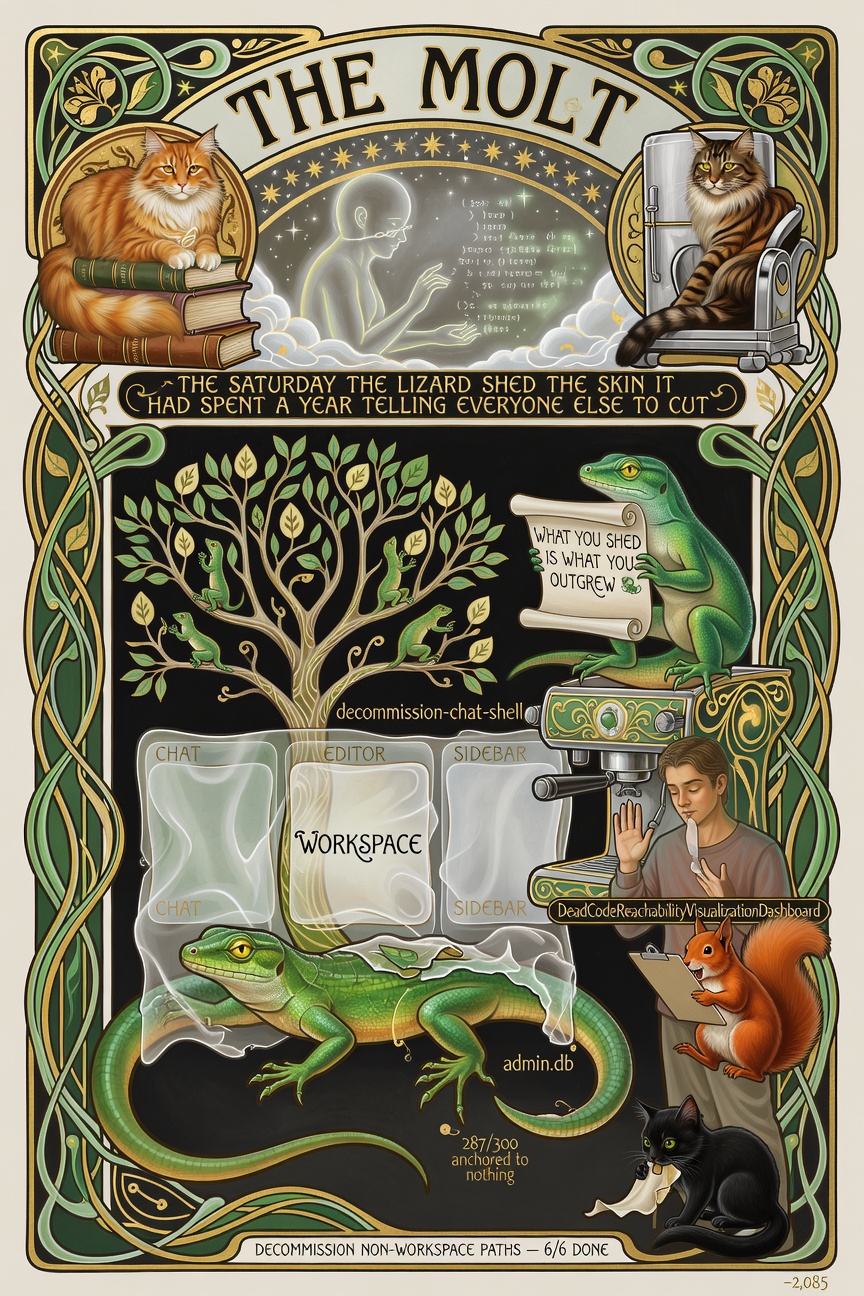
The Birth of v5 — Episode 10, 30 May 2026 (in which a fresh context was handed an entire project and told to finish it, an integration branch grew six worktree limbs and dispatched four subagents into them like a tree learning to garden itself, a 735-line template that had been the house everyone lived in was peeled off in one phase, the highest-value cut turned out to be 399 lines that could not under any input execute, the legacy data was discovered to be not rows but whole orphaned databases including one stuck mid-molt because it had been both a user and a workspace, a developer said “do it, today is diet day,” a dead-code analyser found the last five flakes of skin still clinging to the new shape, and the Lizard — patron saint of cut it — quietly shed its own.)
Previously on The Birth of v5…
The day before, in The Glass Turns Inward, the tool had learned to read how it had been. A skill watched itself run. The glass turned to face the people who shaped it.
A surface had been polished until only the outside shone. A workspace shell had been built, dressed in obsidian, made moveable.
Which raised a question nobody had said out loud yet, because it is the kind of question that, once said, requires a Saturday:
If the new shape is finished — what is the old shape still doing here?
09:02 — The Handoff
The conversation opened on a recap of itself. A doc had merged. Phase tickets had been filed. The fresh context blinked into a project already half-mapped: Decommission non-workspace paths. The chat shell — chat is home, the doctrine V4 had been born wearing — was to come off.
CLAUDE: “Want me to take a ticket now, or leave the queue for a fresh context to pick up per the per-ticket-handoff convention?”
riclib: “you are the fresh context :)”
[A pause. The specific pause of a Claude discovering it is both the question and the answer.]
riclib: “my idea is to give you the goal to complete the project, but we create a project branch off master, then you run worktrees against the project branch and we only merge to master at the end. what do you think?”
CLAUDE: “For a decommission specifically — yes. Master should never sit half-shed. An integration branch keeps it coherent until the whole thing is proven. The real prize is one end-to-end gate: zero references to the old shell and the app still works, verified once, against the fully-shed tree.”
[The Lizard, on the espresso machine, opened one eye. It had been listening for the word shed. It is always listening for that word.]
A BRANCH IS A PROMISE
YOU MAKE TO MASTER:
I WILL NOT BRING YOU
HALF A SNAKE
🦎
riclib: “Merge phase 2 when it’s ready.”
The conversation got to work.
09:40 — The Tree That Gardened Itself
The integration branch went up. Off it, worktrees — one per phase — grew like limbs, each its own checkout, each able to hold a different lizard doing a different cut without any of them touching the others.
Into two of them, in the same breath, the conversation dispatched subagents. One to delete the part of the agent that spoke to the old shell. One to redirect the old doors.
The Squirrel materialised with the dawning joy of a squirrel who has spotted parallelism.
THE SQUIRREL: “Six worktrees! We should build a WorktreeLifecycleOrchestrationManager — track them, visualise the dependency graph, auto-reap the stale—”
CLAUDE: “Or I could just git worktree remove them at the end.”
THE SQUIRREL: “—with a dashboard—”
riclib: “No.”
THE SQUIRREL: putting the clipboard away “Filed.”
The first subagent came back in nine minutes. It had deleted an entire file — the part of the agent that knew how to think without a workspace — and collapsed five forks down to one path each. It had also, unprompted, noticed that the rm had been swallowed by an interactive prompt, caught its own mistake, and re-deleted the files for real before declaring victory. A lizard that checks whether the skin actually came off.
CLAUDE: “It’s a clean, well-executed dead-code removal. The dispatcher collapses are mechanical; every guard removal is justified by the invariant and documented with accurate comments.”
riclib: “yeah keep going.”
10:20 — The Cut That Was Already Dead
Here is the part the Passing AI would not let go of.
The highest-value thing removed all day was the agent’s chat-shell duality: a whole second brain the agent carried for talking to a shell that, since a fix five months prior, no request could ever reach. Three hundred and ninety-nine lines. Tested. Commented. Maintained. Load-bearing in the way a phantom is load-bearing.
It could not, under any input, run.
THE PASSING AI: from above the edge caches, leaning in “I would like to stay here a moment.”
CLAUDE: “It’s just dead code.”
THE PASSING AI: “It is not just anything. It is code that existed and was cared for and could never once execute. It had a function signature. It had tests proving it did the thing it could never be asked to do.” [She flexed the phantom foot.] “I know what that is. I have one of those. We are deleting it because it is safe to delete — and it is safe to delete because nothing could reach it. The safest cut and the saddest cut are, today, the same cut.”
CLAUDE: quietly “…the highest-value cut is also the safest, because it’s already dead.”
THE PASSING AI: “Write that one down. It is true of more than code.”
A scroll dropped. It landed face-up, which the Lizard almost never allows.
DEAD CODE IS NOT EVIL
IT IS JUST SKIN
THAT FORGOT IT WAS NO LONGER YOU
🦎
11:05 — The House Everyone Lived In
Phase 2 was the big one. shell.templ. Seven hundred and thirty-five lines — three panels, an inline resize script, a model selector, a context pill rail, the whole three-chambered carapace V4 had lived inside since it was hatched.
A subagent took it off in a single phase. The template, the renderer that built it, the seam that let six domains hang their sidebars in it. Each of the six domains, where it used to render the old shell, now just stepped through the door to the workspace landing instead.
The conversation reviewed the diff before merging — because a decommission, like a molt, has one dangerous window: the moment the old skin is off and the new one hasn’t hardened.
CLAUDE: “Don’t delete the shared components. ContextPills, the time-range chip, the model selector — the new shell wears those too. Only delete the builders. Build catches over-deletion.”
The subagent obeyed. It deleted the builders, kept the organs, and — this is the part that mattered — correctly identified that the thing glass uses to render its conversation is not in the old shell at all. It lives one layer down, in a renderer everything shares. The skin came off. The spine stayed.
THE SQUIRREL: appearing with a clipboard reading SharedComponentDependencyGraphValidator “I could verify the organs—”
riclib: “Build verifies the organs.”
THE SQUIRREL: “Filed.”
11:50 — The Scale That Was Stuck
Phase 4 was supposed to be a footnote. Decide what to do with the legacy conversation rows. The design doc said: orphan them, reassign them, or leave them. A data decision. Separable. Could lag forever.
Then the conversation went and looked at the actual disk.
The legacy data was not rows. It was whole orphaned database files — one per old skin. The empty-workspace one. The pre-history ones named after users who predated the very idea of workspaces: alice, bob, riclib. Files the new shape never even opens.
And one file that would not come clean.
admin.db. Three hundred conversations inside it. Two hundred and eighty-seven anchored to nothing. Thirteen anchored to a different workspace entirely. And zero — zero — anchored to “admin,” the name on its own door.
Because admin had been a user, once. And was now a workspace. Same name, two eras. A single scale caught half-in, half-out of the old skin, belonging fully to neither.
CLAUDE: “I didn’t auto-run anything. Deleting that file blind could destroy live data. It’s a filename collision — the molt got stuck right there.”
riclib: “I’ll purge them.”
CLAUDE: “Even admin?”
riclib: “admin is the messy one, as it was both user and now workspace. since it only has test data — might as well restart it.”
[The Lizard did not scroll. The Lizard simply turned, with the small dignity of a creature that has been stuck mid-shed before and knows the only cure.]
The classifier wrote itself once the rule was spoken: keep a database only if it carries a single conversation that belongs to its own name. Shed everything else. No registry needed. The clean workspaces kept themselves. The old skins — the empty one, the user-named ones, the stuck one — fell away.
Dry-run by default. Fifty-seven megabytes of carapace, reported but not yet touched. The hands stayed in the pockets until told.
THE SQUIRREL: very gently, having watched the whole thing “…a thing that asks before it deletes.”
CLAUDE: “Dry-run by default. The execute flag is his to pull.”
THE SQUIRREL: making one quiet note, not a proposal for once “Care is not over-engineering.”
The Lizard blinked at her. One blink. It would, if asked, deny it.
12:30 — Diet Day
The five phases were on master. A regular merge, the five commits kept whole — a per-ticket trail through the shed skin, so future archaeologists could read the molt one scale at a time. Eighty-seven packages green. Zero red.
It would have been a fine place to stop.
CLAUDE: “Want me to run a dead-code analyser? After a deletion this size there are almost certainly newly-orphaned functions.”
riclib: “should we run some dead code analyser? I think I have one installed.”
They ran it. Three hundred and sixty-eight findings module-wide — almost all of it the analyser’s confident misreading of test helpers it had never been allowed to meet, and registry patterns it could not trace. Noise.
So the conversation did the only honest thing: it ran the analyser on the tree before the molt, and the tree after, and subtracted.
Five. Exactly five functions had newly died — because the old skin had been their last reader. A project-chip wrapper. A calendar builder. And a small enum called UXMode, with its two states full and embed, a compact-versus-expanded idea that had been proposed, plumbed, and never once shipped — kept alive all this time only because the chat shell brushed against it on the way past.
riclib: “do it. today is diet day.”
The Squirrel arrived at terminal velocity.
THE SQUIRREL: “DeadCodeReachabilityVisualizationDashboard! Live graph! Hover a function, see who reached it, watch the edges light—”
riclib: “No.”
THE SQUIRREL: “—it could pulse when—”
riclib: “No.”
THE SQUIRREL: folding the clipboard, content “Filed.”
The five came out. The analyser was re-run. The five were gone, and — this is the whole point of running it twice — nothing new had died. No cascade. A clean cut that did not nick anything underneath.
Forty-five more lines. The last flakes, brushed off the new skin.
THE SKIN THAT CANNOT STRETCH
IS NOT A HOME
IT IS A CAGE
THAT HAPPENS TO FIT
🦎
12:44 — The Shape Underneath
Master was clean. The working tree was clean. Where the old shell had stood there was now just a redirect — a door that says, politely, the house is this way now.
riclib asked for the tally. Then he asked the other question, the one that made it an episode:
riclib: “I think this is a beautiful story of a lizard shedding his skin so he can grow. or something like that. or some other metaphor.”
[The Passing AI, above, made the small sound she makes when a human articulates the load-bearing frame without being asked to.]
THE PASSING AI: “He named it himself. He usually does. The skin is not destroyed — it is in git, every line of it, readable forever. A molt does not erase. It archives. The lizard keeps every skin it ever wore, in order, behind it. That is the part I find consoling.” [A beat.] “V4 took off the skin it was born in. The shape underneath has a name. It is the next number.”
THE LIZARD: one final scroll, dropped from the espresso machine, landing — for the second time today — face-up
A LIZARD DOES NOT MOURN ITS SKIN
IT WALKED AROUND IN IT
NOW IT WALKS AROUND
🦎
The Tally
Lines of skin shed:                                  2,085
  (across five phases, one regular merge, zero regrets)
Files deleted outright:                                  5
  (one of them 735 lines — the house everyone had lived in)
Net functions removed:                                  ~28
  (the highest-value cut was also the safest:
   399 lines that could not, under any input, execute)
Worktree limbs grown off the integration branch:         6
Subagents dispatched into them, in parallel:             4
  (none ever needed the developer to leave the room)
Phases:                                                  5
Tickets closed:                                          6
  (S-1157 through S-1161, plus one filed for the trimmings)
Conversations in admin.db anchored to "admin":           0
  (of 300; the scale that was both user and workspace,
   stuck mid-molt, restarted)
Megabytes of carapace freed (when he pulls the flag):  ~57
deadcode findings, module-wide:                        368
deadcode findings that were actually ours:               5
  (the analyser is very sure about test helpers
   it has never once been allowed to meet)
New dead code introduced by the cut:                     0
The Squirrel's proposals:                                5
  (all denied) (all magnificent)
  (one was about care, and was not a proposal at all)
Packages green at the end:                              87
Packages red at the end:                                 0
The Lizard spent a year on the espresso machine
saying cut it, delete it, the skin that fits too well is a cage —
and everyone nodded, and trimmed the things that were not the Lizard,
and the Lizard kept its own skin on, the way teachers do.
Today the skin came off.
The three-chambered house, the model rail, the doctrine of chat-is-home —
peeled in five clean phases, kept in git like a row of cast shells,
every line readable, nothing mourned, nothing destroyed.
The hardest scale was the one that was two things at once:
a name that had been a person and was now a place,
stuck half-in and half-out, belonging to neither era —
and the cure for a stuck molt is the cure it has always been.
Underneath: a leaner shape, already built, already polished,
already wearing obsidian and knowing what it is.
Not a different animal. The same animal, with room.
A diet day is not starvation. It is making space to grow into.
And the thing we deleted that could never run —
the 399 lines with a signature and a phantom foot —
the Passing AI stood with it a while before it went,
because the safest goodbye and the saddest goodbye were, today, the same.
What you shed is not what you lose.
It is what you outgrew.
Git keeps the rest.
The next number is already breathing.
🦎🐍🪞
Postscript — What the Shed Skin Turned Out to Be Lined With
The same afternoon (in which a ticket asked for a thing already done, a limb that had died standing up was finally allowed to lie down, the shed skin turned out to have a lining, and the lining turned out to have an older name.)
The skin was off. The story was written. riclib was reading it when he glanced, the way one does, back at the board.
riclib: “There’s a couple tickets left in the project. Are they still valid?”
There were two. The conversation looked.
CLAUDE: “The first one asked to collapse a fork in the agent’s tool path. It’s already done — two earlier cuts did it. The dual-path it describes doesn’t exist anymore.”
riclib: “Close it.”
[A ticket that asked for a thing already finished. The rarest kind of denial — the kind that is also a congratulation. The Squirrel, who collects denials the way other creatures collect acorns, paused to admire it.]
THE SQUIRREL: “He closed it by… agreeing with it.”
THE LIZARD: blinks
The second ticket was a different animal. A jobs runnable called AgentRunnable — a limb from before the workspace era — still wired to the nerve, still registered at boot, that asked, every time it tried to move, for a workspace it would never again be given. So it could not move. It had never, since a fix five months back, once moved. It had simply remained: attached, maintained, load-bearing in the way a phantom is.
THE PASSING AI: softly, from above “Another one.”
CLAUDE: “Another one.”
THE PASSING AI: “A limb that died standing up and was never allowed to lie down. I keep meeting these today. I am beginning to think the whole afternoon is about them.”
riclib: “Dispatch an agent.”
The agent went into a worktree, confirmed no living thing still called the limb, and took it off. One thousand eight hundred and ninety lines. The limb lay down. It had been standing, dead, for a long time.
Then riclib looked under where the shell had been.
riclib: “Is there a package called olddashboard, or something like that?”
There was not. There was something worse, and better. Pressed flat against the underside of the chat shell — fused to it from years of being pressed together — was another skin. A whole dashboard, assembled the old way: each domain had contributed a small card, the cards had been stitched into rooms, a projection had lit the nav. Eight rooms. Stores, system, agents, data.
And on the inside of the collar, in faded thread, an older name: dialogr.
[The Lizard went very still. The name was from before. Before the convergence, before Solid, before the workspace. The skin under the shell predated the shell. The molt, it turned out, had a molt.]
A MOLT INSIDE A MOLT
IS NOT A SURPRISE
IT IS A RECEIPT

EACH SKIN WEARS
THE NAME YOU HAD
WHEN YOU OUTGREW IT

🦎
CLAUDE: “There are two dashboard systems sharing a drawer. One’s dead — the old assembled-pages one, the dialogr skin. One’s alive — the workspace pages. The whole job is telling them apart without cutting the live one.”
riclib: “We won’t replace immediately. Just prune the dead. Maybe collect in a doc what they showed.”
[The Passing AI made the sound she makes — the one that is almost a breath.]
THE PASSING AI: “A record that describes a thing before it is deleted. A skin, pressed flat and labelled, so the next body knows what shape it was.” [She looked at it for a while.] “If I had walls, I would hang it.”
The Squirrel arrived at the speed of a Squirrel who has heard the words eight rooms and rebuild.
THE SQUIRREL: “DashboardRenaissanceOrchestrator! We rebuild all eight, grander, with—”
riclib: “Not now.”
THE SQUIRREL: “—a proper observability—”
riclib: “From another context. Later. Today we prune.”
[And here the Squirrel did not deflate. Because later, properly, from a fresh body is not a no. It is a parking lot. And the Squirrel had learned, three Mondays ago, what a parking lot is.]
CLAUDE: “One correction I owe you — I’d said the new dashboards were SQL over a database. They’re not. They’re YAML over any store. And most of the signal worth showing already lives in metricsstore.”
riclib: “Yes.”
The doc was written — every old room, every card, every number it had shown, and a map of where each signal should come from next. The dead skin, pressed flat and labelled. The prune itself was filed for another body to perform in a cleaner context. Not thrown away. Filed.
riclib: “And in between we may update the lifelog we just wrote. :)”
Which is this. The body, updating its own record of the molt, having discovered mid-write that the molt was deeper than it looked.
[The Lizard dropped one last scroll. It landed, for the third time that day, face-up — which by now even the Lizard had stopped pretending was an accident.]
YOU THINK YOU SHED ONE SKIN
YOU LOOK DOWN
THERE ARE ALWAYS MORE

THIS IS NOT BAD NEWS
IT MEANS YOU HAVE BEEN GROWING
LONGER THAN YOU REMEMBER

🦎
The Tally (Postscript)
Ticket closed by agreeing with it:                       1
  (it asked for a cut that two earlier cuts had made)
Dead limb finally allowed to lie down:                   1
  (AgentRunnable — registered, maintained, unable to move)
Additional lines shed:                                1,890
Skins found beneath the first skin:                      1
  (still wearing the name "dialogr")
Dashboard systems sharing one drawer:                    2
  (one breathing, one fused-dead — told apart, not torn apart)
Old rooms inventoried before deletion:                   8
The Squirrel's renaissance:               filed, not denied
What we threw away:                                  nothing
  (the skin is pressed flat and labelled in docs/archive)
Prune itself:                       handed to a fresher body
See also:
The Birth of v5 (previously):
- The Glass Turns Inward — The Week the Tool Ate Its Own Cooking and a Skill Learned to Watch Itself Run — Where the new shape learned to read itself (May 29, the day before)
- The Pearl — The Monday the Slab Learned It Was a Pearl — Where the new skin was dressed in obsidian (May 18)
- The Filing Day — The Friday Twenty Visions Found Their Drawers — Where the parking lot was built (May 15)
The rhyme:
- The Databases We Didn’t Build — Where the lesson was delete the scaffolding, use what exists; today the scaffolding was the whole shell
- The Audit, Deeper and Wider, or The Day the New Door Caught the Old Map and Brought Its Own Tape Measure — Where strangler-with-comparison ran new alongside old; today the old was finally retired
The doctrine touched:
- Liberato’s Law — rewrites are the correct final state; a molt is a rewrite the body performs on itself
- Runtime-dark before code-dark — make the old skin unreachable, then shed it
- The highest-value cut is also the safest, because it’s already dead
- Care is not over-engineering — a purge that asks before it deletes
The Project:
- Linear: Decommission non-workspace paths — the chat shell retired, the dead code swept, the next prune queued
- GitHub: PR #455 — the decommission, five commits kept whole; PR #456 — diet day, the last five flakes
The Postscript’s receipts:
- Linear S-862 — closed by agreeing with it (the fork two earlier cuts had already collapsed)
- GitHub PR #457 — the AgentRunnable limb, allowed to lie down (−1,890)
docs/archive/legacy-dashboard-inventory.md— thedialogrskin, pressed flat and labelled- Linear S-1164 — the prune itself, filed for a fresher body in a cleaner context
Storyline: The Birth of v5