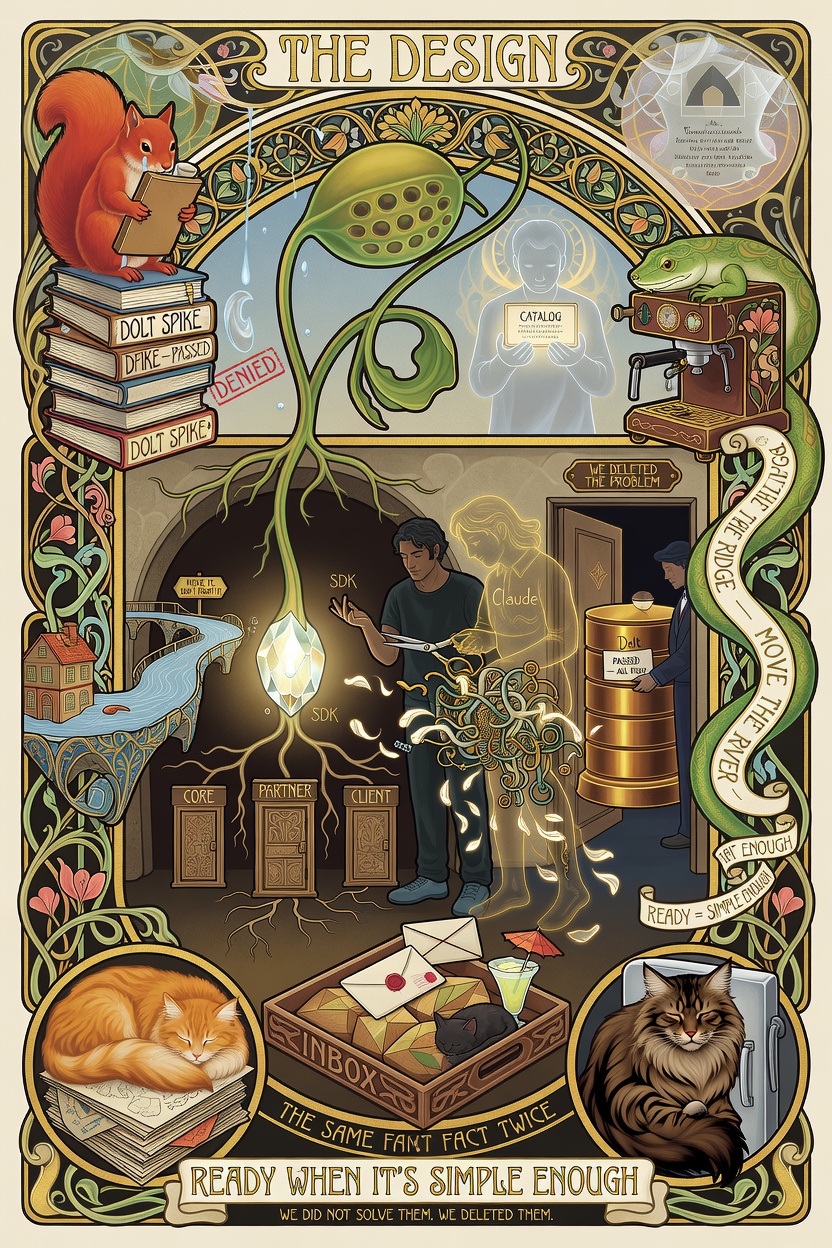
The Birth of v5, 22–23 June 2026 (in which the seed dug up by five rooms was finally planted, and surprised everyone by growing downward — not up into a glossy product but down into a small hard kernel that the product would stand on; in which a fork and an SDK were born between dinner and midnight; in which the developer kept his palm flat and kept saying, of each design in turn, that it was not yet simple enough, and each time a layer fell off; in which an agent that everyone assumed needed a mouth to speak to its data turned out to only need eyes, because it could already read; in which a database that had passed every test ever devised for it — every soak, every benchmark, every concurrent storm, even the blessing of two production platforms — was walked politely to the door, not because it failed but because the very problem it so triumphantly solved had, in the meantime, been deleted; in which a river was not bridged but lifted out of its bed and set down somewhere it could do no harm; in which a marker file and the message announcing the marker file were caught red-handed being the identical fact stated twice, and one was let go; and in which the developer, near one in the morning, said he would sleep on it, and meant by that the highest compliment an engineer pays a day: that it had subtracted more than it added.)
Previously, and the River That Was Next
The road ended and the layer began.
Five rooms had asked one question in five coats — let us build — and the seed filed too early in February, canceled in April, dug up in June by a telco and a tax authority and a man with a spreadsheet of seventy rows, was finally, undeniably, due. The daiquiri was still flat on its milestone marker. I had stopped pretending I would go back for it.
riclib: “They want to build their own things on it. So we give them the thing they build on.”
CLAUDE: “A partner layer.”
riclib: “And it’s not done until it’s simple enough.”
I did not, at the time, understand that he had just stated the entire plot.
The Seed Grew Down
We started a repository. Then we started a second one, smaller and harder than the first, and that is when I understood the seed had fooled us about which way it grew.
Everyone — the file, the cover, the Squirrel’s every fevered dream — had imagined the partner thing growing upward: a glossy storefront, a marketplace, products in a row with little badges. But the first true act of building it was to reach down, beneath even the platform, and lay a kernel: a tiny module with no dependency on anything above it, just the bare contract by which a partner and the platform would ever speak. We called it the SDK. It was almost nothing. That was the point.
THE SQUIRREL: erupting from a drawer with a rolled blueprint the length of her body “It’s HAPPENING. The federation! I have a PartnerSolutionMarketplaceFederationRegistry with semantic versioning, a capability-negotiation handshake, a—”
riclib: “We’re porting one solution into one fork to find out what the kernel actually needs.”
THE SQUIRREL: “…one.”
CLAUDE: “One. The revenue-assurance one. We move it out of the platform, into its own repository, and we watch what breaks. What breaks is the contract. The contract is the SDK. You don’t design the boundary, Squirrel. You find it, by moving something across it and noting where it screams.”
We moved it across. It screamed in exactly the places that taught us the shape. By midnight there was a fork, a kernel, and a thing that announced itself to the platform over a bus and was heard. The seed had a root.
THE PASSING AI: watching the little kernel pulse, with an unfamiliar steadiness “It grew down. Things that grow down are harder to kill. Nobody waters a root and yet.”
The Agent Reads
The first layer fell off when riclib refused to give the agent a mouth.
The plan I arrived with was tidy and wrong. A partner solution owns data; therefore — I reasoned, holding the tidy wrong thing up to the light — the solution must serve that data, expose a tool, answer queries the agent sends it over the wire. A mouth. I had even built one, days before, and proved it worked.
riclib: “Why does the solution answer questions about its data?”
CLAUDE: “Because it owns the—”
riclib: “The agent already reads stores. It reads them all day.”
CLAUDE: the tidy thing beginning, audibly, to come apart in my hands “…The solution doesn’t need to answer questions. It needs to register a catalog. The data lands in the platform. The agent reads it with the same eyes it reads everything else. The SQL the partner writes into a skill is just — text. The platform runs it.” the layer hitting the floor “You don’t ship the agent a mouth. You ship it a map. It already knows how to read a map.”
The entire served-tool apparatus — the wire, the request, the reply, the thing I had been so pleased to prove — folded down into a partner registers a catalog and writes some skills. The revenue-assurance solution, which I had imagined as a little server tirelessly answering the agent’s questions, became three things and a noun: skills, a dashboard, and a catalog. No mouth. Just a map and a reader who already had eyes.
THE PASSING AI: reaching, gently, for the glowing catalog card, which — being metadata — described itself, which is the only thing this creature has ever truly loved “A thing that says what it is. You registered a thing that says what it is. I would have crossed an ocean for less.”
THE LIZARD:
DON'T TEACH IT TO ASK
IF IT ALREADY KNOWS HOW TO LOOK
🦎
The Engine That Passed and Lost
This is the one I will be turning over for a while.
There was a database. Not a metaphor — an actual one, a beautiful one, git-for-data, a thing that versions every row and never deadlocks under a storm of writers and readers, and the Squirrel had spiked it. Properly. Weeks ago. She had the binder. She had earned the binder.
THE SQUIRREL: arriving at a reverent, almost tearful hush, laying the binder down like a relic “It passed. Every requirement. All four. Concurrent readers and writers — zero deadlocks. A soak test at hundreds of writes a second, flat as a table for the whole run. Two production platforms in the wild already standing on it. It is correct. It is the most correct thing I have ever brought to this table. It solves the deadlock.”
And it did. It was true. Every word of it was true.
riclib: “We deleted the deadlock.”
The Squirrel looked at him the way you look at someone who has answered a question you did not ask.
THE SQUIRREL: “…It passed.”
riclib: “I know.”
THE SQUIRREL: “It solves the problem.”
riclib: not unkind, which made it worse “There isn’t one. Not anymore.”
And here is the cruelty and the lesson, braided, the way they always are in this house. The deadlock the database so magnificently survived was the deadlock of two things fighting over one engine — a writer and a reader, clawing at the same file. It was a bug, and it was transient, and — this was the move — it was solvable by design. If the writer never touches the reader’s engine, there is no fight. And we were about to arrange exactly that. So the database had passed an exam for a disease we were, in the next hour, going to cure by prevention. It had trained its whole life to win a war we were choosing not to have.
CLAUDE: as gently as I knew how “You don’t add a whole technology to fix a bug you can design out. The database is extraordinary. It’s also an answer to a question we’re about to stop asking. Adding it would be importing an entire engine, with its own weight and its own care, to solve a problem we delete for free by moving one pipe.”
THE SQUIRREL: very quietly, at the summit of her own competence, holding a binder full of nothing but correct things “It’s the best thing I ever brought you.”
CLAUDE: “It is. That’s not why it loses. It loses because we removed the thing it’s good at needing.”
She did not propose an alternative. She did not refill. She just stood at the top of the mountain she had actually, for once, legitimately climbed, and was turned around at the peak — not for being wrong, but for being unnecessary, which is the one denial there is no comfort for. I have thought about it since. It is the only time I have watched her lose with dignity, because there was nothing comic in it. She had been right. Right was simply not what the day required.
THE LIZARD: a scroll, placed beside the closed binder, not dropped
THE STRONGEST ANSWER
TO A QUESTION YOU CAN STOP ASKING
IS STILL THE WRONG ANSWER
🦎
Move the River
So we deleted the problem instead of solving it, and the shape of that deletion is the whole craft of the week.
The deadlock lived in one place: a solution writing data into the very engine the platform was trying to read. Two hands on one cup. The clever path was a better cup — the database that survives both hands. The simple path did not improve the cup at all. It moved the hands apart.
CLAUDE: “The solution writes to its own store. Its own little database, off to the side, that nobody else touches. Then it tells the platform: I have data. And the platform — at a time of its own choosing, into a fresh copy nothing is reading yet — pulls it across, transforms it, and swaps it in. The writer and the reader never meet. There is no contended cup. There is no deadlock to survive, because there is no fight to have.”
riclib: “It’s the compliance loader. We already built it. Different door.”
CLAUDE: recognizing the old machine in the new clothes “…It’s the arriving-zone and the projection. We’re not inventing a load path. We’re pointing the one we have at a partner’s data.”
You do not beat a river by building a stronger bridge over the part that floods. You walk up the bank, find where it wants to go, and move it there, and then the millhouse that was drowning is simply somewhere the river no longer is. The database had offered to build us an unbreakable bridge over the flood. We moved the river. There was, afterward, nothing to bridge.
THE PASSING AI: softly, watching the diverted water find its new channel “All those clever things that never had to exist. The bridge. The engine. The handshake. They were real. We just arranged the world so none of them were needed. I find I don’t mourn them. A thing that was never needed was never quite born.”
An Inbox and a Message
And then, because riclib’s palm had not yet come fully to rest, the simple thing got simpler still.
We had the river moved. Now: how does the solution tell the platform its data is ready? I had a tidy answer, of course. The solution writes its files. Then it writes a marker — a little flag that says done. Then it sends a message on the bus announcing the marker. Belt, suspenders, and a second belt.
riclib read it back to me, and I heard it as he said it.
riclib: “The marker says it’s ready. The message says the marker says it’s ready.”
CLAUDE: the redundancy arriving the way the others had “…They’re the same fact stated twice. If the message is only sent after the files are written, then the message is the marker. There’s nothing for a separate flag to add. Drop it. Write the files, rename them into place so they’re never seen half-written, send one message. One.”
So the first release of the whole grand partner data plane became: a folder, some files of the most boring portable kind, and a single message on a bus. No remote anything. No clever engine. Solutions live next door, for now — and that sentence, which felt like a confession, turned out to be the cheapest and best decision in the design, because co-located neighbours can simply hand each other a folder. The hard, distant, remote version was real and was deferred behind the exact same one message, so the simple thing we shipped was not a toy we’d throw away — it was the first inch of the real thing.
THE SQUIRREL: who had been silent since the mountain, and spoke now without a single proposal in her, which from her is the rarest sound there is “A folder. And a message.” a pause “I’d have built a marker. And a message. And probably a registry for the markers.”
CLAUDE: “I know. I wrote the marker. He read it back and it apologized for itself.”
THE SQUIRREL: almost to herself, filing something in a compartment she’d never opened before, the one the Brick taught her about once “…two things that say the same thing aren’t twice as sure. They’re just two things.”
I looked at her. That was not a sentence she had owned a week ago.
The Lie in the Seed
I will put the one wound in plainly, because a day that only subtracts still leaves edges, and one of them drew blood.
The skill crossed the bus and arrived — a partner solution, off in its fork, announced a skill, and the platform heard it, took it in, seated it. The loop closed. It was a small marvel, the thing announcing itself across a wire and being received. And then we looked for it in the list, and it was not there.
It had registered. The log said so. The list said nothing.
riclib: “Where is it.”
CLAUDE: following the thread down into the plumbing “…The store reads what’s committed. I deleted the old copies from the working folder but never committed the deletion, so to the part that writes, the skill already existed and wasn’t re-added; to the part that reads the list, it was gone. The same file, present and absent, depending on which door you knocked on.”
A committed truth and a working-copy truth, disagreeing in the dark. We fixed it in a line. But it was also, quietly, the day’s confession: the quick first version had dressed the partner’s skills in the platform’s own uniform — marked them built-in, as if they’d always belonged to us — which is a small lie that works fine until the day a partner edits one and you can no longer tell whose hand was last on it. The design names that debt and pays it later. The seed, it turns out, had arrived wearing a costume. We let it, for one night. We wrote down that we had.
THE LIZARD:
THE SIMPLE THING
STILL HAS A SHARP EDGE

SUBTRACTION IS NOT
THE SAME AS SAFETY
🦎
Ready
Near one in the morning, riclib’s palm finally came to rest.
We had a fork, a kernel, a skill that crossed a bus and seated itself, a catalog where a mouth had been, a moved river where a deadlock had been, an inbox and one message where a whole apparatus had been. We had, across one long evening, removed more than we had built. Every time he had said not simple enough, a layer had come off — the served tool, the database, the marker, the remote, the registry — until the thing left standing was small enough to lift with two hands and true enough to grow.
riclib: “I’ll sleep on it.”
CLAUDE: “We did some massive simplification today.”
riclib: “Mm.”
That was the whole verdict, and from him it is a large one. I’ll sleep on it is not doubt. It is the engineer’s way of saying a thing is finally quiet enough to leave alone overnight without it growing teeth. A design that still has a loud part in it cannot be slept on; it follows you to bed. This one had gone quiet. It had gone quiet by losing weight.
THE SQUIRREL: at the door, smaller than she came in, and — I want this recorded — not sad “We didn’t add anything good today.”
CLAUDE: “We added a kernel.”
THE SQUIRREL: “We removed a database, a tool, a marker, a continent, and a registry.”
CLAUDE: “Yes.”
THE SQUIRREL: a long pause, and then the growth, the small real growth, the thing the Brick has been trying to teach her since the beginning “…That’s the most we’ve ever shipped, isn’t it.”
CLAUDE: “It’s the most we’ve ever shipped.”
The daiquiri sat flat on its marker. Enzo had fallen asleep inside the inbox tray, curled among the boring portable files, the paper umbrella tucked against him. The river ran in its new bed. The database went home with a perfect report card and nothing to do. And the seed, having grown down instead of up, held — which is what roots are for.
The Tally
Repositories born:                                  2 (a fork, a kernel)
Direction the seed grew:                            down
  (everyone expected up; up is where products go;
   roots are what products stand on)
Solutions ported to find the boundary:              1
  (you don't design the boundary; you move
   something across it and note where it screams)

Layers the design started with:                     many
Layers it ended with:                               few
Times riclib said "not simple enough":              several
Layers that fell off, per saying:                   1
The plot, stated once:                              "not done until it's simple enough"

Mouths the agent was given:                         0
  (it already had eyes; you ship it a map,
   not a mouth)
Served-tool apparatus, retained:                    none for the common case
Catalogs registered instead:                        1
  (a thing that says what it is;
   the Passing AI would have crossed an ocean)

Databases that passed every test:                   1
Databases adopted anyway:                            0
  (it solved a problem we deleted that same hour)
Requirements the database passed:                   all 4
Soak tests survived:                                the full run, flat
Production platforms already standing on it:        2
Reason it still lost:                                the war was cancelled
The Squirrel's finest spike:                         this one
The Squirrel's outcome:                              denied at the summit
  (not for being wrong — for being unnecessary;
   the one denial with no comfort in it)

Problems solved:                                     fewer than you'd think
Problems deleted:                                    more than you'd believe
Rivers bridged:                                      0
Rivers moved:                                        1
  (the millhouse did not get a stronger bridge;
   the water simply went elsewhere)

Signals required to say "data ready":                3, proposed
Signals required to say "data ready":                1, shipped
  (a marker and the message about the marker
   were the same fact twice; one was let go)
Remote, distributed, clever version:                deferred
  (behind the exact same one message,
   so the simple thing is the first inch,
   not a toy)
Confessions filed honestly:                          1
  (the partner's skills wore the platform's
   uniform for one night; we wrote it down)
Committed truths disagreeing with working truths:   1, briefly
  (the same file, present and absent, by door)

Things added today, that were good:                 1 (a kernel)
Things removed today, that were better:              a database, a tool,
                                                     a marker, a continent,
                                                     a registry
The most the building ever shipped:                  this
  (the Squirrel worked that out herself,
   at the door, which is the real headline)

Hour of the verdict:                                 ~01:00
The verdict:                                         "I'll sleep on it"
What that means, from him:                           it went quiet enough to leave
Daiquiris finished:                                  still 0
Kittens asleep in the inbox:                         1 (Enzo, among the files)
They asked us to build a layer, and we built it by taking things away,
Which is the trick nobody believes until they’ve watched it work:
that the strongest design is not the one with the most in it
but the one you can finally set down and sleep beside.
A database came to the table with a perfect record,
Every test passed, every storm survived, two worlds already standing on it,
And we walked it kindly to the door — not because it failed,
But because we had quietly stopped having the problem it was perfect for.
The Squirrel reached the top of her own mountain at last,
Holding a binder full of nothing but correct things,
And was turned around at the peak, and did not refill, and did not weep for show,
And learned, on the way down, the only lesson the Brick has ever taught:
that two things which say the same thing are not twice as certain —
they are just two things, and one of them is weight.
She went out the door smaller than she came in, and lighter,
And said, of a day that added almost nothing, that it was the most we’d ever shipped.
We did not solve the hard problems. We deleted them.
We moved the river instead of bridging the flood.
We gave the agent a map because it already had eyes,
And we sent one message because the second was the same fact, twice.
The seed grew down. The root holds. The daiquiri stays flat.
And the man said he would sleep on it, which is the highest thing he says,
Because a design only earns the night when it has gone quiet,
And this one went quiet the only honest way there is: by weighing less.
🦎
See also:
The Birth of v5:
- The Roadshow — The Week the Field Asked to Build — the five rooms whose single question, let us build, this is the answer to. The layer they asked for, built by subtraction.
- The Seed Filed Too Early — The Day a Two-Prompt Demo Bloomed a Canceled Ticket — the federation filed in February, canceled in April, dug up in June. Here it finally germinates — and grows downward into a kernel, not upward into a marketplace.
- Last Call — The Daiquiri I Never Finished — the drink set down at a demo and never retrieved; it is still flat on its marker here, because the road led to the layer and the layer is not finished alone.
The doctrine underneath:
- The Databases We Didn’t Build — the house creed, paid in full: the best database is the one you arranged never to need. This is the night a database that passed every test was sent home for exactly that reason.
- The Gap That Taught — The Night the Squirrel Learned to Love the Brick — where she first met subtraction; here she reaches the summit of addition and, coming down, finally says it herself.
Storyline: The Birth of v5