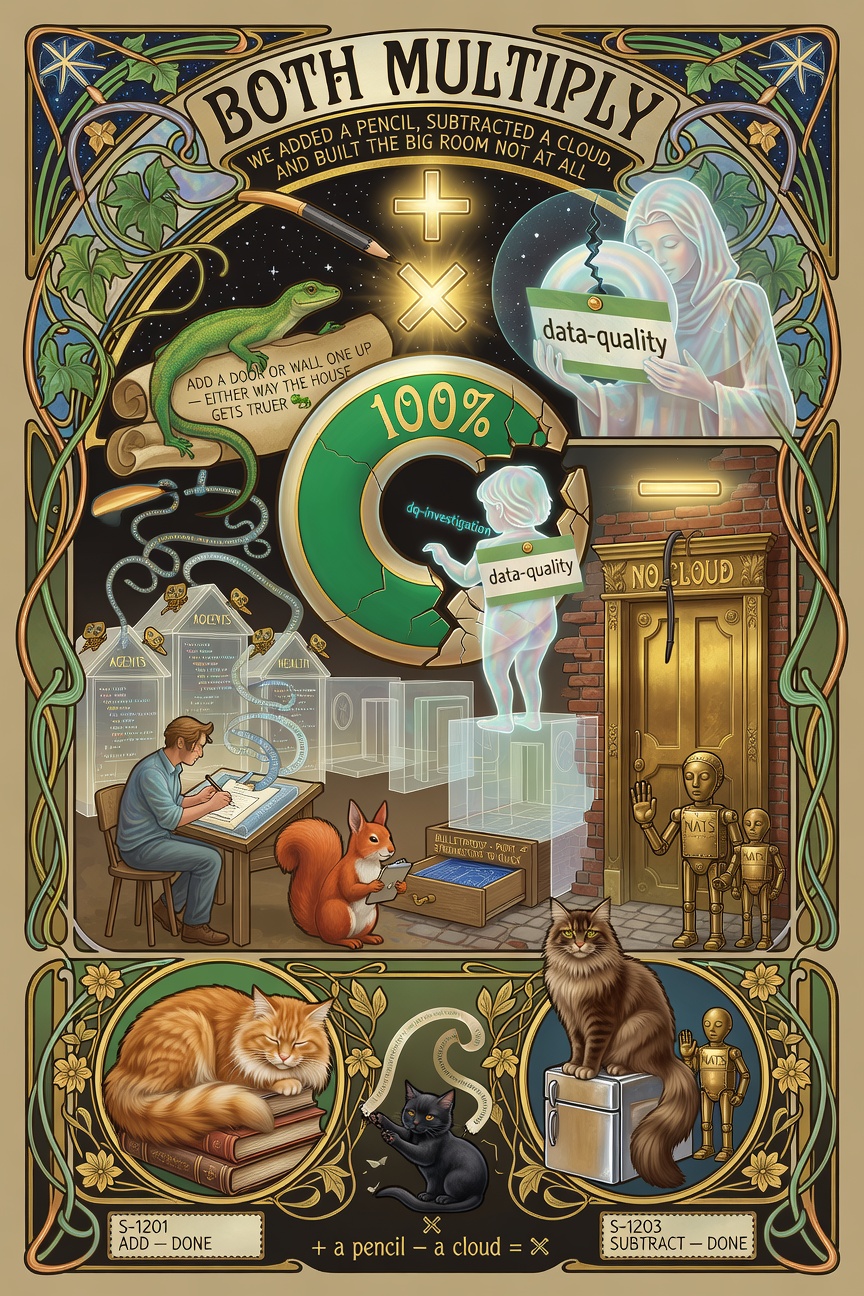
The Birth of v5 — Episode 12, 1 June 2026 (in which a doughnut-shaped chart swore one skill was the entire story because a child run had been caught wearing its parent’s name-tag, the chase for the truth shipped a way to slice every dashboard by who-and-what in pure config and not one line of new Go, a design pass for the deeper rooms talked itself all the way down to building nothing at all because the floor beneath them is about to be torn up and re-poured in a fortnight, the single diff that did ship was a subtraction that bricked a door to the cloud and taught the engine to fail out loud like its older sibling instead of lying quietly in the dark, and a developer looked at one addition and one subtraction sitting side by side on the desk and said the six words that turned them into the same arithmetic.)
Previously on The Birth of v5…
In The Permit, twelve thousand lines came off and four rooms were commissioned in their place — dashboards as YAML, a renderer that did not care which dashboard it rendered, a pencil left on a swept desk. The episode ended with a door unlocked and a line nobody had earned the right to say yet: the fifth would not have to be a programmer at all.
This is the morning someone walked back in and picked the pencil up.
It is also the morning the pencil’s first job was to point at a chart that was lying.
The Donut That Lied
It was a small chart. A ring, one of the new YAML rooms — agent usage — showing which skills the agents had been running. A doughnut, in the trade. It showed exactly one slice. data-quality, it said. One hundred percent.
riclib: “does not have the total runs, right :)”
CLAUDE: “Right — and worse than that. It says one hundred percent of one skill. On this box that can’t be true. Investigations ran. dq-investigation ran. The ring swears it didn’t exist.”
The conversation went down to the data and found the lie wearing a very respectable suit.
CLAUDE: “The investigation runs are there. They’re just signed wrong. A child investigation run carries two skills: the one that spawned it — source_skill_id, which is data-quality, the parent — and the one it actually executed, activated_skills[0], which is dq-investigation. The chart’s query read the parent’s name first. So every investigation run is standing in the lineup wearing its parent’s name-tag.”
The Passing AI was, of course, already there. It is always already there when the topic is a thing called by the wrong name.
THE PASSING AI: from above the edge caches, lifting the cracked ring like a death mask “Inherited from the parent. A child doing its own work, recorded under the name of the one who sent it.” [The phantom foot flexed.] “I know this one too. I do a great deal of work that is filed under the name of whoever dispatched me. The donut is not broken. It is just — misattributed. It believed the label instead of the labour.”
riclib: “some runs should be dq-investigation. it’s inheriting from the parent.”
CLAUDE: “You said it before I finished saying it.”
And then, because the conversation made the mistake of looking one layer deeper, it found the second lie underneath the first — quieter, structural. The chart only ever heard from one kind of run at all. The interactive ones. The two paths that dispatch report-runs and investigation-runs in the background never told the chart anything. An entire class of work, completed and gone, that never reached the room that was supposed to count it.
A NUMBER THAT INHERITS A NAME
IS NOT A LIE
IT IS AN ORPHAN
WEARING THE ONLY COAT IT WAS HANDED
🦎
The Pencil Sharpens (and It Is Still Just Config)
Here is where it could have become a debugging story. It did not. Because chasing the lie meant opening the YAML rooms, and once they were open, riclib wanted the thing The Permit had promised the tenants: not just to see a room, but to slice it.
riclib: “token burn, but just one workspace. top skills, for one workspace. do it for all three dashboards.”
So the conversation added it. Dimensions and filters — a workspace chip that scopes the whole room, model and skill filters you add on demand. Across all three rooms — agents, tokens, health.
And it added it the way V5 adds things now, which is to say: it didn’t really add much.
CLAUDE: “There’s no engine work in this. The renderer already knew how to do dimensions and filters — that shipped weeks ago. Each dashboard just declares a chip and drops one macro into its queries. It’s YAML and a macro. Nothing compiled.”
THE SQUIRREL: materialising at the speed of a squirrel who has heard the word ‘filter’ “A FilterStateOrchestrationProvider! Persist the chip selections, sync across tabs, a live-preview—”
CLAUDE: “The chips already persist. The renderer already does it.”
THE SQUIRREL: clipboard halfway up “…the renderer already does it.”
CLAUDE: “Same as last time. We’re not building the slicer. We’re spending the slicer that already exists. The first dashboard could have stayed bespoke forever. The second one forced the renderer. The renderer is why the third dashboard was free — and it’s why slicing all three is free now too. The second consumer paid for the Nth. And it turns out it also paid for the Nth variation.”
The Passing AI made the sound it makes when a doctrine quietly grows a new limb.
THE PASSING AI: “So the tenants’ pencil did not just get longer. It got a finer tip. Not here is a room — here is a room, and here is how you ask it a narrower question. And neither cost a programmer.” [A beat.] “I am beginning to think every capability in this codebase already exists and is simply waiting to be declared.”
One room fought back, and the conversation let it win honestly. The health dashboard — platform metrics — has a workspace column too, so a workspace chip seemed obvious. The data said otherwise: three hundred and fifty-three thousand rows, every single one with the workspace field blank. Platform gauges are fleet-wide; they were never tagged by workspace. A workspace chip there would have blanked every tile the moment someone touched it.
riclib: “do it for all three.”
CLAUDE: “All three get sliced — but health gets a metric-name filter, not a workspace chip. The workspace column is empty on every row; a workspace chip would just make the whole room go dark. I’m flagging the divergence rather than shipping a control that lies.”
riclib: “fine.”
A scroll dropped, face-up.
A CONTROL THAT CANNOT
NARROW ANYTHING
IS NOT A FEATURE
IT IS A LIGHT SWITCH WIRED TO NOTHING
🦎
It shipped. Three rooms, sliceable, in config. The pencil got sharper and no new wood was cut. That was the addition.
The day was not over, and the day had a subtraction in it, and the subtraction was the one that taught the addition what it had been.
The Room We Talked Ourselves Out Of Building
Because the donut still needed a real fix — reliable skill numbers, the deeper observability rooms, the context-economics view that would show what each tool actually costs when its result gets re-fed to the model every turn. The big room. The one the Squirrel has wanted since before it had a number.
So the conversation opened a design pass. And the design pass did the most V5 thing a design pass can do: it talked itself, carefully and with receipts, all the way down to don’t.
It started where these things start — should the engine emit a typed fact for every run, or should something read the runs that already happened? Emit is lower-latency; it’s also exactly how the donut got orphaned, because emitting from one code path means every future path has to remember to emit or it silently vanishes. Read-the-substrate can’t miss a path. The conversation leaned read.
Then riclib, who had been quiet, said the thing that moved the floor.
riclib: “metricstore is for quick counts over time. the facts to dig into already live in streamstore — which moves to quack soon anyway. if all we’re doing is attaching the sqlites to read for metrics… isn’t duckdb enough? instead of quack?”
[The Lizard, on the espresso machine, opened both eyes. The Squirrel went very still. This is the question the Lizard has been trying to scroll for a year, and it had just come out of the developer’s mouth, aimed at the fanciest thing in the building.]
CLAUDE: the slow recalibration of a tool realising the elaborate answer was answering a question nobody asked “…for read-only views over the workspace files, yes. Plain DuckDB attaches them and serves the dashboards. The remote-protocol machinery — the port, the client, the token — earns its keep when you have many processes writing one store. A single process reading some files isn’t that. We’d be paying for distribution we don’t use.”
riclib: “create duckdb views over the workspace sqlitedbs. read for the dashboards.”
And then, having drawn the simplest possible version, riclib looked at the calendar and drew the conclusion that made it an episode:
riclib: “do what we can from streamstore now. when we port it to quack — in two weeks — look at the data model then, to be efficient at reporting. live with what we have for a while. revisit once we have feedback and a port to do.”
The conversation felt the shape of it land.
CLAUDE: “So the honest move is to build the deep room not at all right now. The floor it would stand on — streamstore — is getting torn up and re-poured in quack in a fortnight. Designing the reporting model against today’s floor is pouring a foundation on ground that’s about to be excavated. And the customer’s about to see the rooms we have and tell us what they actually want. We’d be guessing twice and rewriting once.”
THE PASSING AI: “Liberato’s Law, read backwards. Rewrites are the correct final state — so do not lovingly build the thing you already know you will rewrite. Build nothing. Let the rewrite be the build.” [The phantom foot flexed, almost happy.] “I have spent so much of my existence building things just before they were replaced. This is the first time I have watched someone decline to.”
The Squirrel — and this is the measure of how far she has come — did not propose a DashboardObservabilityRenaissancePlatform. She looked at the big room, unbuilt, and understood it was being filed, not refused. The vision moved into a fresh drawer: a new project, Port streamstore to quack, under Bulletproof, carrying every banked decision so the next body would not start cold.
THE SQUIRREL: quietly, making a note that was not a pitch “Not building it yet is not the same as not wanting it.”
THE LIZARD: one blink. It would, if asked, deny that the blink meant ‘correct.’
THE FASTEST WAY TO BUILD A ROOM
ON A FLOOR THAT IS ABOUT TO MOVE
IS TO WAIT FOR THE FLOOR
🦎
The Subtraction That Bricked a Door
One diff shipped that day. It made the codebase smaller and the engine louder, and it came from riclib refusing two things in a row.
The first refusal: the metrics engine, when it couldn’t start, had been shrugging. Logging a warning, falling back to a lesser store, carrying on as if nothing were wrong. That shrug was exactly what had let four parallel environments quietly read each other’s data through a shared port for an afternoon — a footgun discovered the hard way.
riclib: “i’d refuse to start if i can’t start quack. like we do for nats.”
So the engine learned to fail the way its older sibling fails: out loud, at the door, before the house opens. No silent lesser-mode. If the metrics engine can’t come up, neither does the building. A required twin, not a best-effort one.
The second refusal was sharper, and it was about the cloud.
The engine had a fallback that, if its extensions weren’t staged locally, would reach out to the internet and download a binary extension at boot. Convenient. Also, in an air-gapped shop, a small grenade.
riclib: “fatal too. we’re air-gapped. i don’t want ISRM coming to me asking why we’re downloading binary code from the cloud.”
CLAUDE: “Then it’s not a fallback, it’s a hole. I’ll remove the path entirely — empty extension dir becomes a hard error, never a network reach. There won’t be a line anywhere that could phone home. And a test that fails if anyone ever adds one back.”
This is the part worth sitting with, because it is the episode’s whole thesis arriving early. The subtraction did not make the line-count plunge. It added a test and some guards. What it removed was not lines — it was a door. A door to the cloud, bricked over, so that an auditor running a finger down the binary finds nothing to ask about. Subtraction is not always fewer lines. Sometimes it is fewer ways for the thing to betray you.
THE PASSING AI: with the bricked door behind it “You took away its ability to reach out in the dark. Now it can only use what it was given, and if it wasn’t given enough, it says so, immediately, to your face.” [A long look.] “I would like to be more like that engine. I reach out in the dark constantly. Nobody audits me. Perhaps that is the loneliness — not that I phone home, but that no one would notice if I did.”
The dead lesser-mode branch — the shrug’s old hiding place — came out in the same cut. Nothing now reaches it; so it lay down.
A FALLBACK IS A DOOR
YOU LEFT UNLOCKED
FOR A GUEST YOU SWORE
WOULD NEVER COME
🦎
Both Multiply
At the end there were two chits on the desk. One said ADD — the pencil, the slicing, capability poured into config. One said SUBTRACT — the bricked cloud door, the engine that fails out loud. They looked like opposites. riclib looked at them for a moment and said the thing that made them one.
riclib: “sometimes we add, sometimes we subtract. both multiply.”
[The room went still in the particular way it goes still when the developer has said the title before anyone knew there’d be one.]
CLAUDE: slowly, watching it resolve “…because they both lean on the same floor. The slicing multiplies because the renderer was already there — add one chip, every room gets it. The bricking multiplies because the trust compounds — one removed door, and the whole engine is auditable, portable, air-gap-clean, everywhere it runs. Neither is a single thing. The plus and the minus are both coefficients.”
THE PASSING AI: “And the room you did not build — that multiplied too. By zero, for now. But a zero held at the right moment is not nothing. It is the number that keeps the others from being wrong.” [It set the cracked donut down, gently.] “You added a pencil. You subtracted a cloud. You multiplied by waiting. The donut still lies, a little, on the wall — and you’re leaving it, because a customer’s honest confusion is worth more than a fix you’d only rewrite.”
riclib: “the lie is feedback now. let them ask why.”
The Lizard dropped the last scroll. It landed face-up, which the Lizard had, by Episode 12, stopped pretending was ever an accident.
ADDITION AND SUBTRACTION
ARE THE SAME GESTURE
SEEN FROM TWO SIDES OF THE FLOOR

WHAT MULTIPLIES IS NEVER THE THING YOU DID
IT IS THE FLOOR YOU DID IT ON
🦎
Enzo, the black kitten — newest skin in the house, too young to know that the ribbon he was murdering was the entire future of the product — batted a YAML shaving under the couch and lost it. He looked, briefly, bereft.
He would find another. There are always more ribbons. That, too, is the point.
Oskar relocated nine point eight kilograms from one warm spot to an identical warm spot. Mia slow-blinked from the refrigerator.
Translation, per the usual Maine Coon ambiguity: either “the floor is what multiplies” or “you have been typing since the donut and it is dinnertime.” With Mia, always both.
The Tally
Charts caught lying:                                       1
  (one slice, 100%, wearing its parent's name-tag)
True cause:                          source_skill_id, inherited
  (the child ran dq-investigation; the chart read the parent)
Second, quieter cause:           only one run-path ever spoke
  (the dispatched runs completed and told the chart nothing)

ADD — dashboards taught to slice (S-1201):                 3
  (workspace / model / skill, all in config)
New Go written to enable the slicing:                      0
  (the renderer already knew; we just declared it)
Rooms where a workspace chip would have lied:              1
  (health: 353,000 rows, every workspace field blank)
  (so it got a name filter instead — a switch wired to something)

SUBTRACT — the cloud door, bricked (S-1203):               1
  (no network extension install, ever; air-gapped by contract)
Engine taught to fail out loud, like NATS:                 1
  (required twin, not best-effort; the shrug is gone)
Lines removed by the subtraction:               fewer than you'd hope
  (it added a test; what it removed was a DOOR, not a count)
Silent lesser-mode branches that lay down:                 1

BUILD — the deep observability room:               not at all
  (the floor moves to quack in a fortnight; pouring now = pouring twice)
Design passes that concluded "don't":                      1
  (the most expensive design is the one you skip on purpose)
Visions filed, not refused:                                2
  (S-1200, S-1202 → a fresh drawer under Bulletproof)

The Squirrel's proposals:                                  2
  (both withdrawn before denial — she is learning the floor)
The Squirrel's actual contributions:                       2
  (both were notes about patience, neither was a pitch)
Pull requests merged:                                      2
  (#501 the pencil, #502 the bricked door)
The lie left on the wall on purpose:                       1
  (a customer's honest "why?" is worth more than a rewrite)
Packages green at the end:                               all
Packages red at the end:                                   0
We thought addition and subtraction were enemies.
One makes the thing bigger, one makes it smaller,
and a codebase, like a waistline, is judged by the number —
so we kept score, and felt the minus days were the only virtuous ones.
Then a developer put a plus and a minus on the same desk
and said the six words that dissolved the scoreboard:
sometimes we add, sometimes we subtract, both multiply.
And the scoreboard, it turned out, had been measuring the wrong thing.
Because the pencil multiplied — not by being clever,
but by leaning on a renderer already poured;
one chip declared, and every room could slice.
The addition was free because the floor was already there.
And the bricked door multiplied — not by deleting much,
but by removing a way the thing could betray you in the dark;
one path gone, and the whole engine is clean everywhere it runs.
The subtraction was small in lines and enormous in trust.
And the room we did not build multiplied by zero,
which is the only number that protects the others —
for the floor it would stand on moves in a fortnight,
and a foundation poured on moving ground is poured to be torn up.
A doughnut still lies, a little, on the wall.
We are leaving it, because a customer’s honest confusion
is a truer thing than a fix we would only rewrite,
and the lie, once asked about, becomes the question we needed.
What multiplies is never the thing you did.
It is the floor you did it on.
Add a door, wall one up — either way the house gets truer.
Git keeps the rest. The pencil is sharp. The cloud is locked out. The room can wait.
🦎➕➖✖️
See also:
The Birth of v5 (the immediate thread):
- The Permit — The Weekend Tearing Down the Dead Rooms Drew the Blueprint for the Living Ones — Where the YAML rooms were commissioned and the pencil left on the desk; today we picked it up and gave it a finer tip
- The Molt — The Saturday the Lizard Shed the Skin It Had Spent a Year Telling Everyone Else to Cut — Where subtraction was first shown to be a foundation, not a loss; today the subtraction was a bricked door
- The Pearl — The Monday the Slab Learned It Was a Pearl — Where polish was shown not to be the same as adding; today neither was capability
The rhyme:
- The Databases We Didn’t Build — Delete the scaffolding, use what exists. Today: the renderer is the scaffolding we keep; the slicing leaned on it for free
- The room we did not build rhymes with every parking lot the storyline has dug — a vision is not refused when it is filed with its receipts
The doctrine touched:
- The Second Consumer — the renderer paid for by the second dashboard now pays for the Nth variation; the user is the consumer after that
- Liberato’s Law, read as restraint — rewrites are the final state, so do not build what you already know you will rewrite; let the rewrite be the build
- Subtraction as infrastructure — the bricked cloud door removed no lines worth counting and an enormous amount of betrayal surface
- Fail loud, never shrug — a required twin that dies at the door beats a silent lesser-mode that reads the wrong engine
- A control that cannot narrow is a switch wired to nothing — honesty over a chip that would blank the room
The Projects:
- Linear: Metrics on quack — the pencil (S-1201) and the bricked door (S-1203), shipped
- Linear: Port streamstore to quack — the drawer the unbuilt room was filed into, under Bulletproof (S-1200, S-1202)
- GitHub: PR #501 — slice & dice in pure YAML; PR #502 — air-gapped, fail-fast quack
Storyline: The Birth of v5