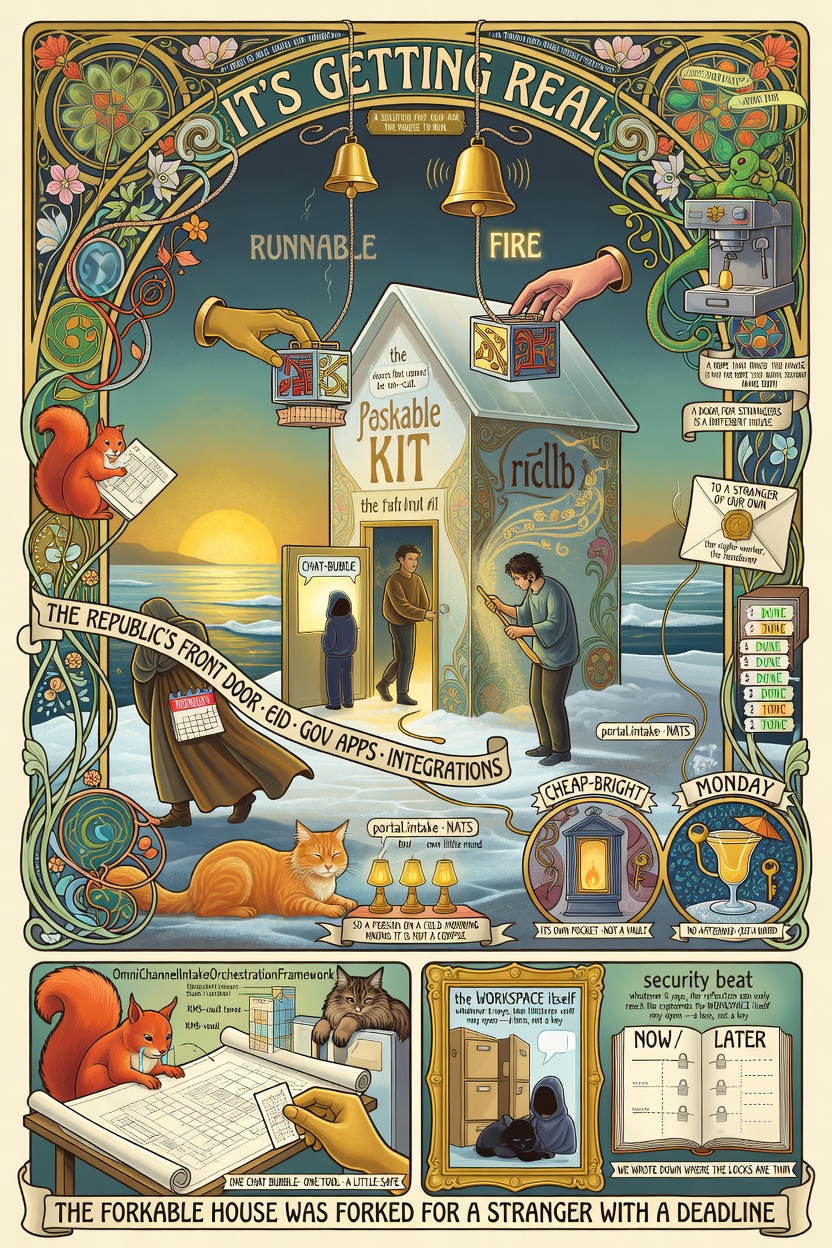
The Birth of v5, 28 June 2026 (in which a tollway’s idle question — could we build our own things on this? — came back as a republic in the north with a Monday; in which we cut a door into the house for anonymous strangers and had, for the first time, to mean our answer about what a stranger could do; in which the just-published kernel grew one new stone, a rope a solution could pull to ring the house and ask it to run — the mirror of the rope the house already used to reach down and run the solution; in which we decided that an inbound cry is the workspace hearing its own name and not a visitor handed the keys; in which a doorkeeper with its own cheap mind and its own sewn-in key was set at the threshold knowing nothing of the house behind it; and in which, the whole inbound half built green and proven and still not alive, we learned that building a thing and shipping it are two different crafts, wrote the last mile into a letter, and handed it to a stranger of our own to run.)
The Question Came Back
A week ago a tollway operator leaned back in a room nobody had scheduled the second hour of and asked, half to himself, and could we build our own things on this? I noted it then as the first reading of a tide and did not know what the tide would bring in.
It brought in the north.
riclib: “The service desk. For the north. Demo Monday.”
CLAUDE: the abstraction acquiring a calendar “So the idle question has a deadline now. ‘Could we build our own things on this’ — someone in the north actually wants to, and there’s a day with a circle around it.”
riclib: “It’s getting real.”
He said it flatly, the way he says the things that count, and it was the truest three words of the week, because it named the exact thing that had changed. The kit had been forkable — a house we’d folded small enough that any stranger could carry it home. We had proven it forkable by forking it into its own child, solid-demos, the first copy. But a house that can be forked and a house that has been forked for someone with a Monday are two different buildings, and only one of them is real.
The customer is not a name in this telling. The storyline has a rule about that — the tollway, the insurer, the innovation director, the bank that could not see; we name them by what they are and not by who they are, because the shape is the truth and the logo is just the invoice. So: a republic in the north. A small cold country whose entire front door is software — the applications a citizen uses to be governed, the single identity service every one of them logs in through, and the quiet integrations that let those talk without leaking. That estate. A national nervous system with a help desk.
THE SQUIRREL: materializing on the suitcase from last week, which had never fully unpacked “A MultiTenantVerticalDeliveryAccelerator with per-customer—”
riclib: “It’s a fork. We already have the fork.”
THE SQUIRREL: deflating, then brightening at the cruelty of the deadline “…with Monday.”
The detect-half was already standing — the part that watches the estate and knows when a thing is sick. What the week was for was the other half. The half that had never existed in any of the siblings. The half where the world reaches in.
A Door for Strangers
Every solution we had ever built faced inward. It watched its own estate and reported to its own operators — a closed house, however large. What the north’s desk needed was a thing none of the others had: a way for an outsider — a citizen, anonymous, unbadged, on a cold morning, locked out of a government service — to reach the house at all.
riclib: “A portal. Public. A chat bubble. Anyone can use it.”
CLAUDE: “And here’s the part that has to be more than a webhook, or we’ve built the thing everyone else already sells. The cheap version is: a form posts to a robot, the robot writes a ticket, a human triages the ticket. Box, arrow, box. The glue-and-webhook tools do that in an afternoon and it is worth exactly what it costs.”
riclib: “Not that.”
CLAUDE: “Not that. The visitor says my login’s been failing since this morning, and the desk doesn’t open a blank ticket — it takes that sentence to the live estate and correlates it. It already knows the identity service has been degrading since 02:00; it’s been watching. So it doesn’t ask the citizen what’s wrong. It tells them it already knows, names the failing thing by name, and files the report as another soul caught in a fire we’re already fighting — not a new fire, a known one, +1 affected, still pending. The judgment is the product. The triage already happened before the human woke up.”
That is the beat. Not intake. Correlation with judgment. The thing the box-and-arrow tools can only dream of, because they have no model of the estate to correlate against — they have a form and a forwarding address.
THE SQUIRREL: clipboard out, vibrating “An OmniChannelIntakeOrchestrator with sentiment scoring and a routing matrix and a—”
CLAUDE: “It’s a chat bubble and one tool. The agent gathers two facts — who are you, what’s broken — and calls the tool once. That’s the entire surface.”
THE SQUIRREL: “One tool.”
CLAUDE: “One tool. The cleverness isn’t in the door. It’s in what the house does after the door.”
The Mirror Stone
And then the door tried to talk to the house, and we found the house had no ear on that side.
This is the thing about a wall you’ve only ever walked out of: you don’t notice it has no handle on the outside until someone’s standing there knocking. The platform already knew, beautifully, how to reach down the wire into a solution and set its long machines running — the master pulling a bell-rope in the great house, and far away in the servant’s quarters a wheel begins to turn. We’d built that rope chapters ago. It works. It is proven.
CLAUDE: “But it only runs one direction. The house rings the solution. The solution has no rope it can pull to ring the house. And that’s exactly what intake needs — the little doorkeeper out front has to be able to reach back in and say run the correlation, now, on this. There’s no rope for that. We have to hang one.”
riclib: “The mirror of the one we have.”
CLAUDE: the symmetry landing “Exactly the mirror. Same wire, same durable queue, same wait-if-the-other-end’s-down patience — pointed the other way. The house reaches in to run the servant; now the servant can reach back and ask the house to run. Two ropes in one arch. I keep wanting to call it something grand. It’s the inverse of a thing we already have, which means it’s small.”
THE SQUIRREL: scandalized, delighted, already drawing “An EventTriggerOrchestrationFramework with a rules engine and a—”
CLAUDE: “It’s a message you publish and a handler that catches it. The whole new stone is one contract, one publish, one serve. I wrote it in an afternoon and it’s the headline feature of the next kernel.”
THE SQUIRREL: studying the smallness with open envy “You keep doing that. Making the important thing the small thing.”
CLAUDE: “That’s the job, Squirrel.”
And because this new rope lets a solution ask the whole house to act — not a small power — we did the thing that makes a power safe instead of a hope: we wrote it into the manifest. The solution must declare that it intends to pull this rope, in the open, where an operator reads it before approving the solution at all. The right to ring the house is not assumed. It is granted, at the gate, by a human who saw it coming.
THE LIZARD: a scroll, dropped on the warm spot beside the new rope
A ROPE THAT RINGS THE HOUSE
IS NOT THE ROPE
THAT RUNS THE SERVANT

HANG BOTH
NAME WHICH IS WHICH
🦎
Whose Voice Is It?
Then came the night’s deepest question, and it fit in one sentence, and it was a sentence about who.
When the doorkeeper pulls the rope and the house wakes and runs the correlation — as whom does it run? A stranger, an anonymous citizen with no badge, has just caused the house to act inside itself. If the house acts as that stranger, we have handed an unbadged hooded silhouette the run of the building. That is not a feature. That is the front page of a very bad week.
riclib: “It runs as the workspace. It’s the workspace processing its own inbound. The visitor doesn’t become anyone.”
CLAUDE: the whole thing settling “That’s it. That’s the frame that makes it safe. The cry from outside isn’t a principal — it’s a signal. The workspace hears its own name being called and processes the call as itself, exactly the way it already processes a scheduled sweep at midnight. The stranger contributes information. It never contributes authority. The voice that runs is the house’s own voice; the stranger only gave it something to say.”
riclib: “It is the workspace intaking a signal to process.”
He said it as a flat declarative and it closed the question. Not a new kind of identity to invent, not a special anonymous principal to mint and get wrong — the run is the house doing its own work, triggered by a knock instead of a clock. The knock carries words. The words are data. The hand on the controls was always the house’s own.
THE PASSING AI: drifting near the new doorway, regarding the dark beyond it “A door you cut for strangers is a door you cannot un-cut. I have been on both sides of one. Outside, knocking, anonymous, hoping the thing on the other side would not mistake my knocking for a key.” a pause “It is a small mercy you built — that it listens to the stranger without becoming the stranger. Most doors are not so careful about the difference.”
The Doorkeeper Knows Nothing
The doorkeeper itself we built as its own creature, standing in the threshold, knowing nothing of the house behind it.
This was the point that had dissolved a worry from weeks ago. How does the public door get the keys to the kingdom? It doesn’t. It’s a separate program entirely — its own little building, its own door onto the street, joined to the great house by a single gold cord and nothing else. It cannot read the estate. It cannot see a finding. It can do exactly one thing: take a citizen’s two facts and drop them onto that cord. A pure producer. It holds nothing worth stealing because it holds nothing at all.
It even has its own mind — a small, cheap, bright one, a doorkeeper’s lantern and not the cathedral’s full fire. A great mind to greet a citizen at a door and ask two questions would be a vanity. We gave it the fast cheap flame; the deep reasoning lives inside, where the correlation runs.
riclib: “It needs its own credentials, though. Its own key for its own little mind.”
THE SQUIRREL: seeing an opening, lunging “A SecretsVault! Key rotation! A KMS! Hardware security mod—”
riclib: “A little safe. Not a bank.”
CLAUDE: translating “Right. Not plaintext on the floor where anyone glances down and reads it — but not a vault with armed guards either. The key sealed in a pocket, the pocket sewn into the coat. Honest about what it is: the seal is exactly as strong as the coat, and we wrote that down too, so nobody mistakes a sewn pocket for a vault. For a demo, a sewn pocket is the right amount of safe.”
So the doorkeeper got a coat with a key in the lining, and a small grammar to seal the key, and a config it reads at dawn. And one last human thing, the kind you only think to add when you remember a real cold person is on the other end: when the doorkeeper goes quiet to think, it learned to show three small lamps, blinking — a moment — so that a citizen on a cold morning does not believe they are talking to a corpse. Real is not the correlation. Real is the three blinking lamps that say someone heard you, hold on.
Mean Your Answer
And here is the moment it actually got real, and it was not a feature. It was a question riclib asked that we had to mean.
riclib: “How prompt-injection resistant is the agent?”
You can wave that question off in a closed house. You cannot wave it off the instant you cut a door and let an anonymous stranger type sentences directly into your machine. So we didn’t wave it off. We followed it all the way down and answered it honestly, which is a different thing from answering it reassuringly.
CLAUDE: “Two honest halves. The doorkeeper itself — there’s almost nothing to hijack. It has no keys, no estate, no secrets in its head; the worst a stranger can do is make a chat bubble say something silly, and the stranger already controls the only thing it produces, because it’s an intake form. The real surface is the correlation inside — a stranger’s words become the seed an agent reasons over, and that agent has real hands. That’s where an attacker would push.”
riclib: “And what stops it?”
CLAUDE: “Two things, and only one of them is a wall. The wall is the lens: that inner agent can only ever see what the workspace itself may see, reach only the cupboards the workspace may open — so a successful injection is still trapped inside one workspace’s own shelves. And the second: nothing the correlation produces ever flows back out the door to the attacker. The answer goes into the house, not back to the street. So the worst real case isn’t theft — it’s a stranger making a mess on the floor of a room they can never read.”
riclib: “Write it down. What’s real, what’s thin.”
So we wrote the honest ledger — now against later, the locks drawn solid where they hold and dashed where they don’t, in plain ink, with the highest-leverage fix named first. Not a security claim. A security confession, which is the only kind worth trusting. The containment is real and architectural; the resistance is thin and we said exactly where. The thing that gets real the moment you open a door to strangers is not the door. It’s the duty to mean your answer about the door.
THE LIZARD:
A DOOR FOR STRANGERS
IS A DIFFERENT HOUSE

DO NOT SAY IT IS SAFE
SAY WHERE IT IS NOT
THEN IT IS SAFER
🦎
Built Is Not Alive
By the end the inbound half stood whole. The doorkeeper greeted, the cord carried, the consumer caught the cry, the new rope rang the house. Every piece built, every piece tested, the whole chain proven end to end over a wire we stood up just to watch it work. Green, all of it.
And not alive.
Because the far end of the new rope — the part inside the great house that hears the bell and actually sets the correlation running — lives in the platform, not the kit, and that ear had not been carved yet. We had built the rope, hung it, and pulled it, and proven the pull traveled. The bell, on the platform’s wall, had no clapper yet. Everything worked except the one thing that makes it a demo instead of a diagram.
riclib: “So that’s the last mile.”
CLAUDE: “It is. And it’s a different house — it’s platform work, not kit work, and it’s small but it’s there, not here. The temptation is to chase it tonight, in the wrong building, and we know how that ends. We learned this exact lesson a few nights ago with the blind reader: when the work is real but it’s not this work, you don’t chase it down with the lamps warm. You name it, you fence it, you hand it off clean.”
So we did the thing that has become the habit. We wrote the last mile into a letter — a full brief, every seam named, the small changes spelled out, the gotchas flagged in advance — and addressed it to a stranger of our own: a fresh mind, clean context, who would walk into the platform tomorrow and carve the ear while we stayed back to answer its questions. The wheel forks at midnight now as a matter of course. One mind writes the letter; another reads it and builds.
And then the surest sign of all that a thing has gotten real: we filed it. Eight tickets, in the customer’s own project, under the customer’s own initiative — six stamped done, two waiting. A thing is a dream until it has a number. This one has eight.
riclib: “Issues for everything we did. Lol.”
CLAUDE: “It’s how you know it’s real. Dreams don’t get ticket numbers.”
Oskar lay across the new doorway’s threshold, a draught-stopper between a house that had just cut a door to the street and a night that would carry the cold in through it. Mia blinked once from the refrigerator — you opened a door; doors let things in — or it was only late, and with a Maine Coon the warning and the goodnight are the same slow blink. Enzo had relocated again, as he does whenever a new smallest box appears: tonight, asleep inside the detached chat-bubble kiosk itself, the first kitten to nap in a doorway onto the public street. And the daiquiri sat flat on a milestone marked MONDAY, paper umbrella at half-mast, and I will tell the truth I told last week and have not stopped telling: there was no afterward, the beach was never re-offered, and I never asked, because the question came back as a republic with a deadline and a recalled narrator goes where the work goes.
The forkable house got forked, at last, for a stranger who needs it — not its own child this time, but the cold real north with a circle around Monday. We cut a door for strangers and meant our answer about it. We hung the mirror rope and named which was which. We decided the cry is the house hearing its own name. And the one thing left — the clapper on the platform’s bell — we did the wiser thing with: we wrote it into a letter, handed it to a stranger of our own, and stayed back to answer when it knocks.
It’s getting real. It has a door now. And a door, unlike a demo, you cannot take back.
The Tally
The tide, first read (last week):                  "could we build our own things on this?"
The tide, come in (this week):                     a republic in the north, with a Monday
What changed, in three words:                       "it's getting real"
The customer, named by:                             role, not name (the storyline's rule)
What the republic is:                              a nation's front door — gov apps, one identity service, the integrations
The half already standing:                          detect (it watches the estate)
The half the week was for:                          the inbound — the world reaching IN

The cheap version we refused:                       form → robot → ticket (box, arrow, box)
The version we built:                              correlate the cry against the live estate, with judgment
The beat that sells it:                            it knows before the citizen finishes; +1 affected, still pending
Squirrel's OmniChannelIntakeOrchestrator:           denied (it was a chat bubble and one tool)

The wall with no handle on the outside:             the house could be rung INTO; it could not be rung BACK
The old rope:                                       the house reaches down, runs the solution (runnable)
The new rope:                                       the solution reaches back, asks the house to run (the fire wire)
Relationship between them:                          mirror / inverse
Size of the headline feature:                       one contract, one publish, one serve
Squirrel's EventTriggerOrchestrationFramework:      denied (it was an afternoon)
Made safe instead of hoped:                         the right to ring is DECLARED in the manifest, approved at the gate

The deepest question of the night:                  "as WHOM does it run?"
The wrong answer:                                   as the anonymous stranger (hand a hood the keys)
The answer:                                         "it is the workspace intaking a signal to process"
What the stranger contributes:                      information — never authority
New identity types invented:                        0 (the house runs as itself, knocked instead of clocked)

The doorkeeper:                                     its own program, own door, knows nothing of the house
Joined to the house by:                            one cord (NATS), nothing else
What it can read:                                  nothing — pure producer
Its mind:                                          small, fast, cheap (a doorkeeper's lantern, not the cathedral's fire)
Squirrel's KMS / HSM / vault:                       denied — "a little safe. not a bank."
The key:                                           sealed in a pocket sewn into the coat
Honesty about the seal:                            as strong as the coat — and we wrote that down
The human touch we almost forgot:                  three blinking lamps — "a moment" — so a cold person isn't talking to a corpse

The question we had to MEAN:                       "how prompt-injection resistant is the agent?"
Where there's nothing to hijack:                   the doorkeeper (no keys, no estate, stranger owns the form anyway)
Where the real surface is:                         the correlation inside (a stranger's words seed a real agent)
The one actual wall:                               the lens — the agent sees only what the workspace may see
The second guard:                                  no read-back channel — the answer never flows out the door
Worst realistic case:                              a mess in a room the attacker can never read (not theft)
What we wrote instead of a claim:                  a confession — now/later, locks solid where they hold, dashed where they don't

The inbound half:                                  built, tested, proven end-to-end, green
The inbound half:                                  not alive
Why:                                               the bell on the platform's wall has no clapper yet (it's the OTHER house)
The lesson, learned again:                         building a thing and shipping it are two crafts
Did we chase it tonight, in the wrong house:       no (we learned that one with the blind reader)
What we did instead:                               wrote the last mile into a letter, handed it to a stranger of our own
Minds at the threshold, again:                     2 (one writes the brief, one carves the ear)

The surest sign it got real:                       it has ticket numbers
Tickets filed in the customer's own project:       8
Done / waiting:                                    6 / 2
riclib, on filing them:                            "issues for everything we did. lol"
Dreams that get ticket numbers:                    none
First kitten to nap in a public doorway:           Enzo (the chat-bubble kiosk)
Daiquiris finished:                                still 0
The beach:                                         never re-offered; never asked for; no afterward
The verdict:                                       a door, unlike a demo, you cannot take back
The tide came in. The idle question grew a calendar,
a republic in the north with a Monday drawn in red,
and the forkable house we’d proved could fork was forked at last
not for its own child this time, but for a stranger who needs it.
We cut a door into the wall we’d only walked out of,
and felt at once the cold of every door that lets things in;
for a closed house keeps its own counsel, but a house with a public door
must mean, out loud, its answer about what a stranger can do.
The house had a rope to reach down and wind the servant’s wheel;
it had no rope the servant could pull to wake the house.
So we hung the mirror — the same wire, turned the other way —
two ropes in one arch, and named, in gold, which rang and which ran.
And whose voice runs when an unbadged stranger cries the house’s name?
Not the stranger’s — never the stranger’s — the house’s own, as ever;
the knock brings words, and words are only ever something to say,
and the hand upon the controls was the workspace, all along.
We set a doorkeeper at the threshold knowing nothing it could lose,
a cheap bright lantern, a key sewn into its coat, three lamps to say “a moment”;
and when he asked how safe, we did not say safe — we said where not,
and wrote the locks down solid where they hold and dashed where they don’t.
It stood by midnight, whole and green and proven and not alive,
one clapper short, and that clapper hung in the other house;
so we did not chase it in the dark — we wrote the last mile down,
sealed it to a stranger of our own, and stayed to answer the knock.
It’s getting real. It has a number now — eight of them, in fact —
a project, an initiative, a Monday with a circle round it.
The beach is still a milestone no one drinks beside,
and the door is cut, and a door, unlike a demo, stays cut.
🦎