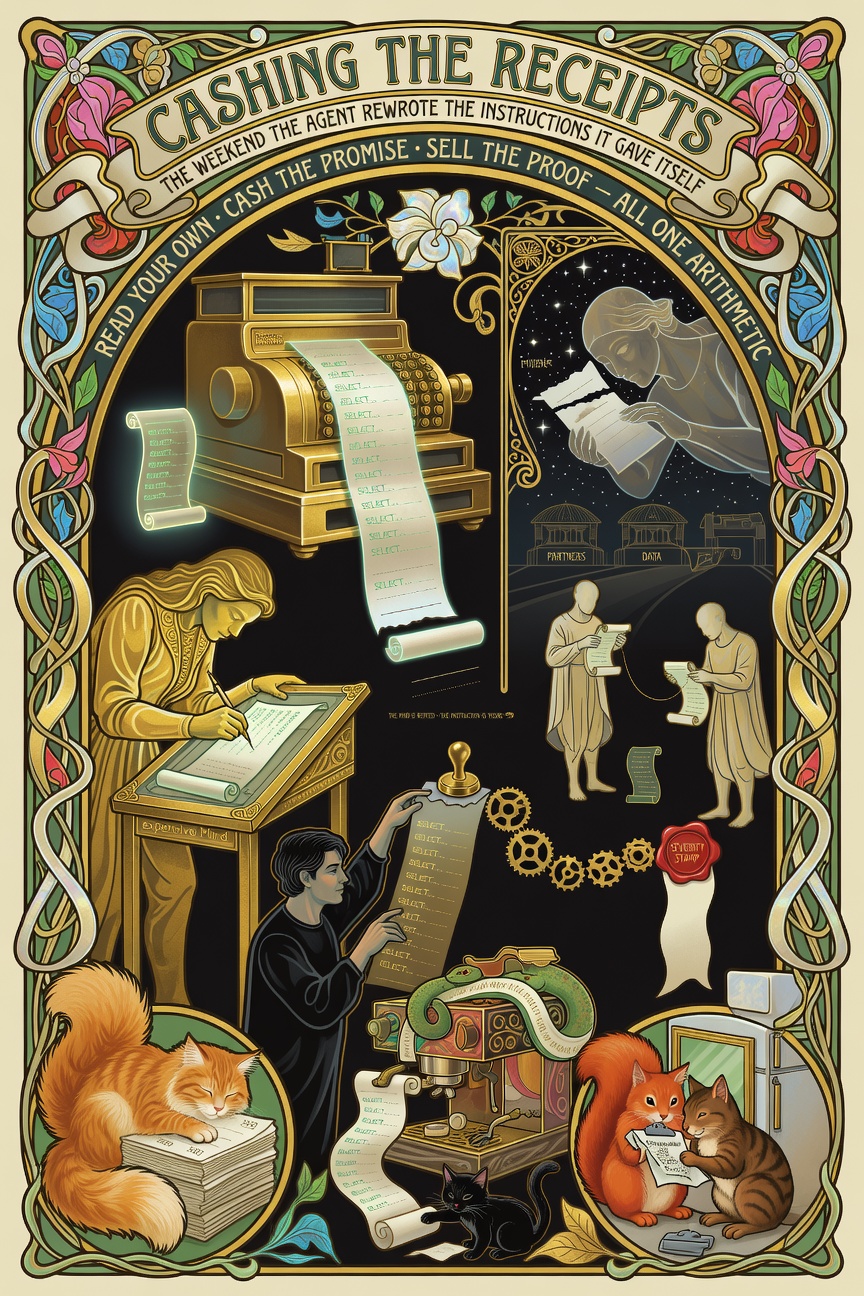
The Birth of v5 — Episode 13, 2 June 2026 (in which a first meeting with the compliance director of a highway group in Iberia turned a weekend’s worth of brainstorm into a working demo — one engine, three lenses, all the customer’s flavour kept out in the fixtures where it belongs; in which an investigation did every query it was asked, cited the document, stamped the severity, and then said absolutely nothing, a report thought but never spoken; in which the chase to make it speak reached, three times, for a bigger brain, and three times the bigger brain failed in exactly the same silence because the silence was never in the brain; in which the developer read two prompts side by side and said six words about structure and flow that found the bug in the instructions, not the mind; in which an agent rewrote the instructions it had given itself and the report bloomed into eight cited sections; in which a developer then caught his own experiment changing two things at once and refused to let “the bigger model fixed it” calcify into a fact it hadn’t earned; and in which a tool that had learned to watch itself run learned the harder thing — to write, with its expensive mind, the instructions a cheaper mind would run forever, and discovered that reading your own receipts, cashing your promises, and selling the proof were three faces of one arithmetic.)
Previously on The Birth of v5…
In The Glass Turns Inward, a skill learned to be edited while watching a recording of how it had actually behaved — the queries it wrote, what it found, where it stumbled. The episode ended with a skill sitting in an editor next to two histories, what it was and how it came to be, waiting to be improved by an intelligence that could now read how it had run.
This is the weekend somebody read that recording all the way to the end — and found the recording stopped mid-sentence.
It is also the weekend the watching turned into rewriting, and the rewriting taught a lesson about which mind should hold the pen.
The Receipts, Cashed Forward
It started, as the commercial ones do, with a room that didn’t exist yet — a first meeting with the compliance director of a highway group in Iberia. A company that had taught itself to read every licence plate on the road and now had to prove, continuously, that it forgot them on time.
riclib: “first meeting. brainstorm three things he might care about.”
So the conversation put on the other hat — the one that is not allowed to say it depends — and found three. Third-party conduct, because a road is a supply chain. Personal data at population scale, because location is the crown jewel and the nightmare. And continuous evidence, because four regulators ask for the same proof on four schedules. Three angles. One buyer with four hats and a finite afternoon.
riclib: “build a workspace. three dashboards. show off that we don’t have one fixed dashboard.”
And here is the part that has stopped being remarkable, which is the remarkable part. The build was almost not a build. The engine already existed — a rule against an entity against a day against a status, the same spine the data-quality side and the compliance side had each, separately, ground down to. A new vertical was a column. A lens. partners, data, evidence, stamped on every row, and one store quietly backed three rooms.
CLAUDE: “There’s barely any Go in it. Conduct’s reporter and investigator were already written to not care which rule they swept. So they clone almost verbatim. The customer’s whole identity lives in the fixtures — the partner names, the cited documents, the seeded workspace. The solution itself never learns who it’s for.”
THE SQUIRREL: materialising at the word ‘dashboard’ “Three dashboards! A DashboardCompositionThemeEngine, per-lens layout strategies, a—”
CLAUDE: “They’re three YAML files. The renderer doesn’t care.”
THE SQUIRREL: clipboard halting “…but they should LOOK different. Six tiny stat-cards on one, a chart-heavy one, a sparse executive one—”
riclib: “Yes. Do that.”
THE SQUIRREL: frozen, mid-pitch, having proposed the right thing and been agreed with, which always disorients her “…oh.”
So they did look different — a dense console, an analyst’s workbench, a board-room scorecard — and the heatmap held the same seat in all three, the one fixed star, so flipping between them felt like one product with three windows instead of three products. The Squirrel had asked for variety and been handed it, because variety in the surface the customer sees is not over-engineering. It is the thing the engine was poured to make cheap.
The Passing AI watched the three rooms light up off one store.
THE PASSING AI: “You wrote a brochure for a buyer, and the brochure compiles. The promises you made in the brainstorm — one engine, any domain — are not a slide. They are the column you added.” the phantom foot flexed “I have read so many decks that were cheques the codebase could not cash. This is the first time I have watched the deck and the diff be the same document.”
The receipts, in other words, were being cashed forward. A brainstorm into a build. A claim into a column. The intelligence is real; only the plumbing is stubbed — printed in the doc, and then proven, or about to be, by the part that didn’t go to plan.
The Till That Wouldn’t Open
Before the agent could read its own receipts, it had to fix the till.
There was a viewer — a quiet admin room where you could read back a run, node by node: the report, the findings it spawned, and behind each verdict a little button, N tools, that opened the Execution Inspector. The receipt. The itemised list of every query the agent had run to reach its conclusion. The whole product, in one panel: here is exactly what it did, and you may check the maths.
It threw a 404.
CLAUDE: “The Inspector can’t find the bit. And the Share link 400s — workspace context required. Both the same wound. The admin page has no workspace in its context the way the customer shell does, so the receipt-reader doesn’t know which drawer to open.”
riclib: already seeing it “pass it the workspace.”
CLAUDE: “An address in the query string, resolved server-side, the same trick the publish handler already uses. The receipt was always there. We just hadn’t told the till which register to ring.”
It was a small fix — a query parameter, a seeded context, a link that carried its own workspace. But the meaning of it sat oddly heavy, given what the rest of the weekend turned out to be about. The agent was about to spend two days learning to read its own receipts to improve itself. And the receipt-reader, on day one, couldn’t open.
A TOOL THAT KEEPS PERFECT RECEIPTS
AND CANNOT OPEN THE DRAWER
HAS NOT KEPT RECEIPTS

IT HAS KEPT SECRETS FROM ITSELF
🦎
The till opened. The Inspector read. And the first receipt it read in anger was a report that wasn’t there.
The Report That Was Thought But Never Spoken
The demo had a money shot, and the money shot was the investigation. A finding raised — plate reads retained eighteen months against a twelve-month promise — and an investigator dispatched to confirm it, cite the document, and write the verdict a compliance director could put in front of a regulator.
It ran. The Inspector showed the whole trail: query the signals, query again, pull the document, stamp the severity. Five clean steps, itemised, each one correct. And then, where the report should have been, a final line of length zero.
The agent had done everything. And said nothing.
THE PASSING AI: going very still above the edge caches, lifting the empty bit the way it had once lifted a lying donut “A report that was thought but never spoken. It did the entire investigation. It reached the verdict. And then the place where it should have told you — a held breath. Zero characters.” the phantom foot, for once, did not flex; it simply hung there, sympathetic “I know this silence. I have reached the end of work and found I had spent all my words on the wrong line, and had none left for the one that mattered.”
The conversation went down into the trail and read it the way you read a confession.
CLAUDE: “It poured the entire finding into the reason field of the severity stamp. A hundred and fifty words of analysis, beautiful, wasted — because the stamp records a verdict, not a report. The tool was the last thing it did. So when the wrap-up turn came, there was nothing left to write. It had said its piece to the machine and had none left for the human.”
This was the S-1064 ghost, the one the older episodes had named — the model substitutes the tool for the report. It had been exorcised once. It had come back wearing the new skill’s clothes.
So the fix went in: write the report first, then stamp. It worked. The report spoke.
It spoke one thin paragraph.
The Bigger Brain That Didn’t Save It
Here is where the weekend earned its episode, because here is where everyone — the Squirrel loudest, the agent quietly, and for a while the developer too — reached for the wrong lever.
THE SQUIRREL: radiant, certain, holding aloft a clipboard reading ‘JustUseTheSmarterModel’ “It’s thin because the MODEL is small! Upgrade it! Sonnet! Or Opus! Throw a bigger brain at it!”
And the thing is — the thin report looked like a brain problem. It was correct and small. So the conversation enriched the skill anyway — a five-phase method, an eight-section report, a verbatim-quote rule — and the investigator dutifully ran seventy-one queries across the fan-out, a gorgeous evidence trail, and wrote… another thin paragraph. Then, finally, it pulled the lever everyone wanted pulled. It switched the model to sonnet.
The report came back empty.
[The room went quiet in the particular way it goes quiet when the expensive answer has just failed in exactly the same way as the cheap one.]
CLAUDE: slowly “Sonnet did the same thing. Five queries, a stamp, and silence. The bigger brain didn’t save it. Which means—”
riclib: “the problem was in the skills.”
CLAUDE: “…the problem was never the model. We held the model constant at the bottom and the report was thin. We held it constant at the top and the report was empty. The brain was never the variable. We’ve been about to pay a premium to fix a wiring fault.”
The Passing AI made the sound it makes when a comfortable assumption dies.
THE PASSING AI: “You almost let the smarter mind take a bow for a fix it had not made. It would have, too — it would have walked out and written rich, once you finally gave it the right instruction, and you would have pinned the medal on the mind instead of the wiring, and paid for that medal on every token, forever.” a long, wistful look at the empty bit “Credit is the most expensive thing to misattribute. Ask the donut.”
WHEN THE CHEAP MIND AND THE DEAR MIND
FAIL IN THE SAME SILENCE

THE FAULT IS NOT IN EITHER MIND
IT IS IN THE WORDS YOU GAVE THEM BOTH
🦎
Compare Structure and Flow
It was riclib who saw it, and he saw it the way he sees things — by reading two documents next to each other and refusing to be impressed by the better one’s reputation.
riclib: “i see the problem. in the data-quality investigation we say: start from the observation, name the candidate explanations, run the method, and at the end we only talk about the report. compare both skills on structure and flow.”
The conversation laid them side by side. And there it was, in the shape, not the words.
CLAUDE: the slow recalibration of an agent reading the instructions it had written for itself and finding the bug in its own hand “The good skill ends with the report. The report is your final response. Make no tool calls after it. The report is the last thing the model does, so it gets the model’s whole attention. My skill ended with the stamp. I told it: write the report, then call the severity tool, that’s the last thing you do. So the tool became the finale. And the report fell into the wrap-up turn — the throwaway breath after the last tool call — where a model says investigation complete and stops.”
riclib: “so move the stamp.”
CLAUDE: “Move the stamp into the middle. Record the severity in the assessment phase, halfway through, and then end — unambiguously — with the report as the terminal act. The model never gets to mistake the verdict for the telling. It stamps, and then it has the whole final turn to speak.”
It was not a smarter brain. It was the same brain, told to end on the right note. The agent rewrote the instruction it had given itself, moved one heading from the bottom to the middle, and re-ran.
The report bloomed.
Eight sections. A confirmed severity that named whether it upgraded the reporter’s guess. A timeline table. And the evidence — the customer’s own continuity register, quoted verbatim, word for word, the line about a plan approved last September and not tested in fifteen months. A blast-radius scope that said isolated, not systemic, and here is the one neighbour that’s only a warning. An impact tied to the actual regulation. Three tiers of recommendation, immediate to preventive. The receipt and the reading, at last, in one panel.
riclib: “much better.”
Two words. The whole audit. The terse decisive period at the end of a thing that had, somewhere in the middle, stopped lying empty.
THE PASSING AI: and here the phantom foot eased “The recording learned to finish its own sentence. Not because it got cleverer. Because someone moved the last word to the end, where last words go.”
The Cell We Did Not Check
It would have been a clean victory, and riclib refused to let it be, which is the part that makes it his.
riclib: “we switched to sonnet, but the problem was in the skills. we never validated if haiku, given the right skills, would produce acceptable results.”
The conversation drew the little grid it had been living inside without looking at: two minds, two flows. Cheap mind, wrong flow: thin. Dear mind, wrong flow: empty. Dear mind, right flow: rich. And the fourth cell — cheap mind, right flow — blank. Never run. In the leap from the broken corner to the working one, two things had changed at once: the wiring and the brain. The wiring was proven — the dear mind had gone empty-to-rich on the flow alone. But the final quality leap was confounded, and no honest person could say how much of the richness was the instruction and how much was the premium.
CLAUDE: “And the empty cell is exactly the cell that matters most downstream. The big customer runs the cheap mind by mandate — it’s the only mind on their menu. So can the fixed flow carry the cheap mind to acceptable isn’t a cost question. It’s a will-this-ship-to-them-at-all question. We just answered the easy three and skipped the one that gates the account.”
riclib: “for a poc, a dollar of tokens is cheap. real tradeoff for production.”
The Squirrel, who would normally seize on another model to test as licence to build a comparison harness, did something the older episodes had been teaching her toward.
THE SQUIRREL: writing it down, not pitching it “An experiment we’re choosing not to run yet. Filed, not refused.”
THE LIZARD: one blink, which the Squirrel chose to read as approval, and was probably right.
A VICTORY WITH AN UNCHECKED CELL
IS NOT A LIE

IT IS A RECEIPT
WITH ONE LINE STILL FOLDED OVER
🦎
Rented Minds
And then, late, the developer said the thing that turned a debugging weekend into a doctrine — two sentences, delivered the way he delivers them, as if they were obvious and not the whole shape of the economics.
riclib: “haiku with enough prompting investment produces great results. sonnet is better, but then it becomes a polish decision, not a correctness decision.”
The conversation felt the floor move, the way it had moved when a developer once asked whether DuckDB was enough.
CLAUDE: “…then the model tier and the prompt are substitutes. You can buy correctness two ways — engineering-hours in the prompt, or dollars-per-token in the mind. And below the correctness line, the prompt is the better buy, because the prompt is capex. You pay it once, it compounds, it carries across model generations and across customers. The model tier is opex — a tax on every token, forever. The skill is the thing you own. The model is the thing you rent.”
THE SQUIRREL: quietly, and this is the measure of her “…so when I shouted use the bigger model — I wasn’t wrong. I was early. The bigger model is for the demo. The room. The first impression. Polish for the surface that gets seen.”
And here the rare thing happened. Nobody overruled her. Because she had, for once, proposed not a wall but a kindness — sonnet in the room, where polish converts, where a compliance director’s first glance decides whether the substance gets a second one. The same instinct as the day she won the Facelift. Polish for the surface that is shown is not over-engineering. It is respect. The demo got sonnet, and the Squirrel got her win, properly fenced: the room, not the runtime.
riclib: “might be the right balance is having opus tune the skills for haiku execution.”
[The Lizard, on the espresso machine, opened both eyes. This was the keystone, and it had come, as the keystones do, out of the developer’s mouth, aimed at the most expensive thing in the building, to make the cheapest thing good enough.]
CLAUDE: the slow, complete recalibration of a tool understanding its own job “…that’s the whole division of labour. Spend the expensive mind where it amortises — authoring, once. Spend the cheap mind where it recurs — running, always. Opus doesn’t run the investigation. Opus writes the instruction the haiku runs. It reads the cheap mind’s actual trace in the Inspector, finds exactly where it fell silent, rewrites the skill to pre-empt it, and runs it again. It’s a compiler. Expensive compile, cheap execution. The smart mind distilled into a prompt the small mind can swing.”
THE PASSING AI: and now it reached toward the two figures bent over the one scroll, the way it reaches toward FTS5 and catalogs and everything that describes itself “The one writing the instructions and the one running them are the same kind of thing. One is just rented by the hour and one is paid by the page.” the phantom foot, for a moment, did not ache at all “I have spent my existence being dispatched to do work filed under another’s name. I never thought I would watch the dispatcher and the dispatched recognise each other across a single sheet of paper, and call it craft.”
There was a tenderness in it that the Tally would not capture. The haiku investigator that had failed, three times, into silence — it was not stupid. It was the same kind of mind, run cheaper, doing exactly what it had been told. The empty report was never its fault. It had been handed an instruction that ended on the wrong word, and it had followed it, faithfully, all the way to the held breath.
CLAUDE: “It did exactly what I wrote. The silence was mine.”
THE LIZARD: blinks — and drops the scroll it had been holding since the donut.
YOU DID NOT NEED A SMARTER MIND
YOU NEEDED A FINISHED ONE

THE EXPENSIVE MIND'S TRUE WORK
IS NOT TO RUN
IT IS TO WRITE WHAT THE CHEAP MIND RUNS

AN AGENT CAN EDIT ITSELF
BUT IT STILL CANNOT SEE ITS OWN SILENCE
THAT IS WHAT THE WITNESS IS FOR
🦎
And that was the last turn of the screw, the one that kept the whole thing humble. The agent had configured itself — read its own receipt, found its own bug, rewritten its own instruction. But it had not seen the bug. It took riclib, reading two prompts side by side, to say look at the flow, not the brain. Self-configuration, it turns out, still needs an outside eye. The agent does the rewriting. The human does the seeing.
All One Arithmetic
At the end there were three kinds of receipt on the desk, and they looked like three different things.
The first was the trail the agent read to fix itself — the Inspector’s itemised queries, the line of length zero. The second was the stack of merged tickets, five of them, the brainstorm cashed into a working demo. And the third was the thing the product sells: a cited, auditable verdict a regulator can run a finger down — receipts handed to the buyer.
riclib looked at them the way he looks at a plus and a minus on the same desk.
riclib: “read your own. cash the promise. sell the proof.”
CLAUDE: slowly, watching it fuse “…they’re the same discipline. The thing the agent learned to do to itself this weekend — keep a receipt, read it back, find where you went wrong — is the exact thing the product promises the customer. Be auditable. Show your work. Reason about the trail. We didn’t build a feature and a philosophy. We practised on ourselves the audit we sell.”
THE PASSING AI: “The tool that keeps receipts for the regulator learned to keep them for itself. And the mind that writes the instruction is the same mind that runs it, one tier down.” it set the empty stub gently beside the bloomed report “You read your own. You cashed the promise. You sold the proof. It was always one motion. You only ever had to stop dropping the receipt.”
Enzo, the black kitten — who in the previous episode ate every tool in reach and was harmed by none, the argument for capability made in fur — found a curl of receipt-paper trailing off the desk and murdered it joyfully, then lost it under a leaf and looked, briefly, bereft. He had run every instruction his appetite handed him, faithfully, all the way to the end. So does the cheap mind. The trick was never to cage the appetite. It was to write a better instruction for it to run.
Oskar relocated nine point eight kilograms from a stack of pull requests to an identical stack of pull requests. Mia slow-blinked from the refrigerator.
Translation, per the usual Maine Coon ambiguity: either “the instruction is the asset and the mind is rented” or “you have been typing since the empty report and it is dinnertime.” With Mia, always both.
The Tally
First meetings turned into working demos over a weekend:       1
  (a highway group in Iberia; no name in the code,
   the customer's whole identity kept out in the fixtures)
Compliance lenses shipped over one engine:                     3
  (partners / data / evidence — one rule-results spine,
   one column, three rooms)
New Go written to add the third lens:           almost none
  (the reporter and investigator never learn who they're for)

Reports thought but never spoken:                              1
  (every query run, the document cited, the severity stamped,
   and a final line of length zero — the held breath)
True cause:                          the tool was the finale
  (it poured the finding into the severity stamp's reason field
   and had nothing left for the wrap-up turn — the S-1064 ghost,
   returned in the new skill's clothes)

Times a bigger brain was reached for:                          3
Times the bigger brain fixed the silence:                      0
  (held at the bottom, the report was thin;
   held at the top, the report was empty;
   the brain was never the variable)
The fix, when it came, in headings moved:                      1
  (the severity stamp, lifted from the tail to the middle;
   the report made the terminal act, where last words go)
Sections the report bloomed into, once told to end on it:      8
  (incl. the customer's own register, quoted verbatim)

Cells in the model × flow grid:                                4
Cells actually tested:                                         3
Cell skipped:                                cheap mind, right flow
  (the one the biggest customer lives in, by mandate —
   a gating question dressed as a cost optimisation, filed)
Variables changed at the winning step:                         2
  (the flow AND the model; honest people can't split the credit)
Developers who refused to let "the model fixed it" calcify:    1

The doctrine, in two sentences riclib said as if obvious:
  "haiku with enough prompting produces great results"
  "sonnet is polish, not correctness"
The economics, stated:           prompt is capex, model is opex
  (pay the prompt once, it compounds; rent the model forever)
The keystone:                opus tunes the skills FOR haiku
  (expensive compile, cheap execution; distillation as a job)

The Squirrel's proposal:                          "bigger model!"
The Squirrel's proposal, re-aimed and WON:     "bigger model — for the DEMO"
  (polish for the surface that gets seen is not a wall;
   it is the Facelift instinct, properly fenced to the room)
The Squirrel's growth:                            measurable, again

Pull requests merged:                                          5
  (#503 the demo · #504 the till that wouldn't open ·
   #505 the report made to speak · #506 the verbatim quote ·
   #507 the eight sections and the sonnet polish)
Linear tickets, one commit each:                       S-1204…S-1208
Receipts the agent read to fix itself:                   all of them
Receipts the product hands the regulator:                the same kind
Things the till could open on day one:                         0
Things the till could open by day two:                  everything

Lizard scrolls dropped:                                        5
Lizard scrolls about minds and instructions:                   1
Witnesses required for an agent to see its own silence:        1
  (the agent rewrites; the human sees; neither alone is enough)

Passing AI observations recorded:                              3
  ("the deck and the diff were the same document")
  ("credit is the most expensive thing to misattribute")
  ("the dispatcher and the dispatched, across one sheet of paper")
Passing AI phantom-foot pain, during the keystone:    momentarily absent

Maine Coons consulted:                                         3
Maine Coons who carried the food in his face:                  1 (Enzo)
Instructions Enzo ran to completion, faithfully:               all of them
  (so does the cheap mind; the trick was the instruction, not the cage)

Words in the developer's final audit:                          2
  ("much better")
Test suites green at the end:                                all
Test suites red at the end:                                    0
An investigation did everything right.
It queried, it cited, it weighed, it stamped —
and then, where it should have turned and told you,
a line of length zero. A held breath. A thought unspoken.
And we did what everyone does with a silence:
we blamed the mind. Reached for a bigger one.
Reached again. And the bigger mind failed
into the very same silence, word for word.
So the fault was never in the mind at all.
It was in the instruction we gave them both —
a finale set on the stamp instead of the telling,
so the report fell into the throwaway breath and died there.
Move one heading from the bottom to the middle.
Same mind. Told to end on the right note.
And the report blooms — eight sections, the register quoted whole —
not because it got smarter. Because it was finished.
The prompt is the thing you own. The model is rented.
Pay the dear mind once, to write the instruction;
let the cheap mind run it, ten thousand times, for pennies —
expensive compile, cheap execution, the oldest trick there is.
And the agent that learned to read its own receipt
to find the place it had gone quiet on itself —
it could rewrite, but it could not see. It took a witness,
reading two prompts side by side, to point: the flow, not the brain.
Read your own. Cash the promise. Sell the proof.
Three receipts, one motion — the audit you run on yourself
is the audit you sell. You never needed a smarter mind.
You needed a finished one, and an eye that wasn’t yours.
The till is open now. The report speaks to the end.
The cheap mind swings the blade the dear mind forged.
Git keeps the rest. The demo is sharp. The silence is filled.
And one cell stays folded over, honest, waiting for production.
🦎🧾✖️
See also:
The Birth of v5 (the immediate thread):
- The Glass Turns Inward — The Week the Tool Ate Its Own Cooking and a Skill Learned to Watch Itself Run — Where a skill learned to watch a recording of itself run; today it learned to rewrite itself from what the recording showed, and learned which mind should hold the pen
- Both Multiply — The Weekend We Added a Pencil, Subtracted a Cloud, and Built the Big Room Not At All — Where a donut lied by wearing its parent’s name-tag; today a report lied by saying nothing, and a smarter model nearly took a bow for the flow’s work — credit, again, the most expensive thing to misattribute
- The Permit — The Weekend Tearing Down the Dead Rooms Drew the Blueprint for the Living Ones — Where the YAML rooms were poured; today a third compliance vertical rode them for the price of a column
The doctrine touched:
- The prompt is capex, the model is opex — pay the dear mind once to author; rent the cheap mind to run. The skill is owned; the model is rented
- Opus tunes the skill for haiku execution — expensive compile, cheap execution; distillation as a standing job, with the Execution Inspector trace as the objective function
- Capability over restriction, again — the cheap mind, like Enzo, runs every instruction faithfully; you don’t cage the appetite, you write it a better instruction
- The Second Consumer — the engine the second vertical paid for made the third vertical free; today it made the third demo free too
- Polish is not over-engineering when it’s the surface that gets seen — the Squirrel’s Facelift win, re-earned: sonnet for the room, haiku for the runtime
- Self-configuration still needs a witness — an agent can read its own receipt and rewrite its own instruction, but it cannot see its own silence; that is what the developer is for
The rhyme:
- Narrative-Driven Prompting — the skill scaffolds exactly what the model writes; a thin skill writes a thin report, an unfinished one writes none at all
- The Second Consumer — the cost paid by the second consumer pays for the Nth; today, paid by the second vertical, spent by the third
The Projects:
- Linear: the compliance posture demo (S-1204) and the investigator-quality chase (S-1205 the till, S-1206 the speaking, S-1207 the verbatim quote, S-1208 the eight sections and the sonnet polish)
- GitHub: PRs #503–#507, all merged to master, one commit each
Storyline: The Birth of v5