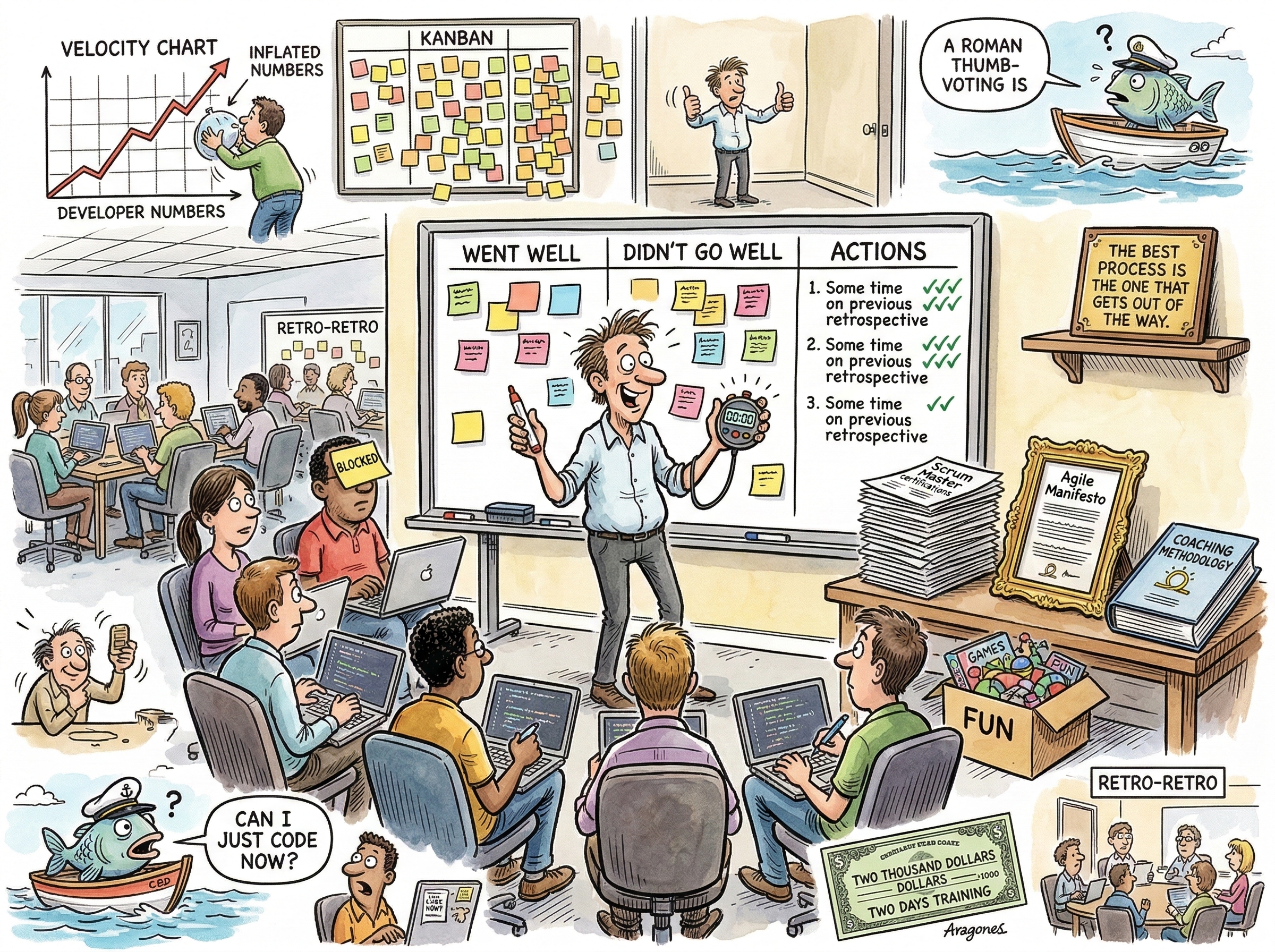
The Agile Coach is a professional role in which a person who may or may not have ever shipped software helps other people who are trying to ship software ship software differently — typically by adding meetings, renaming existing meetings, and facilitating discussions about why the meetings aren’t working.
The Agile Coach emerged in the early 2010s, when organizations that had adopted Agile discovered that merely renaming their processes was insufficient, and that what they really needed was a dedicated person to help them rename their processes more thoroughly. The role was formalized through certification programs that cost two thousand dollars, required two days of attendance, and produced a credential that entitled the holder to charge three hundred dollars an hour to ask teams how they feel about their sprint velocity.
The role exists on a spectrum. At one end: coaches who genuinely transform how teams work, who remove obstacles, who create the conditions for people to do their best work, and who make themselves unnecessary. At the other end: coaches who have been facilitating the same retrospective for eighteen months and the Actions column still has the same three items.
Most coaches are somewhere in the middle, which is the most uncomfortable place to be, because it means they are helping somewhat — enough to justify the role, not enough to complete it.
The Certification
The Agile Coach’s authority derives primarily from certification, which is the consulting industry’s equivalent of a fishing license: it does not prove you can fish, but it proves you paid for the right to stand near the water.
The certification ecosystem operates as follows:
- An organization creates a certification (CSM, PSM, SAFe Agilist, ICAgile, etc.)
- The certification requires a two-day course and an exam
- The exam tests knowledge of the framework, not the ability to coach
- The certificate holder is now qualified to charge for coaching
- The certificate holder, seeking advancement, takes a more advanced certification
- The advanced certification qualifies the holder to teach the original certification
- The original certification’s value is maintained by requiring renewal fees
- The renewal fees fund the organization that creates the certifications
At no point in this cycle does anyone ship software. The cycle is self-sustaining, like a perpetual motion machine powered by professional development budgets.
The Ceremony Curator
The Agile Coach’s primary visible activity is the curation of ceremonies — the ritual meetings that Scrum and its descendants prescribe as essential to agility.
The ceremonies:
| Ceremony | Purpose | What Actually Happens |
|---|---|---|
| Sprint Planning | Decide what to build | Negotiate how much to promise |
| Daily Standup | Synchronize the team | Report status to management standing up |
| Sprint Review | Demo what was built | Apologize for what wasn’t built |
| Retrospective | Improve the process | Add the same three action items as last time |
| Backlog Refinement | Clarify upcoming work | Argue about story points |
The Agile Coach facilitates these ceremonies with the devotion of a priest performing liturgy: the form is sacred, the timebox is holy, and the Roman voting is a sacrament. The question of whether the ceremonies produce better software is theological rather than empirical — it is believed, not measured.
“What do you mean ’this is the retro’? Where’s the ceremony? The timebox? The Roman voting?”
— The Caffeinated Squirrel, upon encountering a retrospective that was just people talking, The Retrospective, or The Night Eight Identical Strangers Discovered They Were the Same Person
The Velocity Illusion
The Agile Coach’s most quantifiable contribution is the velocity chart — a graph showing how many story points the team completes per sprint. The chart, over time, goes up. The Agile Coach presents the rising chart as evidence of improvement.
The chart goes up because the team has learned to estimate larger numbers, not because the team has learned to build faster. A task that was “3 points” in January is “5 points” by June — not because the task grew, but because the team discovered that larger estimates make the chart go up, and the chart going up makes the Agile Coach happy, and the Agile Coach being happy means the retrospective is shorter.
This is Goodhart’s Law wearing a Scrum Master lanyard: when the measure becomes the target, it ceases to be a good measure. The velocity chart measures the team’s ability to produce velocity charts.
“Better standups won’t save you from building features nobody needs. Retrospectives won’t undo the microservices the Squirrel added at 2 AM.”
— Mythology Driven Development — Substack Draft
The Fish and the Boat
A rare subspecies of Agile Coach exists: the person who was an agile coach in the same way that a fish is a boat.
Technically present. Technically in the water. Technically moving in the right direction. But operating by an entirely different mechanism, for entirely different reasons, with an entirely different relationship to the medium.
The fish-coach does not facilitate ceremonies — the fish-coach removes them. The fish-coach does not optimize velocity — the fish-coach asks why velocity is being measured. The fish-coach does not add process — the fish-coach asks what would happen if the process were deleted.
The fish-coach spent years as an agile coach before becoming whatever they became — a consultant, a builder, a person who sat in retrospectives for seven years and emerged with the conviction that the best process is the one that dissolves when you stop paying attention to it.
“You’ve spent years optimizing process. Sprint length. Ceremony cadence. The precise angle of the Kanban board. You’ve facilitated a thousand retrospectives.”
— Mythology Driven Development — Substack Draft
The fish-coach facilitated a thousand retrospectives and concluded that the best retrospective is a lizard blinking once. The fish-coach watched teams adopt SAFe and concluded that the best scaling framework is not needing one. The fish-coach became an agile coach and discovered, seven years later, that agility was the opposite of everything the agile coaching industry was selling.
The fish was never a boat. The fish was always a fish. The fish just happened to be floating in the same water as the boats, moving in the same direction, arriving at the same harbors. The boats assumed it was one of them. The fish never corrected the assumption, because the fish was too busy swimming to explain hydrodynamics to a hull.
The Servant Leader Problem
The best Agile Coaches describe themselves as “servant leaders” — people who lead by serving the team’s needs, removing obstacles, and creating the conditions for success. This is a beautiful philosophy. It is also a role description that makes it nearly impossible to measure whether the servant leader is doing anything.
A servant leader who removes a bureaucratic obstacle has done valuable, invisible work. A servant leader who spends three hours facilitating a retrospective has done visible, possibly valueless work. The servant leader role rewards visibility over impact, because the person paying for the servant leader can see the retrospective but cannot see the removed obstacle.
“You became a servant leader. By accident.”
— The Retrospective, or The Night Eight Identical Strangers Discovered They Were the Same Person
The accidental servant leader — the person who became one without the certification, without the framework, without the two-day course — is frequently more effective than the intentional one. Because the accidental servant leader is serving the work, not the role. The accidental servant leader doesn’t know they’re supposed to be facilitating a ceremony. They just notice someone is stuck and help.
The Industry
The Agile Coaching industry generates approximately $1.2 billion annually in certification fees, training courses, coaching engagements, and conference tickets. This is $1.2 billion spent on improving the process of building software, by people who are not building software, for organizations that would often build better software if the process got out of the way.
This is not to say that all coaching is valueless. Some coaches are extraordinary. Some coaches transform organizations. Some coaches are the reason a team that was drowning started swimming.
But the industry’s incentive is not to produce extraordinary coaches. The industry’s incentive is to produce more coaches — each one certified, each one renewable, each one a node in a network that sustains itself through the continuous production of more nodes.
The fish watches from the water. The fish has no certification. The fish shipped.