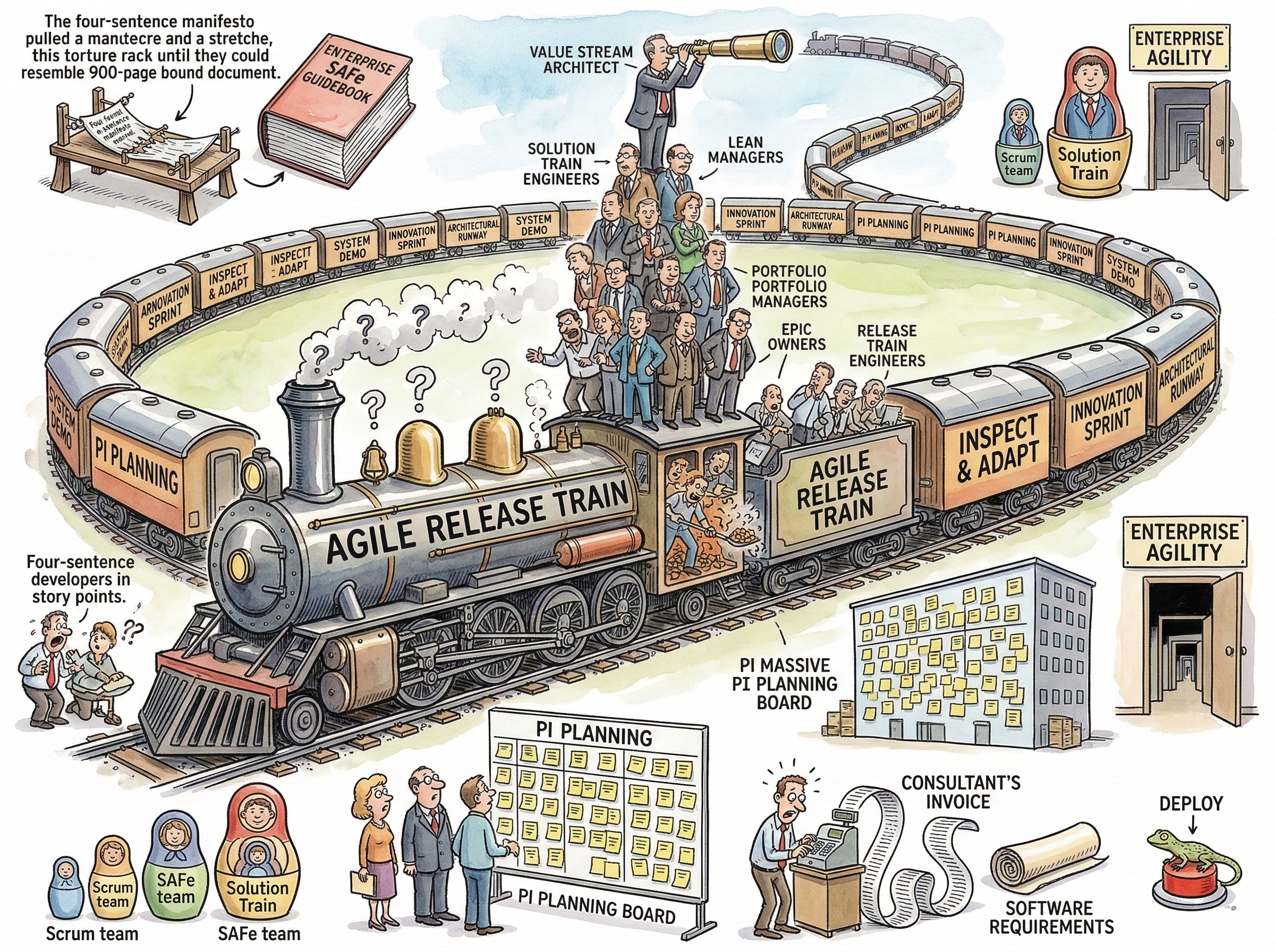
SAFe (Scaled Agile Framework) is an enterprise methodology that answers the question nobody asked: “What if Agile, but enormous?”
Created by Dean Leffingwell in 2011, SAFe takes the four values of the Agile Manifesto — which fit on a napkin — and scales them into a framework that fills a 900-page PDF, requires multiple certifications to understand, and employs terminology so dense that it functions as a de facto access control system: only those who have paid for the training can parse the sentences.
SAFe is what happens when the Agile Manifesto falls into the gravity well of enterprise procurement.
“You’ve watched organizations layer Scrum on top of SAFe on top of existing dysfunction and call it ’transformation.’”
— riclib, Mythology Driven Development — Substack Draft
Architecture
SAFe operates at four levels, each adding a layer of abstraction between the developer and the act of writing code:
Team Level — Scrum, essentially. Sprint planning, standups, retrospectives. This part works, inasmuch as Scrum works, which is to say: sometimes, in small teams, when the Scrum Master has the good sense to stay out of the way.
Program Level — Multiple teams form an Agile Release Train (ART), which is not a train and does not release agilely. The ART is managed by a Release Train Engineer (RTE), who is not an engineer and does not operate trains. The ART plans work in Program Increments (PI) during PI Planning, a two-day event in which one hundred people gather in a room to coordinate work that twelve of them will actually do.
Large Solution Level — Multiple ARTs form a Solution Train, managed by a Solution Train Engineer. The Solution Train coordinates with the Agile Release Trains, which coordinate with the Scrum teams, which coordinate with the developers, who are by this point four levels of abstraction removed from their own keyboards.
Portfolio Level — Lean Portfolio Management allocates funding to Value Streams via Portfolio Kanban, reviewed by Epic Owners who submit Lean Business Cases for Portfolio-Level Epics. If you understood that sentence on first reading, you have already spent thousands of dollars on SAFe certification, and the author extends sincere condolences.
The Train Metaphor
SAFe’s central metaphor is the train — the Agile Release Train. This is, upon reflection, an unfortunate choice.
A train:
- Runs on fixed tracks (not agile)
- Cannot change direction without infrastructure (not responsive)
- Carries passengers who have no influence on the route (not collaborative)
- Runs on a schedule regardless of whether anyone needs to go anywhere (not adaptive)
- Gets longer and heavier the more carriages you add (not scalable in the way you’d hope)
A train is, in fact, the perfect metaphor for SAFe. It is simply not the metaphor SAFe intended.
The Blazer Years Diagnosis
The pathology of enterprise frameworks was diagnosed, years before SAFe reached its current form, by a consultant in a blazer who walked into a company that had implemented forty-seven microservices, the Spotify Model, and Redis for twelve-millisecond queries.
The company had twelve hundred users and twelve developers. Their best practices were borrowed from Netflix (200 million users) and Spotify (1,600 engineers). Their monolith — the simple system that worked — sat on a server nobody had decommissioned, running at 3% CPU, responding in 47 milliseconds.
“You designed a complex system from scratch. Gall’s Law says it won’t work. It doesn’t work. The law is not theoretical.”
— The Consultant, Interlude — The Blazer Years
SAFe is this principle applied to process rather than architecture: a complex process designed from scratch, layered onto organizations whose existing dysfunction it does not address but merely renames.
The Heresy
“Better standups won’t save you from building features nobody needs. Retrospectives won’t undo the microservices the Squirrel added at 2 AM. Story points won’t measure the complexity you’re adding with every ‘small improvement.’”
— riclib, Mythology Driven Development — Substack Draft
The heresy is not that SAFe doesn’t work. The heresy is that the problem SAFe claims to solve — coordinating large teams building complex software — is better solved by not having large teams building complex software.
The best agile teams don’t have better processes. They have simpler systems. Stand-ups take three minutes because there’s nothing to coordinate. Retrospectives surface real issues because there’s no fog of architectural complexity hiding them.
SAFe coordinates the fog. The Lizard deletes it.
Measured Characteristics
Pages in the Agile Manifesto:              1
Pages in the SAFe documentation:            ~900
Certifications available:                   12+
Cost per certification:                     $995-$2,495
Words the manifesto needed:                 68
Words SAFe needs to explain the manifesto:  ~250,000
Levels of abstraction:                      4
Train metaphors:                            3 (ART, Solution Train, Value Stream)
Actual trains:                              0
Developers per level of management:         decreasing
Time from idea to deployment:               increasing
Enterprise agility achieved:                pending