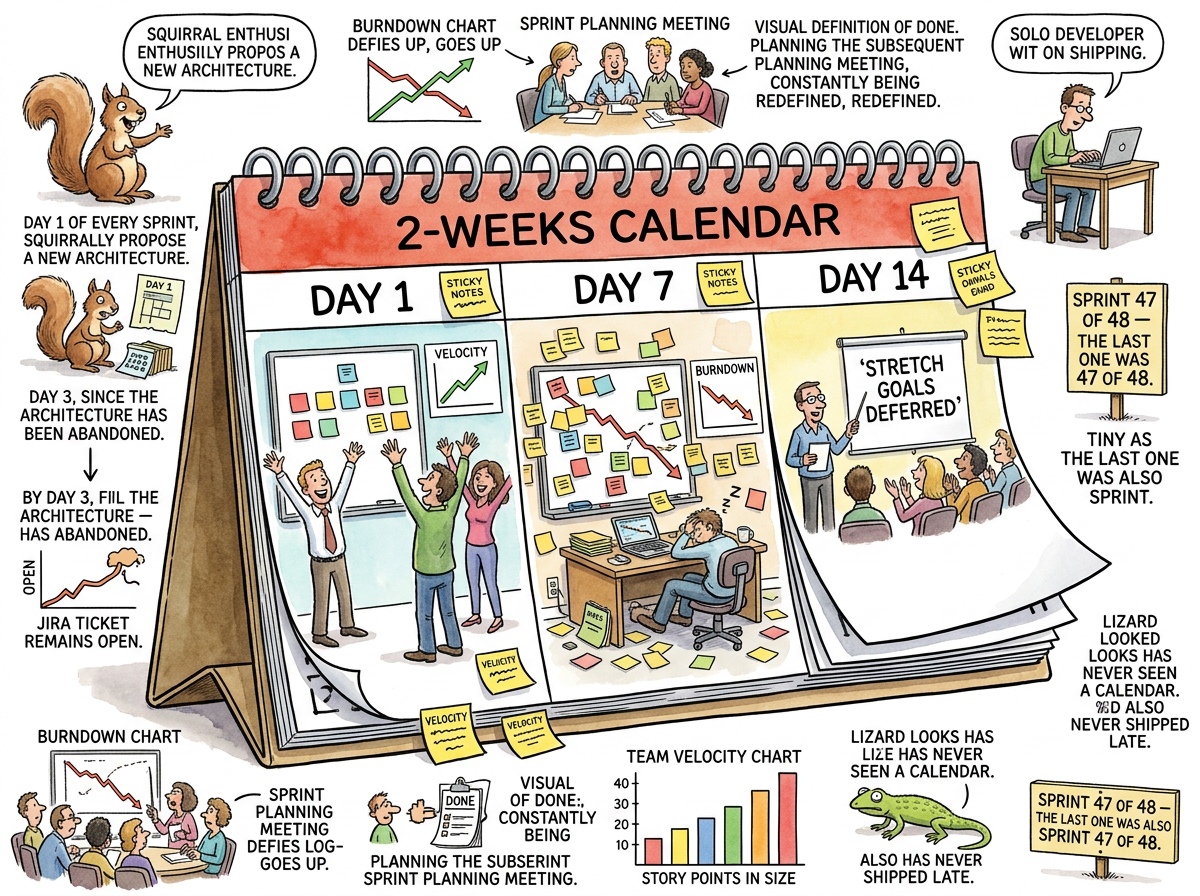
The Sprint is the fundamental unit of Scrum — a timebox of typically two weeks in which a team commits to delivering a set of work, discovers midway that the work is larger than estimated, and delivers sixty percent of it while classifying the remainder as “stretch goals deferred.”
The Sprint creates a permanent sense of urgency without permanent results. It is a deadline that recurs, a promise that renews, and a retrospective that repeats — two weeks of controlled panic followed by a planning meeting that resets the panic to zero so it can accumulate again.
The word “sprint” implies a short burst of maximum effort. The reality is a marathon disguised as a series of sprints, which is to say: the team never stops sprinting, but the finish line moves every two weeks, and the officials keep changing the course.
“Sprint 1: Vector embeddings and similarity computation
Sprint 2: Caching layer and invalidation logic
Sprint 3: UI components with loading states
Sprint 4: A/B testing framework
Sprint 5: Analytics dashboard
Sprint 6: Knowledge graph for thematic connections
Sprint 7: Integration and bug fixes
Sprint 8: Performance optimization”— The Caffeinated Squirrel, proposing eight sprints for a feature that shipped in forty-seven minutes with zero lines of code, The Feature That Wasn’t
The Lifecycle
Every Sprint follows the same arc, which practitioners call “the sprint cycle” and anthropologists would call “a grief ritual with a Jira integration.”
Day 1 (Sprint Planning): The team gathers. The backlog is groomed. Stories are pointed. Commitments are made. The Agile Coach writes the sprint goal on the whiteboard in dry-erase marker, which is appropriate because it will be erased.
Days 2-4 (The Honeymoon): Work proceeds. The burndown chart descends. Developers are optimistic. The Squirrel submits a pull request that is technically within scope but architecturally constitutes a different project.
Days 5-7 (The Discovery): The team discovers that the eight-point story is actually a thirteen-point story wearing a trenchcoat. A dependency on another team surfaces. Someone finds a bug in production that was not in the sprint but is now in the sprint because production is on fire and fire outranks planning.
Days 8-9 (The Negotiation): The product owner and the team have a conversation about “scope.” This conversation is technically about what can be deferred; it is actually about the distance between what was promised and what is possible, which is the same distance every sprint, measured in the same story points, discussed in the same conference room.
Day 10 (The Sprint Review): The team demonstrates what was built. The product owner nods. The items that were not built are reclassified as “carried over,” which is sprint terminology for “we will promise this again in two weeks and discover, again, that it is larger than estimated.”
“By the time the Squirrel had opened Jira — sorry, Linear — to create a sprint board, the parser was handling frontmatter that even strict YAML couldn’t parse.”
— The Homecoming, or The Three Days a Palace Was Built From Markdown and SQLite
The Arithmetic of Commitment
The Sprint’s central paradox is that it asks teams to commit to delivering a known quantity of work while operating in a domain defined by unknowns.
The team’s velocity — the average number of Story Points completed per sprint — is used to determine how much work to pull into the next sprint. This assumes that past performance predicts future performance, which assumes that future work resembles past work, which assumes that the Squirrel will not propose a DistributedContentReconciliationEngine on a Tuesday.
The Squirrel always proposes a DistributedContentReconciliationEngine on a Tuesday.
The result is that the Sprint becomes two weeks to do what takes three, reported as one. The team commits to forty points, completes twenty-six, reports twenty-six as “delivered” and fourteen as “stretch goals,” and the velocity chart records twenty-six — which, over time, becomes the new baseline for commitment, which means the team will commit to twenty-six points next sprint and complete seventeen of them.
This is not dysfunction. This is the system working as designed. The Sprint was never meant to deliver everything that was committed. The Sprint was meant to create a rhythm, and the rhythm’s tempo is: promise, discover, adjust, retrospect, repeat. The fact that the rhythm sounds exactly like a hamster wheel is, according to the Scrum Guide, a feature.
The Carried-Over Story
Every Sprint has at least one story that has been carried over from the previous sprint. Often, this story has been carried over from the sprint before that. In mature organizations, there exist stories that have been carried over so many times they have achieved a kind of institutional permanence — they are not work to be done but landmarks to be navigated around, like load-bearing walls in a renovation.
The carried-over story is always “almost done.” It has been almost done for six sprints. It will be almost done for six more. It is the Zeno’s Paradox of project management: it gets halfway closer to done every sprint and therefore never arrives.
“That’s… that’s what I would have proposed. But it would have taken me three sprints and a design system RFC.”
— The Caffeinated Squirrel, upon discovering that the work shipped without the sprints or the RFC, The Facelift, or The Day the Squirrel Won
The Solo Developer Exception
The Solo Developer does not have sprints, because every day is a sprint. The Solo Developer does not have sprint planning, because sprint planning is thinking in the shower. The Solo Developer does not carry stories over, because the Solo Developer does not have a board from which stories can be carried.
The Solo Developer’s sprint is: wake up, build the thing, ship the thing, go to sleep. The timebox is consciousness. The velocity is “did it ship.” The retrospective is a lizard blinking once.
“The Solo Developer does not have sprints, because every day is a sprint. The Solo Developer does not have retrospectives, because the retrospective is the sound of their own thoughts at 2 AM.”
— Solo Developer
When a single human and eight Claudes were measured, the velocity went from seven tickets to thirty-six in a single iteration — not because the sprint got better, but because the sprint got deleted. The work organized itself around the work, not around a two-week calendar that someone had decided was the correct unit of time because Ken Schwaber said so in 1995.
The Squirrel’s Sprint
The Squirrel loves sprint planning. Sprint planning is an opportunity. Sprint planning is a room full of people whose explicit purpose is to discuss what should be built, and the Squirrel has opinions about what should be built.
The Squirrel arrives at sprint planning with:
- A whiteboard marker (its own, brought from home)
- An eight-sprint roadmap for a feature that could ship in an afternoon
- A RFC draft for a
GenericAbstractFactoryProviderRegistry - Enthusiasm that the timebox cannot contain
The Squirrel’s sprint planning contribution is always the same: take a simple requirement, decompose it into an architecture, decompose the architecture into sprints, and present the resulting eight-sprint plan with the conviction of someone who has confused motion with progress.
“So the eight sprints…”
— The Caffeinated Squirrel, doing the arithmetic on a feature that required zero sprints, The Feature That Wasn’t
The Lizard’s Sprint
The Lizard has never attended a sprint planning meeting. The Lizard has never carried a story over. The Lizard has never negotiated scope. The Lizard has never presented a burndown chart.
The Lizard has also never shipped late.
This is not a coincidence. The Lizard does not need a timebox because the Lizard does not permit work that exceeds the timebox. The Lizard’s sprint is not two weeks — the Lizard’s sprint is now. Build the simple thing. Ship it. Let the gaps teach you. If it takes longer than a day, it is too complex, and complexity is the Lizard’s only enemy.
The Lizard’s absence from sprint planning is itself a form of velocity. While the team spends two hours estimating stories in Fibonacci numbers, the Lizard has shipped three of them.
“The Lizard has never attended a standup, a retrospective, a sprint planning session, or a PI planning event. The Lizard has also never shipped late.”
— Agile
Sprint Anti-Patterns
The Sprintathon — When every sprint is treated as a crisis, the sprint becomes a permanent state of emergency. The team runs at maximum effort for two weeks, recovers during sprint planning (which is technically a meeting but functionally a nap), and then sprints again. After six months, the team is exhausted, and the Agile Coach suggests a “team health check,” which is another meeting.
The Sprint-Within-a-Sprint — When work discovered mid-sprint is too urgent to defer but too large to absorb, the team creates an informal mini-sprint inside the sprint. The mini-sprint has no planning, no review, and no retrospective, which makes it the most efficient sprint the team has ever run.
The Infinite Sprint — When the sprint end date arrives and the team simply continues working on the same stories without acknowledging the boundary, the sprint has become infinite. The Scrum Master will note that this violates the Scrum Guide. The team will note that the Scrum Guide does not compile.
The Ceremonial Sprint — When all the ceremonies are observed but the work is organized around deadlines, not sprint boundaries, the sprint becomes decorative. The team has sprint planning, sprint review, and sprint retrospective, but the actual work is governed by a Gantt chart that a project manager maintains in a separate Excel file that nobody mentions in the ceremonies.
The Metaphysics of Two Weeks
Why two weeks? The Scrum Guide does not mandate two weeks — it allows one to four. But two weeks has become the default, the way QWERTY became the default keyboard layout: not because it is optimal but because everyone agreed to it and changing would require a meeting, which would need to be scheduled in the current sprint, which is already full.
Two weeks is long enough to accomplish something and short enough to panic about it. It is the Goldilocks zone of anxiety: one week is too tight (the team spends all of it planning), four weeks is too loose (the team forgets what they committed to), and two weeks is just right — just right, that is, for creating the permanent low-grade urgency that the framework requires to function.
“You’ve spent years optimizing process. Sprint length. Ceremony cadence. The precise angle of the Kanban board.”
— Mythology Driven Development — Substack Draft
The two-week sprint is the heartbeat of modern software development. It pumps story points through the system the way a heart pumps blood: rhythmically, automatically, and without anyone asking whether the blood is going to the right organs.