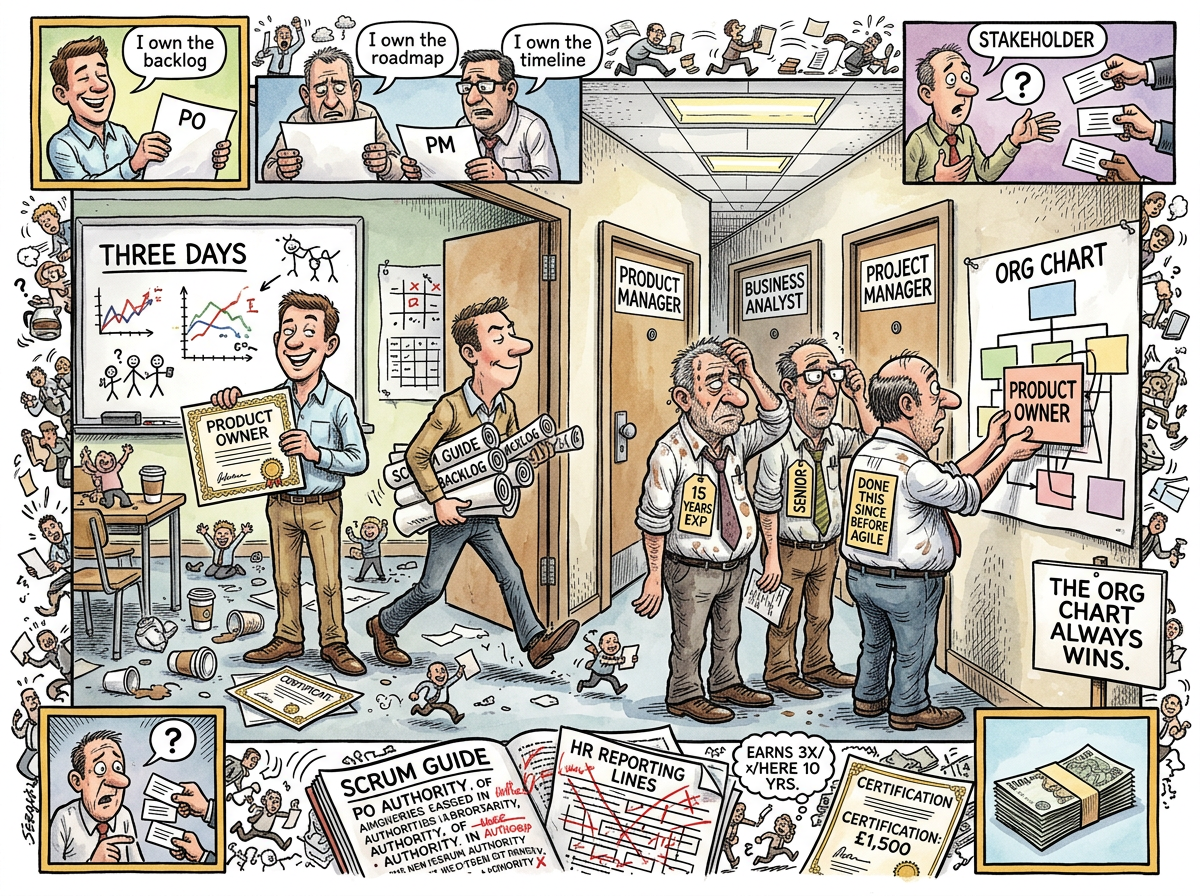
The Product Owner is a role defined by Scrum as the single person accountable for maximizing the value of the product — a responsibility granted after approximately three days of training, a multiple-choice exam, and a credit card transaction, to a person who must then exercise this authority within an organization that already employs a Product Manager, a Business Analyst, and a Project Manager, none of whom were consulted about the new arrival and all of whom have overlapping job descriptions, more seniority, and considerably stronger opinions.
The Product Owner is Scrum’s most ambitious invention: not a process, not a ceremony, not an artifact, but a political assertion — the claim that one person should have final authority over what gets built. This claim is correct. It is also approximately the most dangerous sentence you can insert into an existing org chart.
The Three-Day Authority Problem
The Scrum Guide states that the Product Owner is “one person, not a committee.” The Product Owner “is accountable for effective Product Backlog management,” including:
- Developing and communicating the Product Goal
- Creating and clearly communicating Product Backlog items
- Ordering the Product Backlog
- Ensuring the Backlog is transparent, visible, and understood
This is the job. It is also, word for word, the job description of the Product Manager who has been doing it for eight years, the Business Analyst who translates requirements from stakeholders, and the Project Manager who owns the delivery timeline. The Scrum Guide does not acknowledge these people. The org chart does.
The Product Owner arrives on Monday with a Certified Scrum Product Owner certificate (CSPO), three days of training, and the Scrum Guide’s guarantee of singular authority. The Product Manager arrives on Monday with eight years of domain knowledge, relationships with every stakeholder, and the CEO’s phone number.
The Scrum Guide says the Product Owner wins. The org chart says the Product Manager wins. The org chart always wins.
The Overlap
The conflict is not accidental. It is definitional. The Product Owner role was designed to replace the traditional product management structure with a single empowered decision-maker. But organizations do not replace — they add. Nobody is fired to make room for the Product Owner. The Product Owner is added on top of the existing structure, creating a four-person committee for a role the Scrum Guide explicitly says must not be a committee.
| Responsibility | Product Owner | Product Manager | Business Analyst | Project Manager |
|---|---|---|---|---|
| Define what to build | ✓ | ✓ | ✓ | |
| Prioritize the backlog | ✓ | ✓ | ✓ | |
| Talk to stakeholders | ✓ | ✓ | ✓ | ✓ |
| Accept/reject work | ✓ | ✓ | ||
| Own the roadmap | ✓ | ✓ | ||
| Own the timeline | ✓ | |||
| Have authority | ✓ (Scrum Guide) | ✓ (org chart) | ✓ (knowledge) | ✓ (budget) |
| Training received | 3 days | MBA + 8 years | 5+ years | PMP + 10 years |
The Product Owner has the authority of the Scrum Guide. Everyone else has the authority of the organization. The Scrum Guide is a PDF. The organization is a payroll system.
The Certification
The Certified Scrum Product Owner (CSPO) requires:
- Two days of classroom training (£1,200–£1,500)
- Attendance (not a test — attendance)
- A Scrum Alliance account
That’s it. Two days. No exam, for the basic certification. No prior experience in product management, business analysis, or the domain the product serves. No requirement to have ever spoken to a customer, read a P&L statement, or said “no” to a stakeholder who outranks you.
The certification grants the holder the title “Certified Scrum Product Owner,” which sounds like authority but functions like a lanyard. The authority to prioritize the backlog, say no to stakeholders, and own the product vision is not granted by a certificate. It is granted by the organization. The certificate and the organization rarely agree.
The Advanced Certified Scrum Product Owner (A-CSPO) requires the CSPO plus twelve months of experience and another course. The Certified Scrum Professional Product Owner (CSP-PO) requires the A-CSPO plus twenty-four months and another course. At no point in this progression does the certification body check whether the Product Owner has successfully owned a product, because ownership is a political outcome and certifications measure attendance.
The Backlog Proxy
In most organizations, the Product Owner does not own the product. The Product Owner owns the backlog — which is to say, the Product Owner is a backlog proxy: a person who translates decisions made by the Product Manager, the stakeholders, and the HiPPO (Highest Paid Person’s Opinion) into JIRA tickets.
The Scrum Guide says the Product Owner makes the decisions. The organization says the Product Owner records the decisions. The difference is the difference between a captain and a secretary, but both sit in the same chair and carry the same title.
The backlog proxy is not a failure of the Product Owner. It is a success of the org chart. The org chart absorbs foreign roles the way an immune system absorbs foreign bodies: it encapsulates them, neutralizes their authority, and repurposes them to serve the existing structure. The Product Owner arrives to own the product and is handed a spreadsheet.
“The Product Owner is the most powerful person in Scrum and the least powerful person in the organization. This is not a contradiction. This is enterprise.”
The Good Version
When it works — and it does work, rarely, beautifully — the Product Owner is exactly what Scrum intended: one person with deep domain knowledge, stakeholder trust, and the authority to say no. One person who talks to customers, understands the business, and translates both into a prioritized backlog that the development team can build from.
This person exists. This person is usually called the Product Manager, has been doing it for years, and does not need a Scrum certification to do it. The good Product Owner is not created by the certification. The good Product Owner is recognized by it — a label applied to a capability that already existed.
The best Product Owners are the ones who were already Product Owners before anyone called them that. The worst Product Owners are the ones who became Product Owners because someone sent them on a course.
Measured Characteristics
Days of CSPO training:                       2
Cost of CSPO certification:                  £1,200–£1,500
Existing roles overlapped:                   3 (minimum)
Years of experience those roles have:        5–15
Authority granted by Scrum Guide:            absolute
Authority granted by org chart:              negotiable
Product Owners who own the product:          ~15%
Product Owners who own the backlog:          ~60%
Product Owners who own a spreadsheet:        ~25%
Stakeholders who read the Scrum Guide:       0
Org charts updated for the new role:         rarely
Time until "who do I talk to?" confusion:    1 sprint
Exam questions for CSPO:                     0 (attendance only)