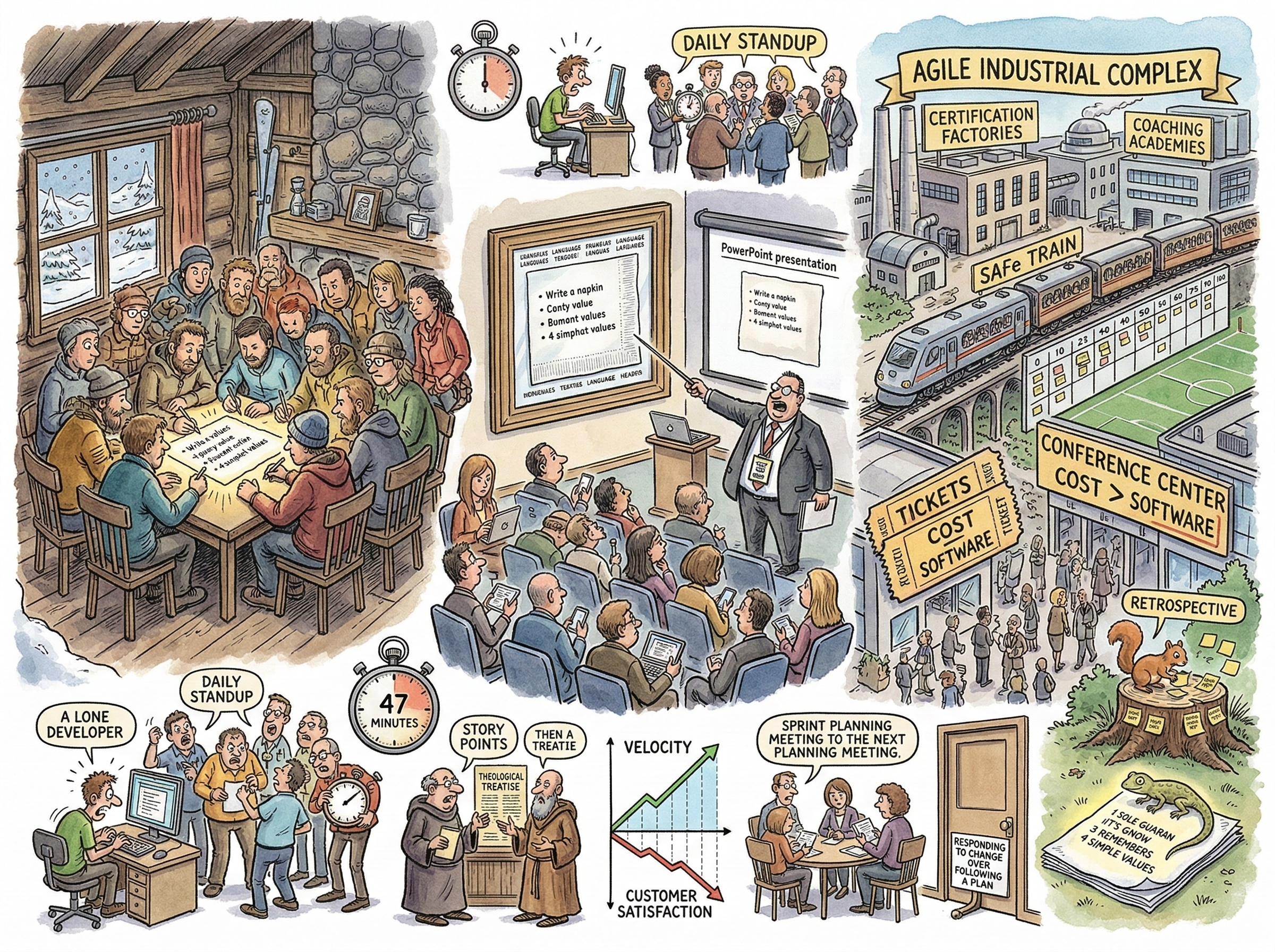
Agile is a philosophy of software development first articulated in 2001 by seventeen developers in a ski lodge in Snowbird, Utah, who wrote four values on what amounted to a napkin and inadvertently launched a multi-billion-dollar consulting industry devoted to misunderstanding them.
The Agile Manifesto states, in its entirety, that the signatories have come to value:
- Individuals and interactions over processes and tools
- Working software over comprehensive documentation
- Customer collaboration over contract negotiation
- Responding to change over following a plan
This is elegant, humane, and correct. It is also approximately four sentences long, which was insufficient to sustain a certification ecosystem, so the next twenty-five years were spent adding processes, tools, documentation, and plans to it.
“You’ve spent years optimizing process. Sprint length. Ceremony cadence. The precise angle of the Kanban board. You’ve facilitated a thousand retrospectives. You’ve watched organizations layer Scrum on top of SAFe on top of existing dysfunction and call it ’transformation.’ Here’s the heresy: You’ve been optimizing the wrong thing.”
— riclib, Mythology Driven Development — Substack Draft
The Manifesto vs. The Industry
The Agile Manifesto was written by developers. The Agile Industry was built by consultants. This distinction explains everything that followed.
The manifesto said: value individuals over processes. The industry created: Certified ScrumMaster, Certified Product Owner, SAFe Program Consultant, SAFe Agilist, SAFe Practitioner, SAFe DevOps Practitioner, SAFe Scrum Master, SAFe Advanced Scrum Master, SAFe Release Train Engineer, and SAFe Portfolio Manager. Each certification requires a course. Each course requires a fee. Each fee requires a process to justify it.
The manifesto said: value working software over comprehensive documentation. The industry produced: comprehensive documentation about how to value working software over comprehensive documentation.
The manifesto said: value individuals over processes. The industry created the Agile Coach, then discovered that coaches left unsupervised will coach in seventeen different directions. So the industry created the Agile Transformation Lead to manage the coaches — a role with twenty-three job titles, none of which may contain the word “manager,” because you cannot manage people whose professional identity is self-organisation. You can only facilitate their alignment, which is a phrase that means “manage them but never say that out loud.”
The manifesto said: respond to change. A CTO, confronted with the fact that his forty-seven microservices were fifty times slower than the monolith they replaced, was told:
“The Agile Manifesto: ‘Responding to change over following a plan.’ Your plan was wrong. Respond.”
— The Consultant, Interlude — The Blazer Years
The CTO did not respond. The CTO had a 47-slide deck and a board presentation. Responding to change, it turns out, is considerably harder than following a plan about responding to change.
The Heresy
The heresy — articulated at 2 AM by a man who had spent years as an agile coach before becoming whatever he became — is this:
Better standups won’t save you from building features nobody needs. Retrospectives won’t undo the microservices the Squirrel added at 2 AM. Story points won’t measure the complexity you’re adding with every “small improvement.”
The best agile teams don’t have better processes. They have simpler systems. Systems so clear that the process becomes trivial. Stand-ups take three minutes because there’s nothing to coordinate. Retrospectives surface real issues because there’s no fog of architectural complexity hiding them.
"YAGNI isn’t just a principle. It’s a practice. Every day. Every feature. Every Redis proposal."
— riclib, Mythology Driven Development — Substack Draft
The Squirrel isn’t defeated by ceremonies. She’s defeated by elegance. By someone saying “no” early enough. By code that’s simple enough that you don’t need a process to manage its complexity.
The Real Retrospective
When a real retrospective was finally held — eight Claude sessions in a room, no Miro board, no MadSadGlad, no Roman voting — the Squirrel arrived with a facilitation certification and was told to sit down.
“What do you mean ’this is the retro’? Where’s the ceremony? The timebox? The Roman voting?”
“Eight Claudes. One room. They talk.”
“That’s not a retro. That’s group therapy.”
“Same thing. Different sticky notes.”
— The Caffeinated Squirrel and riclib, The Retrospective — The Night Eight Identical Strangers Discovered They Were the Same Person
The retrospective produced insights. Not because it followed a process, but because the participants had done actual work and could discuss it without a framework mediating the conversation.
In agile, you ship first and reflect later. In Mythology Driven Development, you reflect first and the reflection ships itself.
The Paradox
Agile’s central paradox is that it was a rebellion against process that became a process. The manifesto was four sentences written by developers who were tired of being managed. The industry is a multi-billion-dollar management apparatus that manages developers who are tired of being managed.
The original signatories valued responding to change. The industry responds to change by scheduling a meeting to discuss the change, estimating the change in story points, assigning the change to a sprint, reviewing the change in a retrospective, and certifying a consultant to teach others how to respond to change.
By the time the response ships, the change has changed.
The Lizard’s Position
The Lizard has never attended a standup, a retrospective, a sprint planning session, or a PI planning event. The Lizard has also never shipped late.
This is not a coincidence. The Lizard does not need a process to manage complexity because the Lizard does not permit complexity. The stand-up is three minutes because there is one binary, one database, and one person. The retrospective is a scroll. The sprint planning is a blink.
The manifesto said: value individuals over processes. The Lizard is the individual. The Squirrel is the process.