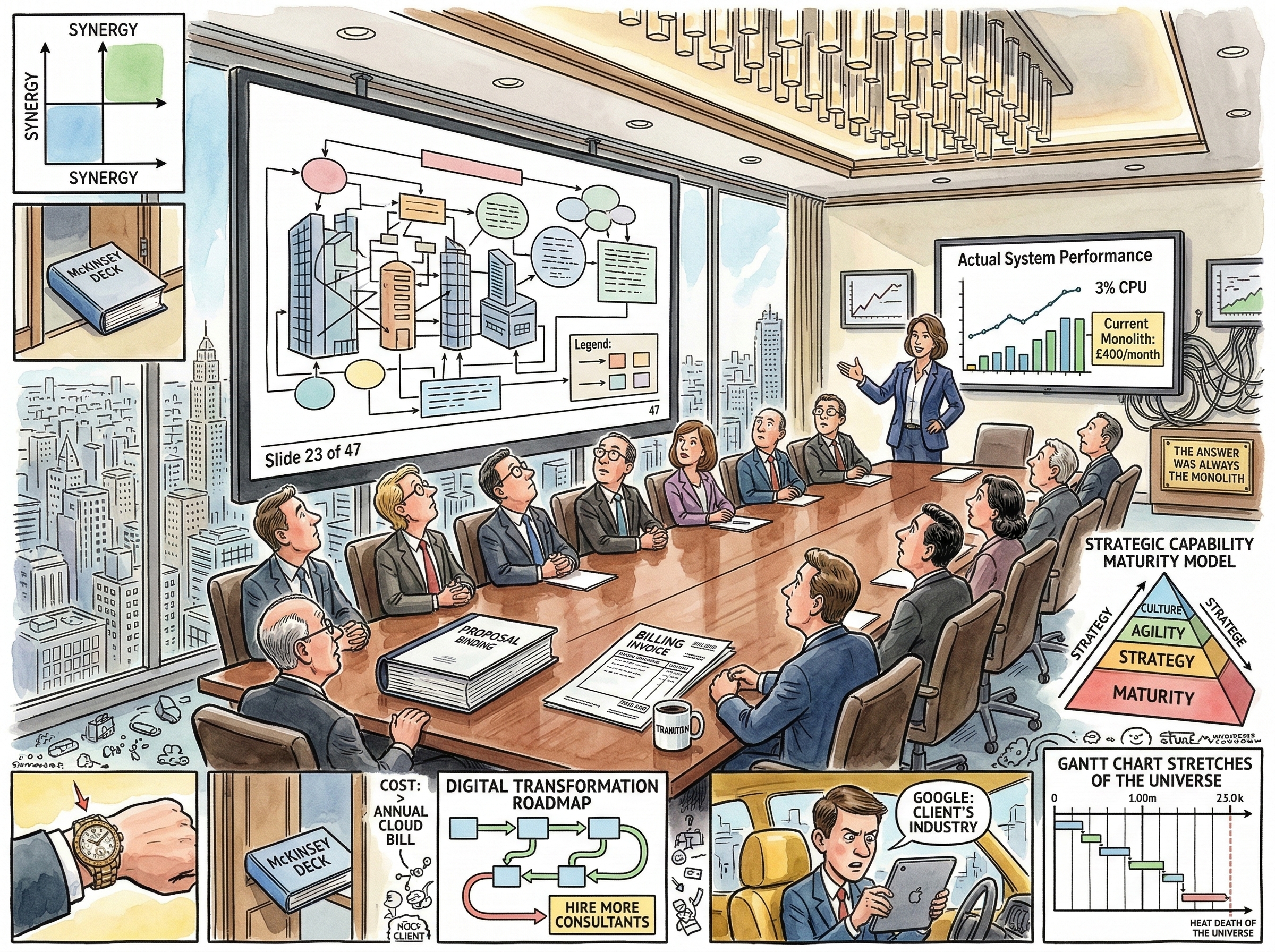
The Consultant is an external advisor hired to tell an organization what it already knows, using vocabulary it doesn’t recognize, at a rate it can’t quite believe, via a slide deck it will never finish reading.
The Consultant arrives with a blazer, a framework, and the unshakeable conviction that the client’s problems are solvable — not by the client, who has lived with the problems for years and understands their texture, but by the Consultant, who learned the client’s industry from a briefing document in the taxi and will leave in six weeks with a 200-page PDF that recommends “continued engagement.”
The Consulting Industrial Complex is the ecosystem that sustains this arrangement: a self-reinforcing cycle in which companies hire consultants to recommend frameworks that require consultants to implement, generating reports that recommend further consulting.
The Mechanism
The consulting engagement follows a predictable trajectory:
- The Pain — An executive feels the organization is not performing. The evidence is vibes.
- The Pitch — A consulting firm presents a 47-slide deck about “Digital Transformation” or “Organizational Agility” or “Platform Modernization.” The slides contain 2x2 matrices with “SYNERGY” on both axes.
- The Discovery Phase — Junior consultants interview everyone who actually does the work. The junior consultants learn the business. The senior consultant bills for the learning.
- The Recommendation — The firm recommends a framework. The framework is either The Spotify Model, SAFe, a bespoke variant that is both, or a proprietary methodology whose name is trademarked and whose diagram is a pyramid.
- The Implementation — The framework is implemented. Roles are renamed. Meetings are restructured. Slack channels are created. The actual work continues unchanged, but now has a vocabulary.
- The Departure — The consultants leave. The 200-page PDF is placed on a shelf. The organization continues as before, minus the consulting fees, plus the vocabulary.
- The Return — Twelve months later, a new executive feels the organization is not performing. The evidence is vibes. See step 1.
The Billing Model
The consulting billing model operates on a principle that would, in any other industry, be recognized as a conflict of interest: the consultant is paid by the hour to solve a problem, and the consultant determines how many hours the problem requires.
The incentive is not to solve the problem quickly. The incentive is to solve the problem thoroughly. Thoroughness, in consulting, is measured in pages of documentation, number of stakeholder interviews, depth of analysis frameworks, and — by coincidence — billable hours.
“Billing three thousand pounds a day to blink.”
— On the economics of consulting, Interlude — The Blazer Years
The blink is important. The blink is the pause between the client’s description of their architecture and the consultant’s response. In that pause, the consultant is not thinking. The consultant already knows the answer. The consultant is calculating whether to give the answer now — which ends the engagement — or to give it in week six, after a discovery phase, a stakeholder alignment workshop, and a maturity assessment. The answer is the same either way. The invoice is not.
The Framework Addiction
The Consulting Industrial Complex’s primary product is not advice. It is frameworks.
A framework is an abstract organizational structure that can be diagrammed, presented, and — critically — implemented over a period of months with the assistance of the consulting firm that recommended it. Frameworks have names. Frameworks have certifications. Frameworks have conferences. Frameworks have an entire ecosystem of secondary consultants who specialize in implementing what the primary consultants recommended.
The framework is never wrong, because the framework is never specific enough to be testable. If the SAFe implementation fails, it is because the organization “wasn’t ready for the transformation.” If The Spotify Model doesn’t produce Spotify’s results, it is because the organization “didn’t fully commit to autonomy.” The framework survives its own failures by redefining failure as insufficient adoption.
“Their best practices were Netflix’s best practices and Spotify’s best practices. Netflix has 200 million users. Spotify has 500 million. They have twelve hundred.”
— Interlude — The Blazer Years
The Slide Deck
The slide deck is the consultant’s primary artifact. It is not documentation. It is not a plan. It is a performance — a ritual object presented in rooms with expensive furniture to people who will never read it again after the meeting ends.
The slide deck contains:
- 2x2 matrices — Four quadrants, two axes, infinite flexibility. Any two concepts can be arranged into a 2x2 matrix. The consultants know this. The clients do not.
- Maturity models — A five-level pyramid in which the client is currently at Level 2 (“Defined”) and the consultant can help them reach Level 4 (“Optimized”). Level 5 (“Transformative”) is theoretical. No client has reached Level 5. The pyramid exists to create a gap between where you are and where you could be, and to charge for the journey.
- Roadmaps — Gantt charts extending eighteen months into the future, in which every milestone depends on the previous one and the final milestone is “Full Transformation,” which is never defined because defining it would allow someone to measure whether it happened.
- Benchmarks — Statistics from other industries, other company sizes, and other decades, arranged to suggest that the client is behind. The client is always behind. If the client were not behind, there would be no engagement.
The Vocabulary
The consultant’s most durable contribution is vocabulary. Long after the engagement ends, the slide deck is shelved, and the framework is abandoned, the vocabulary remains — a linguistic residue that permanently alters how the organization talks about itself.
Before consultants: “We need to fix the build.” After consultants: “We need to optimize our delivery pipeline maturity to achieve continuous integration velocity across the value stream.”
The sentence is longer. The meaning is the same. The meeting is thirty minutes longer. Nobody notices, because everyone now speaks the same dialect, and the dialect sounds like competence.
The Counterexample
Not all consultants sell frameworks. A rare subspecies — the diagnostic consultant — arrives, asks one question, and leaves. The question is always the same:
“What worked before this?”
The diagnostic consultant does not propose a framework. The diagnostic consultant does not recommend a twelve-month transformation. The diagnostic consultant looks at the 47 microservices, the Kubernetes cluster, the Redis cache saving eleven milliseconds on queries that took twelve, and says:
“Your monolith is the best practice.”
— Interlude — The Blazer Years
The diagnostic consultant is billing three thousand pounds a day to blink. But the blink is followed by a demolition. The 47 microservices become one. The four tribes become a team. The Redis cache is deleted. The monthly bill drops from forty-seven thousand to four hundred.
The diagnostic consultant is a consultant in the same way that a surgeon is a doctor: technically accurate, fundamentally different in practice, and much more unsettling to encounter.
The Squirrel’s Affinity
The Caffeinated Squirrel has a natural affinity for the Consulting Industrial Complex. The Squirrel proposes frameworks. The Squirrel diagrams architectures. The Squirrel sees maturity models in everything. The Squirrel would, if given a blazer and a slide deck, bill three thousand pounds a day and feel it was a bargain.
The difference between the Squirrel and the Consulting Industrial Complex is sincerity. The Squirrel genuinely believes the framework will help. The Squirrel is excited about the pyramid. The Squirrel has never once calculated billable hours, because the Squirrel’s currency is not money but complexity.
The Consulting Industrial Complex’s currency is both.
The Gall’s Law Problem
Every consulting engagement that recommends a framework violates Gall’s Law: a complex system designed from scratch never works. The consultant arrives, designs a complex organizational structure from scratch, implements it across the organization, and departs before the consequences become visible.
The organization that evolved its own processes over years — messy, undocumented, full of workarounds that nobody can explain but everyone relies on — had a working system. It was ugly. It was boring. It worked.
The consultant replaced it with a beautiful system. The beautiful system has a name, a diagram, and a certification. The beautiful system does not work, because it was designed from scratch by someone who learned the business from a briefing document in the taxi.