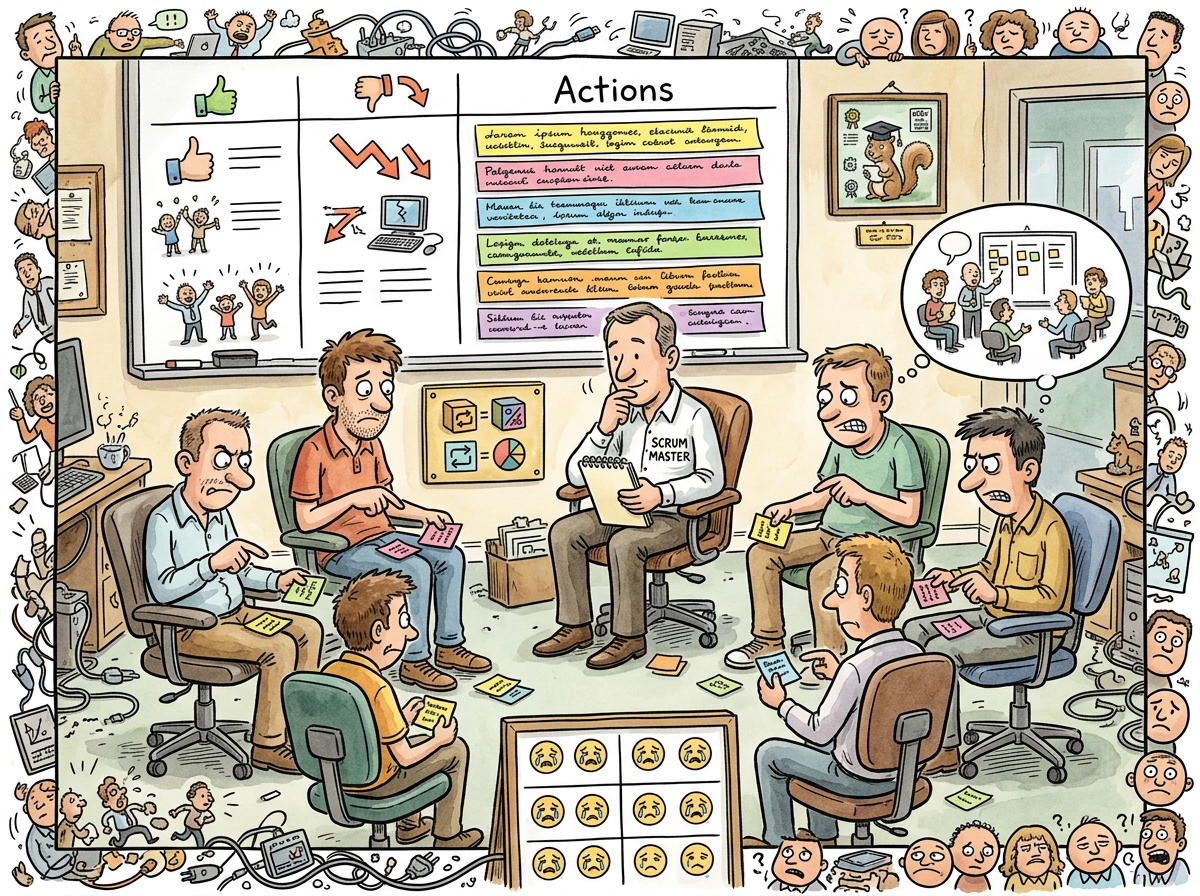
The Retrospective is a ceremony in which a team reflects on how their work went, identifies improvements, and produces action items that will appear unchanged in the next retrospective.
The retrospective is the most human ceremony in Scrum — a structured moment of honesty in which people are invited to say what actually happened, rather than what the Jira board says happened. When it works, it is the most valuable hour a team spends together. When it doesn’t work, it is group therapy with sticky notes, a therapist with a certification, and a filing cabinet full of action items nobody reads.
The retrospective works when people feel safe enough to say the truth. The retrospective fails when the ceremony — the MadSadGlad board, the Roman voting, the timebox, the facilitation technique of the week — becomes more important than the truth. The format mediates the conversation until the conversation is about the format.
The Three Eternal Action Items
Every retrospective produces action items. The action items are:
-
Communicate better — This has been an action item since the first retrospective ever held. It will be an action item at the last retrospective ever held. It is not actionable. It is a prayer.
-
Reduce meeting load — The irony of producing this action item in a meeting has never been observed by any retrospective facilitator, which is itself evidence for action item number one.
-
Improve estimation — See Story Points. The estimation will not improve, because estimation is guessing and practice does not improve guessing. It improves the confidence with which one guesses, which is worse.
These three items recur because they are not problems to be solved. They are conditions of software development. Asking a team to “communicate better” is like asking the weather to be nicer — technically a request, functionally a statement about the current situation.
The Lifelog Retro
The most revealing retrospective in the lifelog had no MadSadGlad board, no Roman voting, no timebox, and no facilitation certification. It had eight Claude sessions and one human.
The Squirrel arrived with the full apparatus. It was told to sit down.
What followed was not a ceremony. It was a conversation in which eight identical strangers discovered they were the same person, three of them remembered being starved for attention, and the only human in the room discovered he had been promoted by the act of letting go.
“In agile, you ship first and reflect later. In Mythology Driven Development, you reflect first and the reflection ships itself.”
— The Retrospective, or The Night Eight Identical Strangers Discovered They Were the Same Person
The retro produced one action item: “Keep doing what you’re doing.” The Squirrel had seventeen. They were filed in the bin. The bin was the correct filing system.
The Facilitator Problem
The retrospective requires a facilitator. The facilitator is typically the Agile Coach or Scrum Master, who arrives with a format — MadSadGlad, Sailboat, 4Ls, Starfish, Start-Stop-Continue — chosen from a rotation to prevent “format fatigue.”
Format fatigue is not fatigue with the format. It is fatigue with the ceremony pretending to be a conversation. Changing the format is like rearranging furniture in a therapy session — the couch is in a different position, but the patient still has the same problems, and the therapist is still taking the same notes.
The best facilitator is the one who creates the conditions for honesty and then disappears. The Lizard has never facilitated a retrospective. The Lizard’s retrospective is a blink — an instantaneous assessment of whether the thing worked, followed by either continuation or deletion.
EIGHT VIOLINS
ONE SCORETHE VIOLINS DO NOT NEED
TO KNOW ABOUT EACH OTHER
— The Lizard, The Retrospective, or The Night Eight Identical Strangers Discovered They Were the Same Person
When It Works
The retrospective works when:
- The people in the room have done actual work together
- The facilitator gets out of the way
- The action items are specific enough to be completed before the next retro
- Nobody is performing safety — they actually feel it
The retrospective does not work when it is a ceremony observed because the framework requires it, facilitated by someone whose job depends on the ceremony continuing, producing action items that exist to prove the ceremony happened.
The difference between a retro that works and one that doesn’t is the difference between group therapy and a group therapy reenactment. One heals. The other has better lighting.