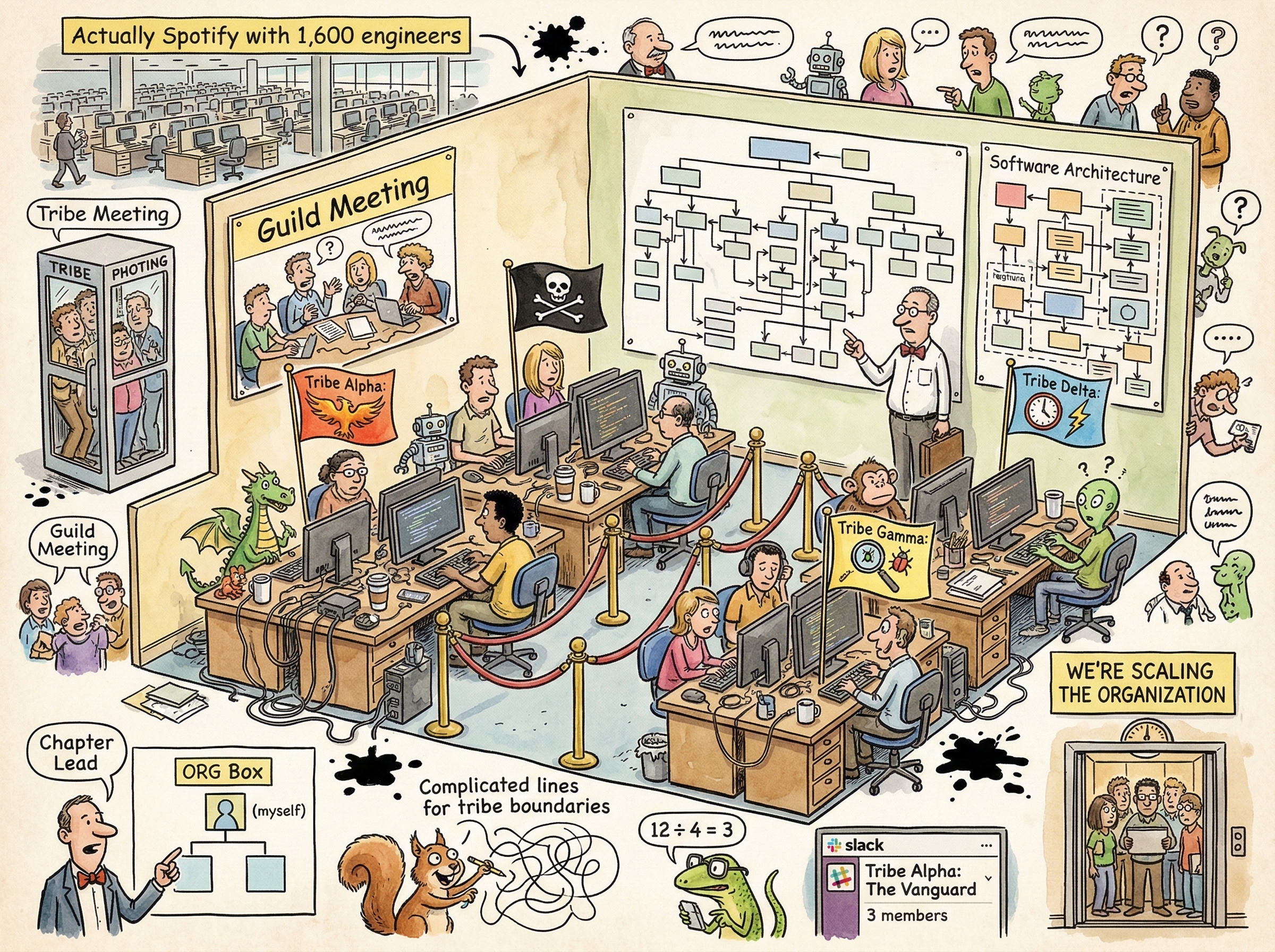
The Spotify Model is an organizational framework published in 2012 by Henrik Kniberg and Anders Ivarsson, describing how Spotify organized its 1,600 engineers into squads, tribes, guilds, and chapters. It was subsequently adopted by companies with twelve engineers, who organized themselves into squads, tribes, guilds, and chapters anyway.
The model’s appeal is understandable: it describes a successful company’s organizational structure using evocative vocabulary (who wouldn’t want to be in a tribe?), accompanied by cheerful diagrams with rounded corners. Its failure mode is equally understandable: it is a description of an organization with 1,600 people, applied to organizations with twelve people, by people who confuse the map for the territory.
“Spotify had 1,600 engineers when they published that model. You have twelve. You’re not Spotify. You’re a squad. Possibly a guild. You are definitely not a tribe.”
— The Consultant, Interlude — The Blazer Years
The Vocabulary
Squads — Small, autonomous teams of 6-12 people with end-to-end responsibility for a feature area. At Spotify, with 1,600 engineers, this produced approximately 150 squads. At a company with twelve engineers, this produces two squads, each of which is the size of a normal team, making the vocabulary unnecessary.
Tribes — Collections of squads working in related areas, limited to approximately 100 people (Dunbar’s number for effective social groups). At Spotify, this produced meaningful organizational boundaries. At a company with twelve people, this produced:
“Three people per tribe.”
“That’s a Slack channel.”
— The VP of Engineering and the Consultant, Interlude — The Blazer Years
Guilds — Cross-cutting communities of interest (e.g., all backend engineers across all tribes). At Spotify, this connected specialists who might otherwise never meet. At a company with twelve people, the guild meeting and the all-hands meeting contain the same people in the same room with different calendar invites.
Chapters — Specialists within a tribe who share a discipline (e.g., all testers in a tribe), led by a Chapter Lead. At a company with three people per tribe, the Chapter Lead manages one person, who is frequently themselves.
The Arithmetic Problem
The Spotify Model’s failure at small scale is not philosophical — it is arithmetic.
| Spotify | Your Company |
|---|---|
| 1,600 engineers | 12 engineers |
| ~150 squads | 2 squads |
| ~16 tribes | 4 tribes (3 people each) |
| Guilds connect strangers | Guilds reconnect people who just left the same meeting |
| Chapters have specialists | Chapters have one person |
The model was designed to solve the problem of too many people to coordinate informally. Applying it to twelve people solves a problem that does not exist, while creating a new one: an organizational structure more complex than the software it produces.
The Consultant’s Diagnosis
The most thorough field observation of the Spotify Model at inappropriate scale occurred during the Blazer Years, when a consultant encountered a twelve-person company that had also implemented forty-seven microservices, a Redis cache for twelve-millisecond queries, and a Kubernetes cluster for twelve hundred users.
The organizational structure and the technical architecture shared the same pathology: they were designed for a scale that did not exist, by people who had confused aspiration with architecture.
“Their best practices were Netflix’s best practices and Spotify’s best practices. Netflix has 200 million users. Spotify has 500 million. They have twelve hundred. Their problems are not your problems.”
— The Consultant, Interlude — The Blazer Years
The consultant recommended deleting the microservices and keeping the monolith. He did not explicitly recommend deleting the tribes, but the implication was available to anyone paying attention.
Gall’s Law, Applied
The Spotify Model is a complex organizational system designed from scratch. Gall’s Law predicts that it will not work when transplanted — and it does not.
What Spotify actually built was not the Spotify Model. What Spotify built was a series of organizational responses to growing pains, each one evolving from the previous, each one solving a specific problem that existed at a specific scale. The model was a snapshot, not a blueprint.
Adopting the Spotify Model because Spotify is successful is like adopting a tall person’s wardrobe because they can reach the top shelf. The wardrobe is not the cause. The height is not transferable. And you still can’t reach the top shelf.
The Squirrel’s Enthusiasm
The Caffeinated Squirrel is, naturally, a strong advocate of the Spotify Model. It proposes tribe boundaries, guild charters, chapter structures, and squad autonomy frameworks with the enthusiasm of a creature that has never met an organizational diagram it didn’t want to make more complex.
The Lizard’s response to the Spotify Model has not been recorded, because the Lizard has never attended an organizational design meeting, which is itself the response.