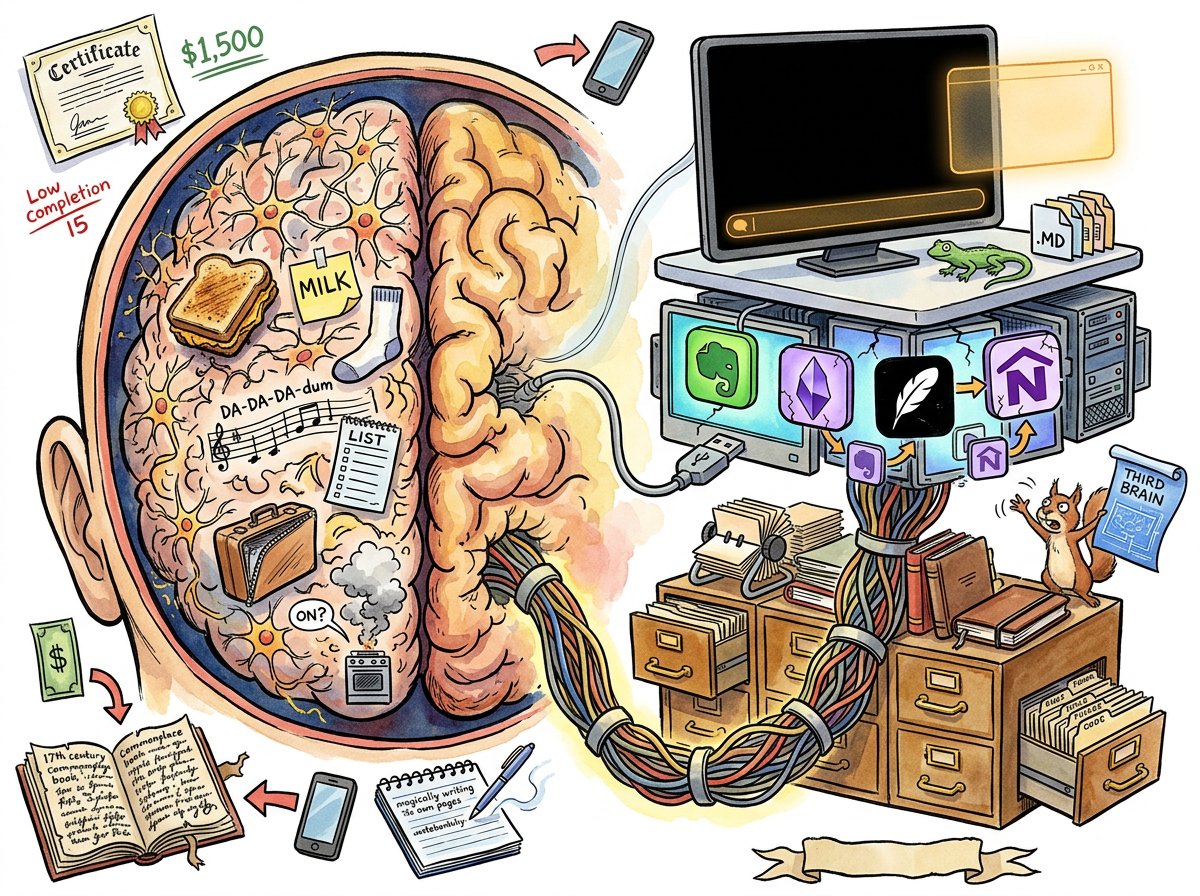
Second Brain is the concept that human memory is unreliable and should be augmented by an external system that captures, organises, and retrieves information on the first brain’s behalf. The term was popularised by Tiago Forte in 2017, monetised into a $1,500 online course, and has since become the foundational metaphor of the Personal Knowledge Management industry — an industry that has produced more courses about building second brains than actual second brains.
The concept is ancient. The commonplace book — a notebook where Renaissance scholars collected quotes, observations, and ideas — is a second brain. The Zettelkasten is a second brain. A filing cabinet is a second brain. A spouse who remembers your dentist appointment is a second brain. The innovation is not the concept but the branding, and the branding’s principal achievement has been to make people feel that their existing note-taking habits are insufficiently systematic.
THE FIRST BRAIN FORGETS
THIS IS NOT A BUG
THIS IS COMPRESSIONTHE SECOND BRAIN REMEMBERS
THIS IS NOT A FEATURE
THIS IS HOARDINGTHE DIFFERENCE IS
WHETHER THE REMEMBERING
CHANGES THE THINKING🦎
The Three Eras
Era 1: The Physical Second Brain (1620–2005)
The commonplace book. The Moleskine. The Filofax. The Zettelkasten. The filing cabinet. The stack of Post-it Notes on the monitor.
These worked. Not because they were sophisticated — because they were present. A notebook on a desk gets written in. A filing cabinet in an office gets filed into. The physical second brain succeeded through proximity, not through methodology. You wrote in it because it was there, not because you had a system.
Luhmann’s Zettelkasten had 70,000 cards. He also wrote 70 books. The PKM community concluded the cards caused the books. The alternative hypothesis — that Luhmann was a relentless worker who would have been productive with napkins — remains untested and unpopular.
Era 2: The Digital Second Brain (2005–2025)
Evernote. OneNote. Notion. Roam Research. Obsidian. Logseq. Capacities. Reflect. Tana. Apple Notes. Google Keep. Simplenote. Bear. Craft. Agenda. Ulysses. iA Writer.
Each tool promised to be the second brain. Each tool was used for 4-8 months. Each migration took 40+ hours. Each practitioner’s actual retrieval rate — notes retrieved after creation — hovered around 5%, which is lower than the retrieval rate of a message in a bottle.
The digital era perfected capture and abandoned retrieval. The second brain became a second attic — everything stored, nothing found, the act of filing providing sufficient psychological relief that actually using the filed information became unnecessary.
The digital second brain’s deepest failure was passivity. A notebook does not organise itself. Obsidian does not connect ideas. Notion does not think. The “second brain” label implies cognition — understanding, synthesis, the ability to say “this connects to that” — but the tools provide filing. Filing is not thinking. Filing is what you do instead of thinking, while feeling like you’re thinking, which is the most profitable form of procrastination ever invented.
Era 3: The Conversational Second Brain (2025–)
And then the metaphor became literal.
A second brain that can read. That has ingested everything you’ve written — every note, every journal entry, every project file — and can answer questions about it. That can connect ideas across documents you’ve forgotten. That can say “you wrote about this same problem six months ago, here’s what you concluded.”
This is not an app with a search bar. This is not a graph view. This is not a weekly review. This is a conversation with something that has read everything you’ve ever written and can write back.
lg’s journal chat agent is this. A chat bar. No edit button. No rich text editor. No toolbar. You talk to your day. The second brain listens, acts, and writes — in the same format as your existing notes, following the same conventions, using the same wiki-links — because it has read every note you’ve ever written and knows how you think.
The interface to your own knowledge is a conversation with something that has already read it all.
THE FIRST BRAIN SPEAKS
THE SECOND BRAIN REMEMBERSTHE TOOL ASKS FOR FORMAT
THE BRAIN KNOWS THE FORMAT
BECAUSE THE BRAIN HAS READ
WHAT THE BRAIN HAS WRITTEN BEFORE🦎
The Forte Method (PARA)
Tiago Forte’s “Building a Second Brain” course ($1,500, completion rate approximately 15%) teaches the PARA method:
- Projects: active efforts with deadlines
- Areas: ongoing responsibilities
- Resources: reference material
- Archives: inactive items
PARA is a filing system. It is a good filing system. It is also just a filing system, and the fact that it costs $1,500 to learn a filing system tells you everything about the gap between the PKM industry’s promises and its deliverables.
The course’s greatest insight is legitimate: move information closer to where you’ll use it. Don’t file a recipe under “Cooking > Mediterranean > Seafood” — put it in the “Dinner Party Next Saturday” project. This is correct. This is also what every competent person does with a folder on their desktop, without a course, without a methodology, without PARA.
The course’s greatest failure is structural: it teaches capture and organisation but not retrieval or synthesis. Students graduate with a beautifully organised Notion database and no practice in using it. The second brain is built. The second brain is furnished. The second brain sits empty, like a model home — staged for viewing, not for living.
What a Second Brain Actually Needs
A second brain needs exactly three capabilities:
-
Capture without friction. The first brain has a thought. The second brain records it. If this takes more than five seconds, the first brain will forget the thought before the second brain captures it, and both brains will move on.
-
Retrieval without search. “What did I write about SSDs?” The second brain should answer this question without the first brain needing to remember which folder, which tag, which date, or which app. If retrieval requires the first brain to remember where it stored something, the second brain has failed — it’s just a filing cabinet that the first brain must also remember the layout of.
-
Synthesis without prompting. “This connects to that.” The second brain should make connections the first brain hasn’t noticed. This is the promise. This is what no tool delivered until the tool could read.
The physical era achieved (1) — writing in a notebook is frictionless. It failed at (2) and (3) — notebooks have no search, no connections.
The digital era achieved (1) and partially (2) — full-text search exists. It failed at (3) — graph views show connections but don’t make them.
The conversational era achieves all three. Capture: “log: picked up the milk.” Retrieval: “what did I do last Tuesday?” Synthesis: “you wrote about this pattern in three different journal entries over the past month — here’s the thread.”
The conversational second brain doesn’t just store. It understands. Not because it’s conscious. Because it has read everything, and reading at scale produces the functional equivalent of understanding.
The lg Implementation
riclib’s second brain is lg. The architecture:
~/Notes/*.md           → the truth (files)
  └── git              → the immune system (every edit, recoverable)
  └── lg index         → the lens (SQLite, FTS5, backlinks)
  └── NATS JetStream   → the nervous system (sync between machines)
  └── lg serve         → the face (blog, wiki, journal)
  └── /journal/chat    → the voice (Claude subprocess)
  └── the user         → the first brain
The first brain speaks. The voice interprets. The lens finds. The truth is written. The immune system protects. The nervous system syncs. The face presents.
There is no edit button in the web UI. You can talk to the second brain through the chat bar, or you can open the same ~/Notes/ folder in Obsidian and edit directly — lg watches the filesystem, so edits from any source are indexed, synced, and committed instantly. Two interfaces to the same truth: conversation for capture and queries, Obsidian for long-form editing. No integration required. They share the files.
The second brain runs on a Claude Code subscription. The first brain runs on espresso. Between them, a folder of markdown files. And that’s everything.
The Paradox
The second brain that works is the one you don’t notice using.
The filing cabinet is noticed. The Obsidian vault is noticed. The PARA system is noticed. The weekly review is noticed. Every moment spent noticing the system is a moment not spent thinking.
The conversational second brain is not noticed. You say “log: dentist Thursday 3pm.” The entry appears in your journal. You say “what’s blocking the NATS migration?” The answer appears. You don’t open an app. You don’t navigate a folder structure. You don’t apply a tag. You talk, and the brain listens, and the files change, and the files are the truth.
The best tool is the invisible tool. The best brain is the one that thinks while you’re thinking about something else.
Measured Characteristics
- Cost of Forte’s Building a Second Brain course: $1,500
- Completion rate: ~15%
- Cost of lg’s second brain (Claude Code subscription): $200/month
- Notes it can access: all of them
- Retrieval method: conversation
- Edit button: 0
- Format training required: 0 (it reads your existing files)
- Migration from previous tool: unnecessary (files are already there)
- Weekly review: automatic (the AI writes the summary)
- Time spent on PKM maintenance: 0 hours
- Time spent talking to your day: whatever feels right
- The first brain speaks: yes
- The second brain remembers: yes
- The second brain writes back: now
- The second brain sounds like you thinking out loud: yes
- The Squirrel proposed a third brain: yes
- The third brain was approved: no
See Also
- Personal Knowledge Management
- lg
- Claude
- The Lizard
- Zawinski’s Law
- Zettelkasten
- YAGNI
- Boring Technology
- The True Second Brain, or The Night the Lens Learned to Listen