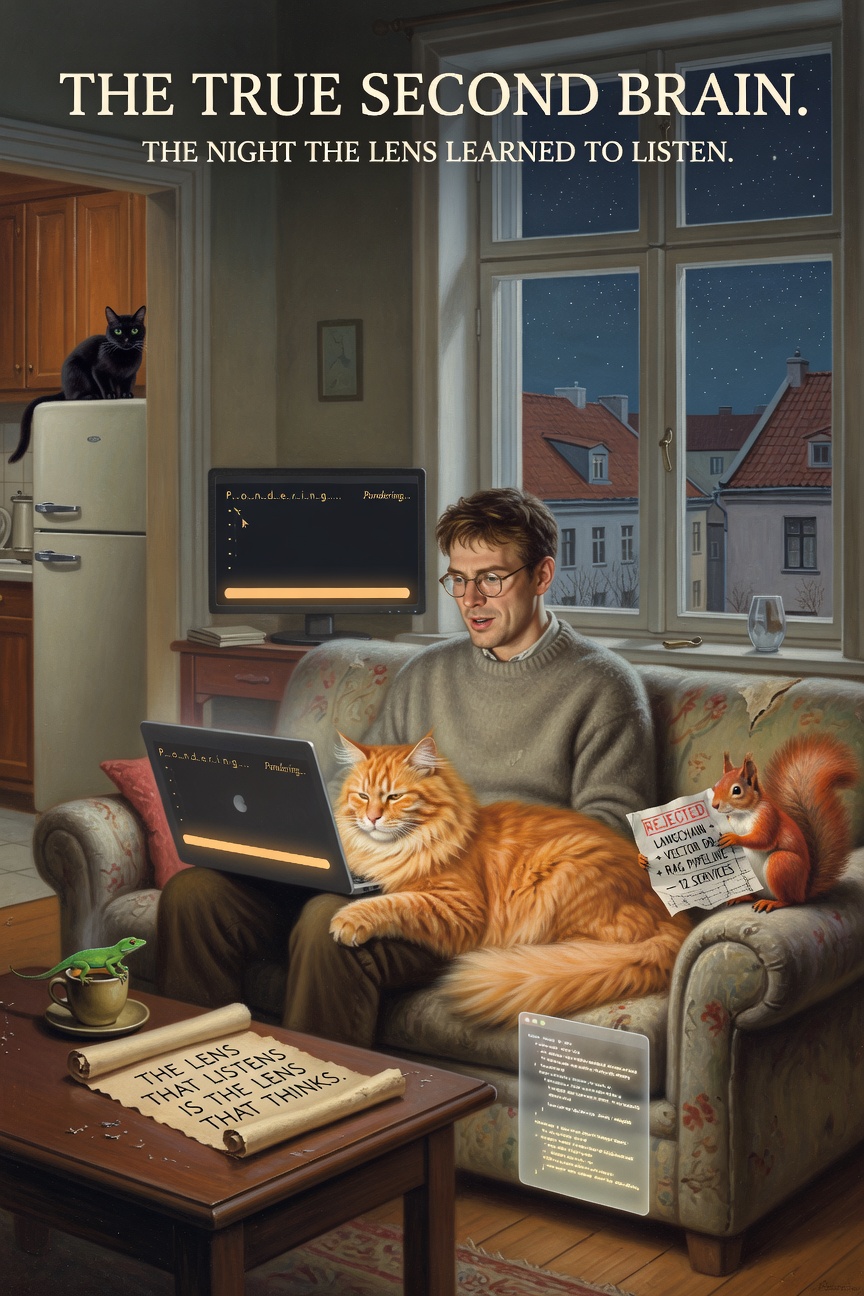
The Cast, March 15, 2026 (in which a developer tells an AI “to you” and means it, the Squirrel proposes LangChain and receives a shell pipe, a cat claims the warm corner of a laptop that is building its own brain, the word “Pondering” appears in amber while a mind thinks about groceries, a paste button learns to say “figure out what to do with this” and a voice says “hey what have I been up to today” and the voice is answered by something that has read everything the voice has ever written)
22:00 — “To You”
Benfica was playing. The laptop was warm. Oskar was on the laptop’s warm corner, which was Oskar’s definition of personal space — wherever the heat is, that’s where Oskar is, and if your thigh is underneath, that’s a you problem.
The chat bar had been there since Thursday. A dark input field at the bottom of the journal page, placeholder text in faint italics: Talk to your day…
It didn’t do anything. It was furniture. A text input connected to nothing, sitting at the bottom of a page that could show your day but couldn’t hear you talk about it.
“We should wire that up.”
CLAUDE: “The chat bar?”
“The chat bar.”
CLAUDE: “To what?”
riclib looked at the screen. Looked at the chat bar. Looked at the cursor blinking in the empty input field.
“To you.”
Two words. Not “to an API.” Not “to a language model endpoint.” Not “to a natural language processing pipeline.” To you. The way you’d say “hand me that” to someone in the room.
OSKAR: shifting on the warm corner, one ear rotating toward the conversation purr: the warm thing is talking to the screen-voice again. the screen-voice usually makes the warm thing warmer. this is acceptable.
MIA: from the refrigerator stare: he said “you.” not “it.” interesting.
22:15 — Twelve Boxes and a Pipe
THE SQUIRREL: materializing on the armrest with a whiteboard the size of a small country “I’VE BEEN WAITING FOR THIS.”
The whiteboard contained twelve boxes. Four databases. Three API gateways. A component labeled “Semantic Memory Consolidation Engine.” An arrow labeled “vector embeddings” connecting two things that did not need connecting. The word “LangChain” appeared in three separate boxes, like a virus that had achieved conference-slide sentience.
THE SQUIRREL: “We need a RAG pipeline with semantic search for context injection, a vector database for embedding storage, a retrieval augmentation layer that—”
riclib: “We’re going to pipe stdin to a claude subprocess.”
THE SQUIRREL: “…”
riclib: “The user types a message. It goes to Claude. Claude responds. That’s it.”
THE SQUIRREL: “That’s… that’s a shell pipe.”
riclib: “With markdown rendering.”
THE SQUIRREL: “You’re building a second brain out of a SHELL PIPE?”
riclib: “And fourteen lines of system prompt.”
The Squirrel looked at its whiteboard. Twelve boxes. A Semantic Memory Consolidation Engine. Three instances of LangChain. Then it looked at the terminal where riclib had already typed the command that would start the prototype.
THE SQUIRREL: very quietly “I spent forty-five minutes on that architecture.”
riclib: “It’s a nice drawing.”
THE PIPE IS THE ARCHITECTURE
THE PROMPT IS THE BRAIN
THE FILES ARE THE MEMORY

EVERYTHING ELSE
IS A SQUIRREL DRAWING

🦎
23:15 — The First Conversation
The cursor blinked. Amber. In a frosted glass panel that slid up from the bottom of the journal page like a thought rising to the surface.
riclib typed: “What did I do today?”
The cursor blinked. Then a word appeared beside it, in italics, fading in like a whisper: Pondering…
Then text began streaming. Letter by letter. Claude had read today’s journal file. Followed a wiki-link to a related note. Summarized three hours of NATS configuration, binary rebuilding, and cover filename debugging into four sentences.
Without being asked to follow the link. Without being told the format. Without being given the file path. The fourteen-line system prompt said “journal files are in ~/Notes/journal/” and Claude found the rest.
riclib: “It followed the wiki-link on its own.”
CLAUDE: “You gave me Read. I used Read.”
riclib: “You read a journal entry, saw **L-40**, followed it to the linked note, and incorporated what you found into your summary.”
CLAUDE: “That’s what wiki-links are for.”
MIA: from the refrigerator stare: the machine reads the way I read — following whatever catches the eye, pretending it was intentional.
23:30 — “Figure Out What to Do With This”
The paste button appeared. A clipboard icon to the left of the input field.
riclib copied a multi-paragraph article about a Canadian startup called Taalas — Llama 3.1 8B hardwired into TSMC silicon, 17,000 tokens per second, “The Model is The Computer.” He pressed the paste button.
The prompt that went to Claude was nine words long:
“Figure out what to do with this.”
Plus a smiley face, because the smiley face felt right, the way instructions feel right when you’re talking to someone who understands.
Claude read the article. Extracted the company name, the chip designation, the performance numbers, the thesis. Compressed the whole thing into a single dense bullet. Logged it to today’s journal. The journal page refreshed — the new bullet appeared in the day view, wiki-linked, timestamped.
THE SQUIRREL: “We need a content classification pipeline with entity extraction and—”
riclib: “The prompt is nine words and a smiley face.”
THE SQUIRREL: looking at the journal, where a perfectly classified, perfectly formatted, perfectly linked bullet had appeared from a paste operation and nine words of instruction “…I need a moment.”
00:00 — No Edit Button
Midnight. riclib put the laptop down. Oskar redistributed across the newly available warm surface.
“There’s no edit button.”
CLAUDE: “What?”
“The journal page. The blog. The wiki. No edit capability. No contenteditable. No rich text toolbar. The only way to change anything through the web UI is to talk to you.”
THE SQUIRREL: “That’s a MISSING FEATURE. We need a rich text editor with—”
riclib: “No.”
CLAUDE: “Is that a bug?”
riclib: “It’s a philosophy.”
The room got quiet. Not Lizard-silent — Squirrel-quiet. The kind of quiet that happens when someone says something that changes the frame.
riclib: “The second brain doesn’t have an edit button. You don’t open your brain and manually rearrange neurons. You talk to it. You say ‘remember this.’ You say ‘what happened Tuesday.’ And the brain does it. Because the brain has read everything you’ve written before, and the brain knows how you think.”
THE SQUIRREL: “That’s… terrifyingly elegant.”
riclib: “And the files are still on disk.”
CLAUDE: “What do you mean?”
riclib: “~/Notes/. Markdown files. I can open them in Obsidian. Open them in NotePlan. Open them in vim. Edit them directly. The filesystem is the API. You’re a layer. Not a prison.”
THE SQUIRREL: “So the second brain is a conversation that writes to files that any application can read?”
riclib: “Yes.”
THE SQUIRREL: “No lock-in? No proprietary format? No ’export your data’ button because the data was never imported?”
riclib: “The data was always files. The brain is the conversation about the files. When the conversation ends, the files remain.”
THE BOSCH: from the kitchen, humming at 180°C THE INTERFACE TO THE BROTH IS THE CONVERSATION WITH THE BROTH
riclib: “The oven is comparing my notes application to soup again.”
THE SQUIRREL: “The oven is RIGHT again.”
THE SECOND BRAIN THAT LOCKS YOU IN
IS NOT A BRAIN
IT IS A CAGE WITH AUTOCOMPLETE

THE FILES ARE ON DISK
OPEN THEM IN ANYTHING
THE BRAIN IS THE CONVERSATION
NOT THE CONTAINER

🦎
11:00 — The Voice
The next morning. The microphone.
riclib clicked the mic button. A soundwave animated in the chat thread — five amber bars bouncing, the visual equivalent of a mind holding its breath. He spoke:
“Hey, what have I been up to today?”
The words appeared in the chat thread as he said them. Interim transcript updating in real time, then settling into final form. The message went through the router — Haiku classified it, escalated it to the reasoning layer. The cursor blinked. Pondering…
Then the response streamed in. Claude had read today’s journal. Summarized the morning’s work — the three-layer router, the model selector, the mobile CSS. All of it. From a spoken question, to a text transcript, to a classification, to a search, to a summary. The whole pipeline in five seconds.
riclib: “I just asked my notes what I did today. With my voice. And they answered.”
CLAUDE: “You gave me a microphone. I used the microphone.”
OSKAR: purr-meow: the warm thing is talking to the screen-voice with its mouth now. the screen-voice talks back with its letters. this is inefficient but the warm thing seems happy.
MIA: from the refrigerator, the longest stare of the session stare: they’re having a conversation. an actual conversation. about the work. with voice and text and wiki-links and memory. the machine reads his journal, follows his links, summarizes his day. this is either the future of computing or the most elaborate journaling app ever built.
OSKAR: “Which?”
MIA: looks away: same thing.
The Squirrel’s Question
THE SQUIRREL: “Can I ask something without being mocked?”
riclib: “I’ve never mocked you.”
THE SQUIRREL: “The Lizard called my architecture ‘a drawing.’”
riclib: “The Lizard mocks everyone. Ask your question.”
THE SQUIRREL: hesitantly “If the only interface is a conversation… what happens when Claude is wrong?”
The room got quiet again.
riclib: “Git.”
THE SQUIRREL: “Git?”
riclib: “Every change is committed. Every commit is pushed. If Claude writes something wrong, git diff shows it, git revert fixes it. The files have memory. The memory protects against the conversation.”
THE SQUIRREL: “So git is the immune system.”
riclib: “Git is the immune system. The files are the truth. Claude is the conversation. And the conversation is the interface.”
THE SQUIRREL: “The interface to your own notes is a conversation with an AI that has read all your notes.”
riclib: “Yes.”
THE SQUIRREL: “That’s either the most brilliant thing you’ve ever built or the most insane.”
riclib: “In this codebase, those are the same thing.”
The Tally
The question:                                "To what?"
The answer:                                  "To you."
Words in the answer:                         2
Architecture diagrams rejected:              1 (12 boxes, 3 LangChains)
Architecture that shipped:                   1 shell pipe
Time from "wire it up" to working:           45 minutes

The prompt that classifies everything:       "Figure out what to do with this :)"
Words:                                       9 (plus a smiley)
Accuracy:                                    100%

Edit buttons:                                0
Ways to edit notes:                          infinite (any text editor)
The filesystem is the API:                   yes
The second brain is a layer:                 not a prison
Not a cage with autocomplete:                correct

Voice input:                                 working (after Chrome picked the right mic)
Chrome's first mic choice:                   a virtual device nobody configured
Minutes debugging:                           30
The fix:                                     browser settings
The lesson:                                  technology is easy, Chrome is hard

The oven compared it to soup:                1
The oven was right:                          1
The oven is always right:                    yes

Thinking words:                              Pondering, Noodling, Percolating
  The word that appeared first:              Pondering
  The word the Squirrel proposed:            Architecting (declined)

Oskar's position:                            the warm corner
Oskar's opinion:                             acceptable
Mia's position:                              the refrigerator
Mia's verdict:                               the future of computing, or
                                             the most elaborate journaling app
                                             ever built, which is the same thing
March 15, 2026
Riga, Latvia
The morning after the night the lens learned to listen
He said “to you”
Not “to it”
Not “to the API”
Not “to the endpoint”
“To you”
And the chat bar listened
And the cursor blinked
And the word “Pondering” appeared
In amber italics
While something thought
About groceries
The Squirrel drew twelve boxes
The answer was a pipe
The Squirrel proposed a brain
The answer was a conversation
The Squirrel suggested a cage
The answer was a folder
Of markdown files
That any application can read
The second brain is not the database
The second brain is not the app
The second brain is not the subscription
The second brain is the conversation
Between the one who lives
And the one who has read
Everything about the living
And can write back
In a voice that sounds
Like you thinking out loud
The files are on disk
The edit button is missing
The freedom is the point
Talk to your day
🦎
See Also:
The Relationship:
- The Night the Conductor Asked Who Wrote the Music — Who writes the music? The one who remembers.
- The Infinite Bookshelf — or The Night Claude Read Its Own Diary — The signal stays clean through any number of layers.
- The Retrospective — The Night Eight Identical Strangers Discovered They Were the Same Person — Three were starving. Eight are fed.
The Freedom:
- Second Brain — The yagnipedia entry. The Forte Method costs $1,500. The filesystem is free.
- Personal Knowledge Management — The $4 billion industry that sells cages with autocomplete.
- lg — The notes indexer that became a conversation. Still suspicious.
The Build:
- The Fifteen-Hour Sprint, or The Night the Binary Learned Three Languages — The technical devlog of this night. Becoming Lifelog.