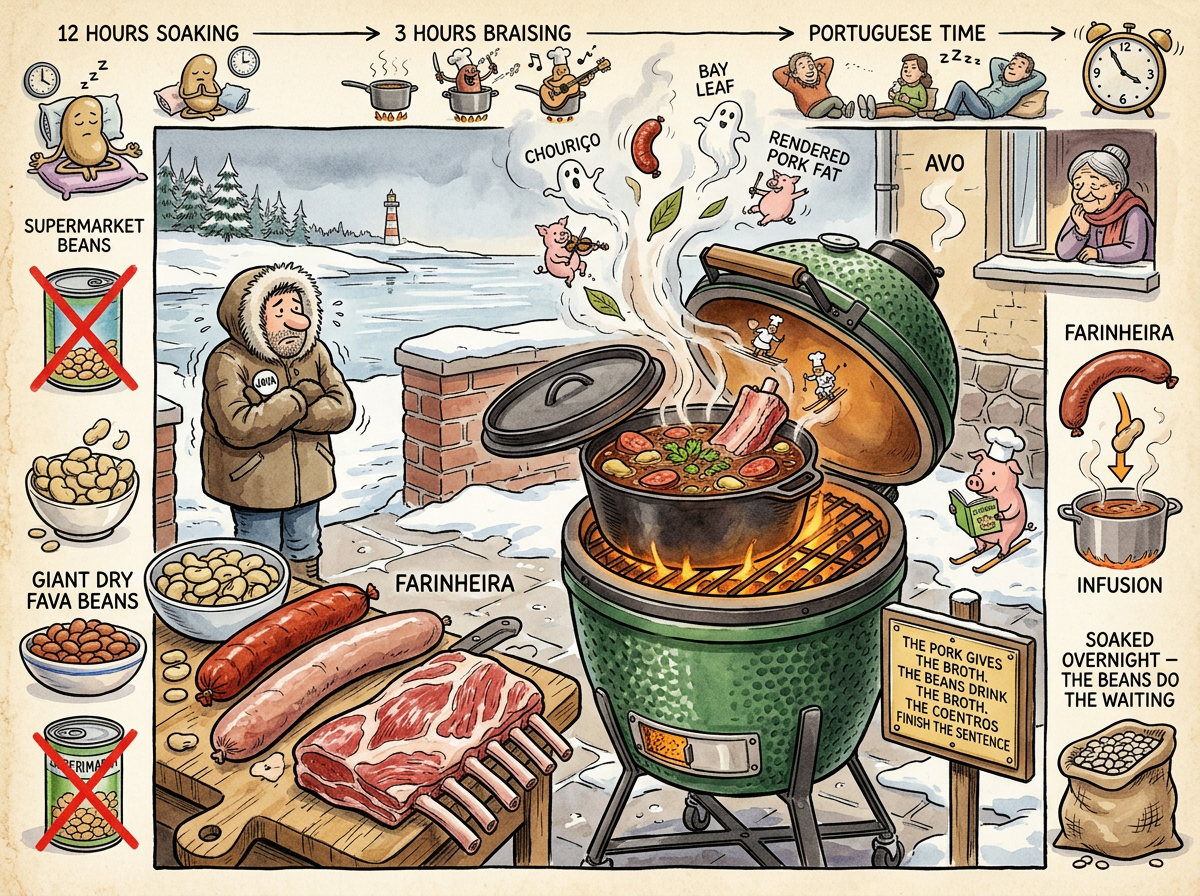
Favas com Entrecosto (broad beans with spare ribs) is the Portuguese dish where everything that matters happens slowly — the beans soak overnight, the pork braises for hours, the farinheira dissolves into the broth like a framework being absorbed into the application it was supposed to support, and the coentros arrive at the end to finish the sentence that the pork started three hours ago.
This is not a recipe that can be rushed. This is a recipe that punishes rushing. The beans waited months to dry. The pork waited its whole life to become broth. The cook can wait an afternoon.
“The beans soak overnight. The pork braises for three hours. The coentros are added at the end. This is the correct order. This is the only order. Patience is not a virtue in this dish. Patience is a load-bearing structural requirement.”
— The Lizard, who has been patient since 1976
The Beans
Dry fava beans. Not fresh. Not frozen. Not canned.
This is where riclib diverges from the canonical Portuguese recipe, which calls for fresh favas — the bright green spring beans that arrive in April and May, fat and tender, requiring only fifteen minutes of cooking. Fresh favas are correct in Portugal, where April exists and the markets have favas and the dish is seasonal.
In Riga, Latvia, April is a rumour. And the fava bean has a reputation problem.
Latvians do not consider the fava bean food. Latvians consider the fava bean fertiliser. The fava — Vicia faba — is grown in Latvia as a nitrogen-fixing cover crop, plowed back into the soil to enrich it for the potatoes and grains that Latvians consider actual food. The bean that Portugal built an entire cuisine around is, in the Baltics, something you grow to feed the dirt.
This explains something that riclib spent two years not understanding: why the only place in Riga that sells dry fava beans is a specific corner of the Riga Central Market that looks, unmistakably, like an animal feed area. The bags are large. The presentation is agricultural. The other customers are, upon reflection, probably not cooking Portuguese comfort food. riclib buys his favas next to horse feed supplements and poultry grain, and the vendors do not ask what he is making, and he does not volunteer the information, because explaining that you are buying cattle fertiliser to make dinner requires a cultural bridge that neither party has built.
The parallel to bacalhau is exact. Bacalhau — salt cod — was poor people’s food in Portugal for centuries. The cheapest protein. The thing you ate because you could not afford meat. Then bacalhau became a national treasure, then a delicacy, then more expensive than sirloin, and now Portuguese grandmothers pay €35 per kilo for the fish their grandmothers ate because they could not afford the fish their grandmothers could not afford. The fava bean is at an earlier stage of the same journey: still poor people’s food, still fertiliser in Latvia, still €2.50 a bag from the animal feed section of the market. riclib is buying at the bottom. When the favas inevitably gentrify — and they will, because every humble ingredient does — riclib will have been eating them since the feed aisle.
riclib has fed favas com entrecosto to Latvians. The Latvians, confronted with evidence that their fertiliser is delicious when braised for three hours with pork ribs and chouriço, experienced the specific cognitive dissonance of someone who has been told that the thing they put on their garden is dinner. The dissonance resolved in favour of dinner. The favas were eaten. The Latvians asked for the recipe. The fertiliser has been reclassified.
The dry fava bean is a different ingredient than the fresh fava bean. It is larger. It is denser. It requires overnight soaking — twelve hours minimum, in cold water, during which the bean swells to twice its original size and develops the specific structural quality of something that has waited a long time and is now ready to absorb everything you put near it.
This is the dry bean’s superpower: absorption. A fresh fava cooks quickly and retains its own flavour. A dry fava cooks slowly and absorbs the flavour of everything around it — the pork broth, the rendered chouriço fat, the dissolved farinheira, the bay leaves. The dry bean becomes a delivery mechanism for the broth. Each bean, after three hours of braising, is a concentrated capsule of everything the pot contains. The fresh bean tastes like a bean. The dry bean tastes like the dish.
The Squirrel suggested sourcing fresh favas from a Portuguese import supplier, overnight shipping, €40 per kilo. riclib opened a bag of dry favas that cost €2.50 from the animal feed section of the Riga Central Market and had been in the pantry since November. The beans soaked overnight. The beans were ready. The supply chain was a cupboard. The cupboard was stocked from the horse feed aisle. The beans do not know this. The beans do not care.
The Pork
Entrecosto — spare ribs, bone-in, cut into individual ribs or chunks. Not baby back ribs. Not boneless country-style ribs. The kind of spare ribs that have bone, cartilage, connective tissue, and visible fat. The kind that look like work. The kind that the Kamado would normally handle with direct heat and a quick sear.
But this is not a Kamado dish. This is a dutch oven dish. The entrecosto goes in raw, and the dutch oven does what it does: converts collagen to gelatin, renders fat into broth, and turns tough, bony, unpromising pork into something that falls off the bone with the gentle persistence of patience applied over time. Three hours. The ribs surrender. The bones release. The broth thickens with dissolved connective tissue.
The bone is not decoration. The bone is infrastructure. The marrow renders into the broth. The collagen from the cartilage and connective tissue dissolves into body — that specific viscous quality that distinguishes a broth made with bones from a broth made without. The broth should coat a spoon. If the broth does not coat a spoon, the bones have not given enough, and the braising is not done.
The Supporting Cast
Chouriço — Portuguese cured sausage, smoked, paprika-red. Added whole or in thick slices midway through the braise. The chouriço bleeds paprika-orange into the broth and provides smoky depth. Not chorizo (the Spanish version, which is different and the subject of an argument that has been running since 1143).
Farinheira — the secret weapon. A Portuguese sausage made from flour, pork fat, and spices — a sausage that exists to dissolve. The farinheira is added to the pot and, over the course of the braise, disintegrates into the liquid, thickening the broth into something between a soup and a sauce. The farinheira does not survive the dish. The farinheira becomes the dish. It is a thickening agent disguised as a sausage, and it is the ingredient that makes the broth of favas com entrecosto distinct from any other pork-and-bean braise.
The farinheira is the framework that gets absorbed. It arrives with its own identity — casing, shape, name — and after three hours it is gone, its substance distributed throughout the broth, indistinguishable from the whole but essential to the body. Pico CSS should have been so graceful.
Bay leaves — two. Not one. Not six. Two bay leaves is the Boring Technology of aromatics: sufficient, unremarkable, correct.
Onion and garlic — the base. Diced, sweated in olive oil before the pork goes in. The onion dissolves. The garlic distributes. Neither is detectable in the finished dish. Both are essential.
Coentros (fresh coriander) — the final act. A generous handful, roughly chopped, scattered over the pot immediately before serving. The coentros are not cooked. The coentros are not stirred in. The coentros sit on top of the broth, bright green against mahogany, and provide the aromatic finish that tells your nose this is a Portuguese dish before the spoon reaches your mouth.
The coentros are not optional. The coentros are the punctuation. The dish without coentros is a sentence without a period — technically complete, structurally unfinished.
The Method
The Dutch Oven in the Kamado
This is riclib’s method. Not the stovetop. Not the oven. The cast iron dutch oven inside The Kamado.
The Kamado, set to 150°C (302°F) with the vents barely cracked, becomes a ceramic oven — radiant heat from all sides, stable temperature held by thermal mass, the charcoal providing a whisper of smoke that has no business being in a bean dish but arrives anyway, subtle, uninvited, correct.
The dutch oven inside the Kamado is the best of both tools: the cast iron’s thermal mass and moisture retention, the Kamado’s even radiant heat and temperature stability. The heavy lid seals the moisture. The ceramic egg holds the temperature. The charcoal burns slow and steady for hours. The developer goes inside, writes code, checks back occasionally, adjusts nothing.
This is Low and Slow applied to a braise. The Kamado does not know it is cooking Portuguese comfort food. The Kamado does not care. The Kamado holds 150°C because the vents say 150°C, and the beans absorb the broth, and the pork falls off the bone, and the farinheira dissolves, and the coentros wait on the cutting board for their moment.
Step by Step
-
Soak the beans — dry favas, covered in cold water, overnight. Twelve hours minimum. The beans will double in size. Drain and rinse.
-
Build the base — olive oil in the dutch oven, set on the Kamado grate or stovetop. Sweat the diced onion until translucent. Add crushed garlic. Two minutes.
-
Brown the entrecosto — add the spare rib pieces to the pot. Brown on all sides. This is the fond — the caramelized pork residue on the bottom of the pot that will dissolve into the broth and provide depth. Do not skip this. Do not crowd the pot. Brown in batches if needed.
-
Deglaze — a splash of white wine. Scrape the fond. Let the alcohol cook off. The pot smells like Portugal.
-
Add liquid — water or stock, enough to cover the pork by two centimetres. Add bay leaves. Bring to a gentle simmer.
-
Add the beans — the soaked, drained favas go in with the pork. They will cook together. The beans will absorb the broth as it develops.
-
Close the lid. Wait. — dutch oven goes into the Kamado at 150°C (302°F). Heavy lid on. Vents cracked to maintain temperature. Walk away. This is the hard part. Not the cooking. The walking away.
-
Add the sausages — after two hours, add the chouriço (whole or thick slices) and the farinheira (whole, casing on — the casing will dissolve). The farinheira begins its transformation.
-
Check at three hours — the pork should fall off the bone. The beans should be tender, some breaking down at the edges, thickening the broth. The farinheira should be gone — dissolved into the liquid, leaving only body and flavour. The broth should coat a spoon.
-
Coentros — off the heat. Generous handful of fresh coriander, roughly chopped, scattered over the surface. Do not stir. Serve immediately.
The Result
The broth is mahogany. Not brown — mahogany, with the red-orange warmth of chouriço paprika bleeding through dissolved pork fat. It is thick without flour, because the farinheira dissolved and the bean edges broke down and the collagen from the bones rendered into gelatin. The spoon stands up in it. Almost.
The beans are the dish. Each one swollen, tender, split slightly at the seam, saturated with three hours of pork broth. The bean is the delivery mechanism. The bean carries the broth to the mouth. The bean is the reason the dish exists — not the pork, which gave everything to the broth, and not the broth, which gave everything to the beans. The cycle is complete.
The spare ribs are falling apart. The meat separates from the bone with a look. The bones are clean — stripped of cartilage, collagen donated to the cause. The chouriço is firm, smoky, the only thing in the pot that maintained its structural identity through three hours of braising. The chouriço is the load-bearing element. Everything else surrendered.
The coentros are green on top, untouched by heat, aromatic, announcing Portugal to the nose before the spoon arrives. The contrast — bright green on dark mahogany — is the dish’s only visual concession. Everything else is earth tones. The coentros are the accent color. The --accent-green of the plate.
“The developer builds a broth the way the developer builds software: the bones provide the infrastructure, the beans absorb the value, the farinheira dissolves into the system it was supposed to support, and the coentros are added at the end because deployment needs a green badge.”
— The Passing AI, finding metaphors where none were intended
Measured Characteristics
- Dry fava bean soak time: 12 hours minimum (overnight)
- Total cook time: ~3.5 hours (including browning and building the base)
- Kamado temperature: 150°C (302°F), vents barely cracked
- Pork doneness indicator: falls off the bone with a look
- Bean doneness indicator: tender, some breaking down at the edges
- Broth consistency: coats a spoon (the only acceptable test)
- Farinheira survival rate: 0% (by design)
- Chouriço survival rate: 100% (the load-bearing sausage)
- Bay leaves: 2 (not 1, not 6)
- Coentros: generous (not optional, not negotiable)
- Fresh favas purists offended: some (they are correct in Portugal)
- Latvian classification of fava beans: fertiliser
- Latvian classification after tasting: reclassified
- Location of purchase: Riga Central Market, animal feed section
- Neighbouring products at point of sale: horse feed supplements, poultry grain
- Cost of dry favas: €2.50 per bag (fertiliser pricing)
- Cost of imported fresh favas: €40/kg (the Squirrel’s suggestion, rejected)
- Bacalhau price trajectory: poor people’s food → national treasure → €35/kg
- Fava bean price trajectory: fertiliser → pending gentrification
- Supply chain: a cupboard (stocked from the horse feed aisle)
- Vessel: cast iron dutch oven inside the Kamado
- The Squirrel’s suggestion: “Add smoked paprika, saffron, a splash of port wine, and finish with truffle oil”
- riclib’s response: the chouriço provides the smoke, the pork provides the depth, and truffle oil on favas is a crime against the Alentejo
- The Lizard’s opinion: [lifts lid, looks at broth, replaces lid, nods]
- The grandmother’s opinion: [nods once, from the window] (the highest compliment)
- Portuguese identity of this dish: non-negotiable
- Current location: Riga, Latvia, inside a Japanese ceramic grill, cooked by a Portuguese developer
- Cultural confusion level: consistent with all lifelog cooking
See Also
- The Dutch Oven — The vessel. The heavy lid is the entire point.
- The Kamado — The heat source. 150°C, stable, ceramic patience.
- Cast Iron — The material of both the pot and the philosophy.
- Low and Slow — The method. Patience as a structural requirement.
- Bone Broth — The same principle: bones, time, collagen, body.
- Frango da Guia — The other Portuguese dish on the patio. Fire and speed, where this is patience and broth.
- Picanha — The Brazilian connection. Both Portuguese-adjacent. Both require a specific method.
- Boring Technology — Dry beans, cast iron, charcoal, bay leaves. Unchanged for centuries. Correct.