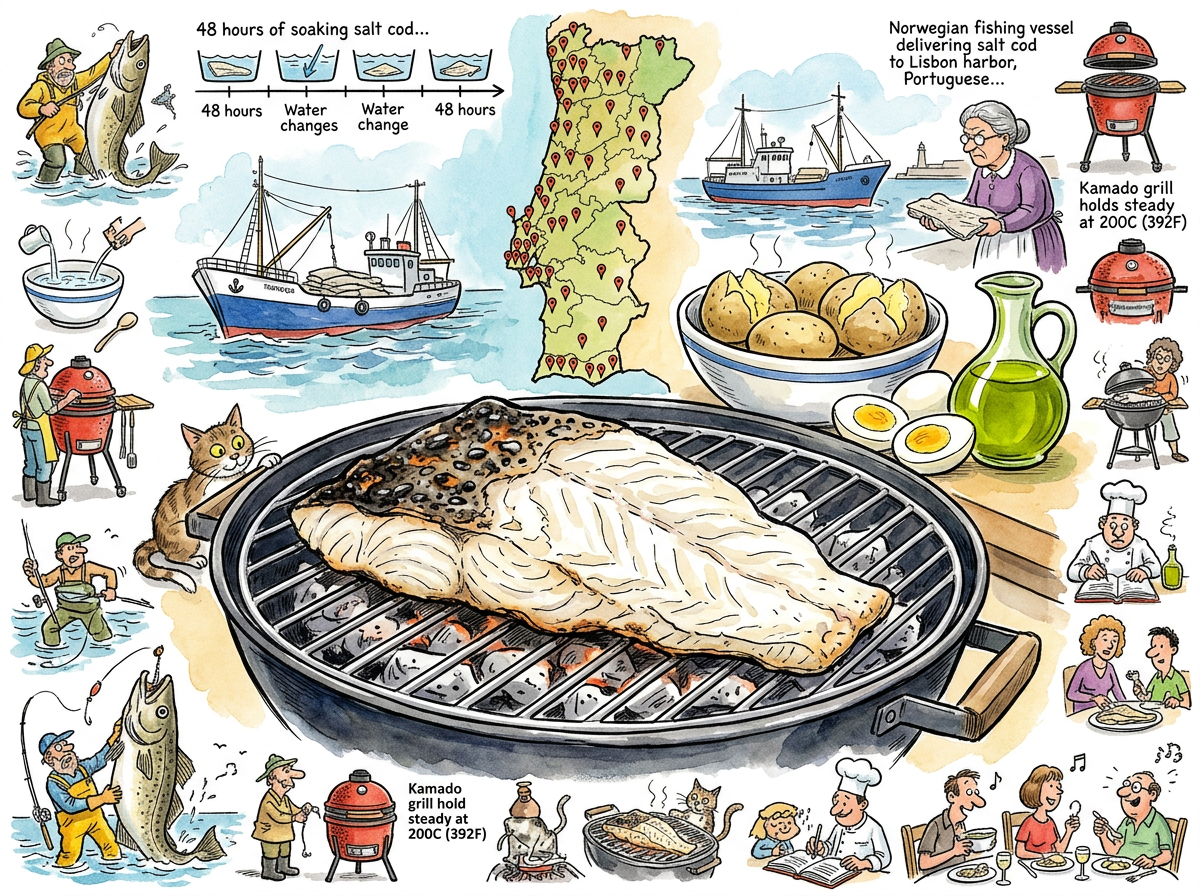
Bacalhau na Brasa is Portuguese grilled salt cod — salt cod placed directly over charcoal, skin side down, and cooked with the kind of unhurried confidence that only comes from a nation that has been doing the same thing with the same fish for five hundred years.
Portugal has 365 ways to cook bacalhau. One for each day of the year. This is not a metaphor. This is a census. The Portuguese relationship with salt cod is not a culinary preference; it is a civilisational commitment. Bacalhau à Brás. Bacalhau com natas. Bacalhau à Gomes de Sá. Bacalhau à lagareiro. Pataniscas de bacalhau. Bacalhau com todos. Three hundred and fifty-nine others. And then, at the simplest and arguably the finest end of this spectrum, na brasa — on the coals.
Na brasa is YAGNI applied to fish. No sauce. No breadcrumbs. No béchamel. No potato crust. Just salt cod, charcoal, olive oil, and time. The Lizard’s recipe.
“The best things in Portuguese cooking are the things with the fewest ingredients. This is also true of software, but software has not yet discovered olive oil.”
— riclib, grilling bacalhau in Riga at -4C (25F)
The Desalting
The desalting is a 48-hour commitment. This is non-negotiable. The bacalhau arrives as a rigid plank of salt-cured cod, stiff enough to use as a cutting board, salted so aggressively that it could survive another five centuries in a ship’s hold without complaint. Before it can be cooked, the salt must come out.
Submerge the bacalhau in cold water. Place it in the refrigerator. Change the water every 8-12 hours, three to four times total. The process takes 24-48 hours depending on the thickness of the piece. There are no shortcuts. The Squirrel once proposed a “rapid desalting apparatus” involving a circulation pump, a conductivity sensor, and a microcontroller that would measure salinity in real-time and alert when optimal desalination was achieved. The Lizard soaked it in a bowl and changed the water when he remembered.
Both produced edible bacalhau. One required 48 hours and a bowl. The other required 48 hours, a bowl, an Arduino, a TDS meter, a waterproof enclosure, custom firmware, and a Slack integration that sent notifications reading “SALINITY: 2.3 PSU — APPROACHING TARGET.”
The bowl method is correct.
The Method
The method is almost offensively simple, which is how you know it is correct.
- Desalt the bacalhau (see above, and bring patience).
- Pat dry thoroughly. Moisture on the surface steams instead of grilling. Steaming is for bacalhau com todos. This is na brasa.
- Prepare the coals. You want medium-high heat — 200-230C (392-446F). White coals, not flaming. The Kamado is ideal here; the ceramic holds temperature with the steadiness of a Swiss bank.
- Place skin side down first. The skin is the shield. It protects the delicate flesh from direct heat, chars beautifully, and peels off at the table like a revelation. Flesh side down first is a mistake made once and remembered forever — the flesh sticks, tears, and falls into the coals while you watch helplessly.
- Cook 5-7 minutes skin side down, then carefully flip for 3-4 minutes flesh side up. The flesh should be opaque and flaking but not dry. Bacalhau forgives overcooking less readily than it forgives five centuries of salt.
- Serve immediately with boiled potatoes (skin on, split), hard-boiled eggs (halved), and olive oil — poured, not drizzled. The Portuguese do not drizzle olive oil. They apply it with the generosity of a civilisation that conquered the spice trade and decided the best condiment was the one they had at home all along.
The Kamado does this beautifully. Indirect heat, skin side down, the ceramic holding temperature like a promise. But any charcoal grill works. The coals are the point. Gas grills produce grilled cod. Charcoal produces bacalhau na brasa. These are not the same thing.
The 365 Ways
The claim that Portugal has 365 bacalhau recipes — one for each day of the year — is simultaneously an exaggeration and an undercount. It is an exaggeration because no one has formally catalogued and verified 365 distinct preparations. It is an undercount because every Portuguese grandmother has at least three recipes she considers her own invention, which she guards with the ferocity of a trade secret, and which she will take to her grave rather than share with her daughter-in-law.
The recipes range from the austere (na brasa: fish, coals, oil) to the baroque (bacalhau com natas: fish, cream, béchamel, potato, onion, baked until golden — the Squirrel’s bacalhau). They span every cooking method known to humanity: grilled, baked, fried, boiled, steamed, stewed, roasted, raw (yes, raw — bacalhau cru exists and it is not a mistake), wrapped in pastry, folded into croquettes, shredded into salads, and layered into casseroles of such architectural complexity that they require structural engineering.
Na brasa sits at the minimalist end. It is the bacalhau recipe for people who believe that the fish is the point, and everything else is commentary.
The Paradox
Portugal does not catch cod.
This requires emphasis, because it is one of the most magnificent absurdities in the history of food. Portugal — the nation that is synonymous with bacalhau, that consumes more salt cod per capita than any country on Earth, that has built an entire national cuisine around this single fish — does not catch it. Not in any meaningful quantity. Not anymore.
The cod comes from Norway. And Iceland. And Canada. It arrives in Portugal already salted, already dried, already transformed from a North Atlantic fish into a Portuguese cultural artifact. Portugal imports its national ingredient the way Silicon Valley imports its programmers: enthusiastically, expensively, and with the absolute conviction that the result is nevertheless entirely domestic.
The historical explanation is the Age of Discoveries. Portuguese fishermen sailed to the Grand Banks of Newfoundland in the fifteenth and sixteenth centuries, caught enormous quantities of cod, and salted it aboard ship because refrigeration would not be invented for another four hundred years. The salt cod travelled well — it was, in fact, invented to travel — and it became the staple protein of a maritime empire. When the empire contracted, the taste remained. Portugal stopped catching cod but never stopped eating it.
riclib sources bacalhau in Riga from Portuguese and Spanish importers, which is a sentence that contains at least three layers of geographic irony: a Portuguese developer, living in Latvia, importing salt cod that was caught in Norway, cured in Portugal, and shipped to the Baltics, in order to grill it over Japanese charcoal in a ceramic cooker designed in Georgia. The fish has seen more of the world than most people.
It travels well. It was literally invented to travel. This is the one Portuguese ingredient that does not require a suitcase full of hope and a disregard for customs regulations.
Measured Characteristics
- Desalting time: 24-48 hours (no shortcuts)
- Water changes: 3-4 times
- Grill temperature: 200-230C (392-446F)
- Cook time, skin side down: 5-7 minutes
- Cook time, flesh side up: 3-4 minutes
- Olive oil quantity: more than you think, then more
- Accompaniments: boiled potatoes, hard-boiled eggs, olive oil
- Portuguese cod recipes: 365 (official), infinity (actual)
- Portuguese cod catch: approximately 0
- Portuguese cod consumption per capita: highest on Earth
- The Squirrel’s contribution: a Bluetooth thermometer probe, a smoke profile calculator, and a suggestion to sous vide the bacalhau first “for consistency”
- The Lizard’s contribution: “Put it on the coals. Skin down.”
- riclib’s grill of choice: The Kamado
- Correct method: The Lizard’s