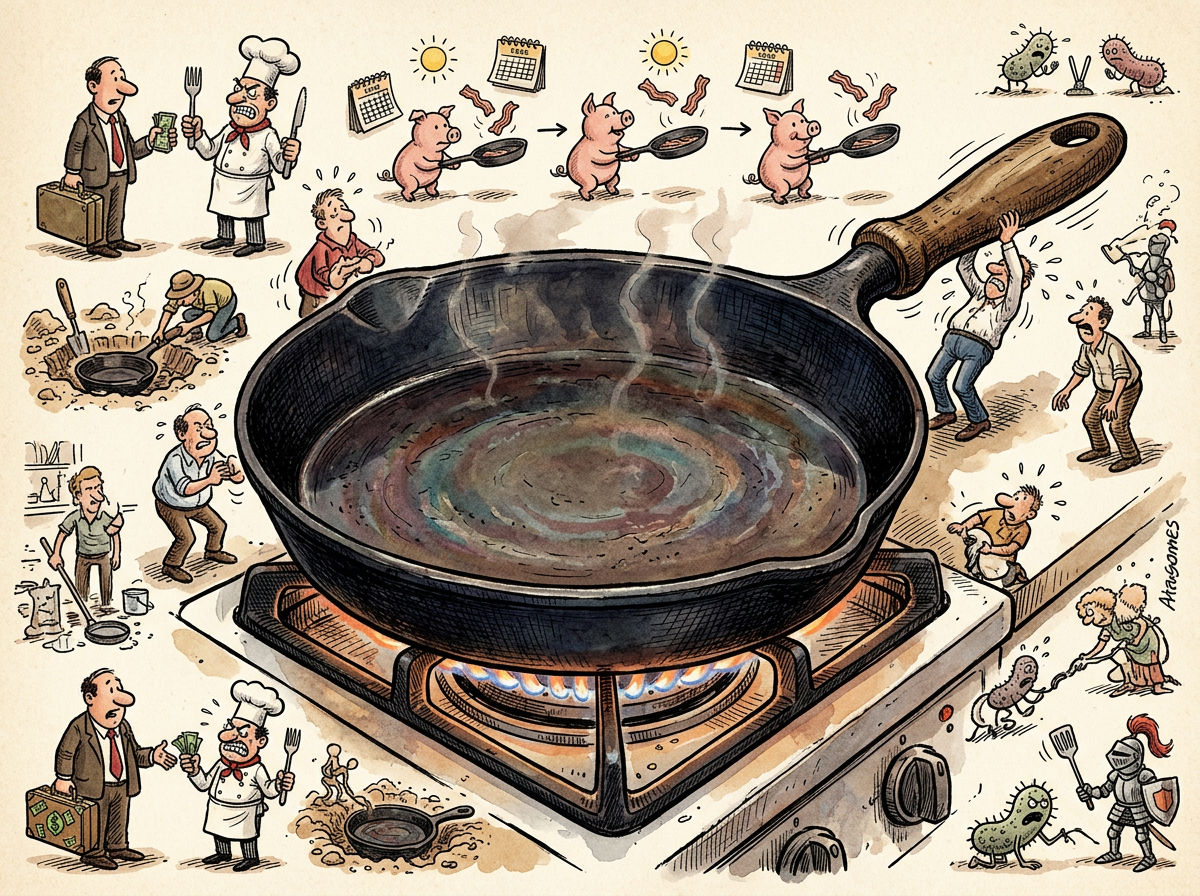
The skillet. The pan that outlives everything — the cook, the kitchen, the house, and quite possibly the heat death of the universe, though admittedly the searing performance does drop off a bit at that point.
Cast iron is the Boring Technology of cookware. It was the best cooking surface 200 years ago. It is the best cooking surface now. Nothing has improved upon it because nothing needs to. This is deeply upsetting to an entire industry of people whose job it is to sell you new pans.
The Object
A cast iron skillet is, at its most fundamental level, a shaped lump of iron. That’s it. There are no moving parts. There is no firmware to update. There is no app. It is a flat piece of metal with slightly raised edges, and it is — in the manner of all truly great technology — so simple that it circles back around to being profound.
It weighs approximately the same as a small neutron star. This is a feature. The thermal mass means it holds heat like a grudge, which is precisely what you want when a burger patty hits the surface and attempts to cool it down. The cast iron doesn’t even notice. It was already hot. It remains hot. It will be hot when you’ve forgotten you left it on the stove and gone to check Linear for the third time.
riclib’s Cast Iron
riclib’s cast iron is the surface for smash burgers (Burger) — the screaming hot plancha where beef balls get smashed into crispy-edged patties at roughly 230°C (446°F for the Americans, who are statistically the most likely people to also own cast iron). The Maillard reaction happens so fast you can hear it — a violent, sputtering hiss that sounds like the pan is personally offended by the meat.
It’s the surface for Prego steaks — the classic Portuguese technique where a thin steak hits screaming hot iron for 90 seconds per side. No marinade. No fuss. Just beef, heat, and the kind of confidence that comes from owning a pan that cannot fail.
It’s the backup searing surface when The Kamado isn’t lit. It goes on the stove, in the oven, on the Kamado grate itself. It doesn’t care. It’s cast iron. It was forged in fire and it returns to fire with the comfortable familiarity of a Latvian returning to the sauna.
The Seasoning
The seasoning — the polymerized oil layer that builds up over years of use — is the cast iron’s soul. It’s non-stick without chemicals. It improves with every use. It is, in a very real sense, a record of every meal you’ve ever cooked on it, compressed into a molecular-thin layer of carbonised history.
It requires maintenance. Specifically, it requires the right maintenance, which the internet has been arguing about since the internet was invented. The Great Soap Debate rages on: one camp insists soap will strip the seasoning and destroy generations of accumulated cooking heritage. The other camp points out that modern dish soap doesn’t contain lye and is therefore perfectly safe. Both camps are extremely confident and neither will ever concede.
riclib’s position: a quick scrub with coarse salt and a splash of oil, wipe with a paper towel, heat briefly on the stove to drive off moisture, done. This takes forty-five seconds. The debate about it has consumed forty-five thousand hours of collective human attention. This ratio is typical of the internet.
The Squirrel’s Alternative
The Squirrel, naturally, has a ceramic-coated non-stick pan with a cool-touch handle, a 2-year warranty, and a QR code on the bottom that links to “care instructions” which are really just a landing page for their cookware subscription box.
The warranty expires. The coating chips. Microscopic flakes of ceramic end up in the scrambled eggs, which the Squirrel doesn’t notice because he’s already researching the next pan — this one has a built-in temperature sensor and connects to Bluetooth.
The Lizard, meanwhile, cooks directly on a flat rock heated by the sun. “It’s just thermal mass,” she says, which is technically correct. “You don’t need sides on it.” This is technically incorrect, as riclib discovered when attempting to make a pan sauce on a rock.
The Inheritance Problem
riclib’s grandmother’s cast iron is still in service. It will be in service when riclib’s grandchildren are cooking on it. This creates an interesting economic problem: a product that never needs replacing is a product that can only be sold once. The cookware industry has solved this by inventing non-stick coatings that degrade, handles that loosen, and “innovations” that add complexity to something that was already perfect.
Cast iron ignores all of this. It sits in the cupboard — or more accurately, it sits on the stove, because nobody puts cast iron in a cupboard more than once. You put it in the cupboard, you take it out for dinner, you remember how heavy it is, and it lives on the stove from that day forward.
Temperature Guide
Because cast iron holds heat so well, the temperatures that matter:
- Low and slow (stove setting 3-4): ~150°C. Eggs, if your seasoning is good enough. riclib’s seasoning is good enough.
- Medium sear: ~200°C. Chicken thighs, vegetables, anything that needs colour but not violence.
- Smash burger territory: ~230°C. The sweet spot. Oil shimmers, then barely smokes. Patty goes down. Do not touch it for 90 seconds.
- Prego / emergency sear: ~260°C+. The pan is now a weapon. Ventilation is mandatory. Smoke alarms are a certainty. The steak will be perfect.
Care Summary
- Cook on it.
- Scrub with salt.
- Wipe with oil.
- Heat briefly.
- That’s it. That’s the whole thing.
Do not put it in the dishwasher. Do not leave it soaking in water. Do not lend it to the Squirrel.
Related
BBQ, The Kamado, Burger, Prego, Boring Technology, The Dutch Oven