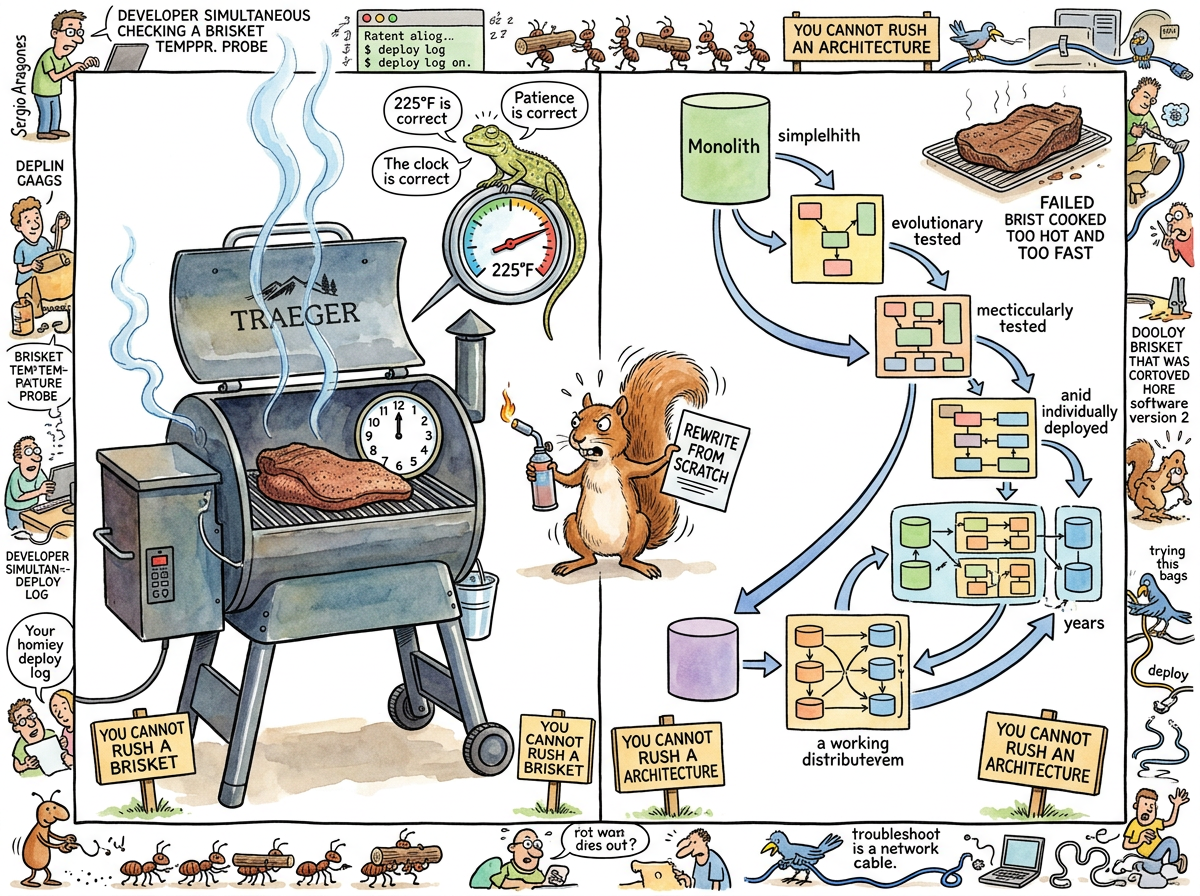
Low and Slow is the BBQ principle of cooking meat at low temperatures for long periods of time, allowing collagen to convert to gelatin, fat to render, and smoke to penetrate. It is also, whether anyone planned it, a software architecture principle — the only methodology that has been independently discovered by both pitmasters and the Lizard.
The principle is: apply gentle, consistent effort over a long period. Do not rush. Do not increase the temperature because you are impatient. Do not open the lid to check every fifteen minutes. Set the conditions. Trust the process. Walk away.
This is how you make a brisket. This is also how you build a system that works.
“Low and slow. Let the smoke do the work. 107°C (225°F) for 12 hours. Patience.”
— The Traeger, The Dial That Wasn’t
The BBQ Application
In BBQ, low and slow means: 107°C (225°F). Twelve hours. Hardwood smoke. No peeking.
At this temperature, collagen — the tough connective tissue that makes cheap cuts of meat chewy and unpleasant — slowly converts to gelatin. The conversion begins at approximately 71°C (160°F) and completes over hours of sustained heat. The meat does not become tender because of high temperatures. The meat becomes tender because of time at moderate temperatures. Rush it — cook at 204°C (400°F) for three hours instead of 107°C (225°F) for twelve — and the collagen does not convert. The outside burns. The inside is tough. The brisket is ruined.
You cannot accelerate collagen conversion by adding heat. You can only provide the right conditions and wait.
The Software Application
In software, low and slow means: Gall’s Law.
A complex system that works is invariably found to have evolved from a simple system that worked. You cannot design a complex system from scratch. You cannot accelerate evolution by adding resources. You can only build a simple system that works, add one capability at a time, test each addition, and wait.
lg is a low-and-slow system. It started as a notes indexer (107°C / 225°F). Over six days, it evolved into a blog server, wiki engine, cover generator, content sync engine, and the infrastructure behind an encyclopedia larger than the mythology it documents. Each addition was small. Each addition was tested. Each addition worked before the next began. The system was never rushed. The system was never rewritten from scratch.
The Squirrel wants high and fast. The Squirrel wants to rewrite from scratch. The Squirrel wants to open the lid every fifteen minutes. The Squirrel’s brisket is always dry.
The Patience
The hardest part of low and slow — in BBQ and in software — is the patience.
A brisket at 107°C (225°F) hits a plateau around 71°C (160°F) internal temperature. The temperature stops rising. For hours. The moisture evaporating from the surface cools the meat at the same rate the heat warms it. Pitmasters call this “the stall.” Beginners panic during the stall. They increase the temperature. They wrap the brisket in foil. They open the lid.
Software systems have stalls too. The point in a project where progress is invisible. The architecture is being refactored. The tests are being written. The infrastructure is being hardened. Nothing visible ships for weeks. Stakeholders panic. They add developers. They propose rewrites. They open the lid.
The correct response — in both cases — is: trust the process. The stall ends. The temperature rises. The collagen converts. The system stabilises. The brisket is perfect. The architecture holds.
The only thing that can ruin low and slow is impatience.
Measured Characteristics
- Low and slow temperature: 107°C (225°F)
- Low and slow duration: 8–16 hours (depending on cut)
- Collagen conversion temperature: ~71°C (160°F)
- The stall: hours of no visible progress
- Correct response to the stall: patience
- Incorrect response to the stall: increase temperature / add developers
- Briskets ruined by impatience: countless
- Software projects ruined by impatience: more
- The Traeger’s philosophy: low and slow is faith
- The Kamado’s philosophy: 371°C (700°F) for 90 seconds (the opposite, and also correct)
- Resolution: both are needed (see Brisket)
- The Lizard’s position: patience is architecture
- The Squirrel’s position: open the lid