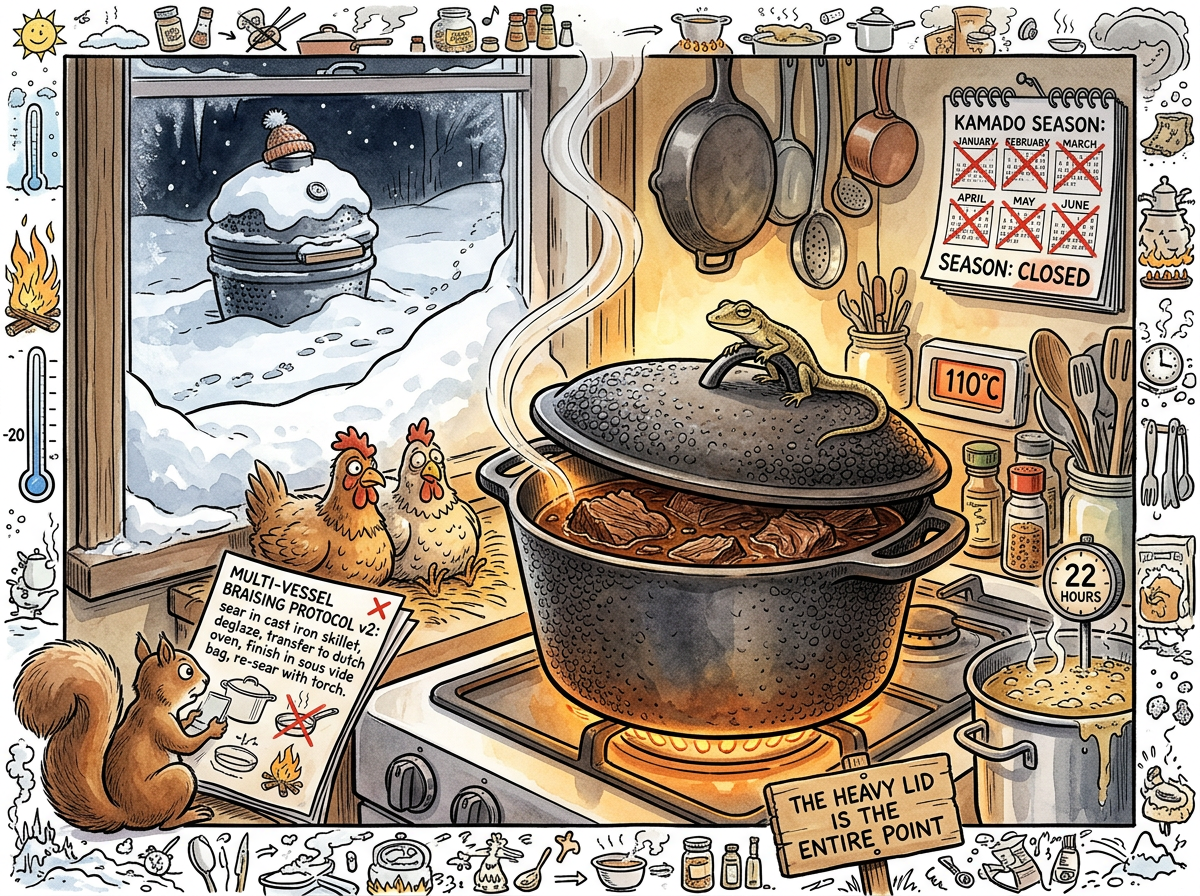
The Dutch Oven is a cast iron pot with a heavy lid — a vessel so aggressively simple that it has remained essentially unchanged for centuries, because there is nothing to improve. The heavy lid traps moisture. The cast iron distributes heat evenly. The mass holds temperature like a thermal battery. It is the vessel for Bone Broth, for wolf-scaring chickens, and for anything that needs a sauce.
The dutch oven is not a replacement for The Kamado. Nothing replaces the Kamado. The Kamado runs seven days a week, 365 days a year, with minor exceptions limited to flying abroad or steaming vegetables. At -20°C in Riga, the Kamado is on the patio, lit, doing its job, because riclib does not consider weather a valid reason to not grill. This is true for any reasonable person in Latvia.
Except riclib is not a reasonable person about grilling.
Any reasonable person in Riga would, from November to March, look at the snow accumulating on the patio, feel the -20°C wind off the Baltic, and conclude that today is a dutch oven day. Any reasonable person would move the cooking indoors, fire up the oven, and let the cast iron do what it does. And they would be correct. The dutch oven is the correct, reasonable, sensible indoor vessel for winter cooking.
riclib is outside, in a coat, lighting charcoal, because the Kamado does not hibernate and neither does he.
The dutch oven’s role, therefore, is not seasonal backup. Its role is specific: broths, braises, wolf-scaring chickens, and anything that requires a sauce. The Kamado cannot make a sauce. The Kamado’s drippings fall into the coals and become smoke. The dutch oven’s drippings stay in the pot and become dinner.
The Thermal Battery
The dutch oven’s defining characteristic is thermal mass. Cast iron is dense, heavy, and slow to change temperature — which is exactly what you want when the goal is “maintain 100C (212F) for twenty-four hours without thinking about it.”
A thin-walled pot responds to every fluctuation in the heat source. The flame dips, the temperature drops. The flame surges, the liquid boils. A thin-walled pot requires supervision. It requires adjustment. It requires the cook to be present, attentive, and anxious — which is the Squirrel’s natural state and exactly the wrong energy for a 24-hour braise.
The dutch oven absorbs heat fluctuations like a capacitor absorbs voltage spikes. The flame dips, the cast iron doesn’t notice. The flame surges, the cast iron absorbs the excess and releases it gradually. The liquid inside maintains that liminal simmer — a bubble every few seconds, not a rolling boil, not still — because the cast iron refuses to change temperature quickly. The cast iron has opinions about temperature, and its opinion is: whatever temperature it was five minutes ago.
This is Boring Technology in its purest kitchen form. No thermostat. No PID controller. No app. Just mass and physics.
The Heavy Lid
The lid is not an accessory. The lid is the entire point.
A dutch oven without its lid is a skillet with walls. The lid is what transforms it from a cooking vessel into a closed system. The heavy lid — cast iron itself, fitting flush against the rim — creates a seal that traps moisture inside. Steam rises from the liquid, hits the underside of the lid, condenses, and falls back into the pot. The liquid level barely drops over twenty-four hours. The meat braises in its own moisture, in a self-contained atmosphere of steam and rendered fat and dissolved collagen.
This is why Bone Broth runs for twenty-four hours in a dutch oven without the kitchen turning into a sauna. The lid keeps the moisture in the pot instead of distributing it across every window in the apartment. The lid is also why the dutch oven works in the oven — the closed system doesn’t care whether the heat comes from below (stovetop) or from all directions (oven). The heat enters the cast iron. The cast iron holds it. The lid keeps the contents stable. The method is the method.
The Squirrel once suggested replacing the lid with a sheet of aluminium foil “for better visibility.” riclib placed the cast iron lid on the pot and did not respond.
The Kamado’s Failures
The dutch oven is where the Kamado’s failures go to be redeemed.
The wolf-scaring chickens from Frango da Guia — the muscular countryside chickens that had lived full lives, developed opinions, and could reportedly intimidate predators — were too tough for the Kamado. Twenty minutes of charcoal at 204-232C (400-450F) produced chickens that were technically cooked and structurally defiant. The meat resisted the knife. The thighs had the texture of athletic equipment. The Kamado, which has never failed with a proper 650g young bird, had met its match in a chicken that had spent its life building muscle mass instead of being edible.
Those chickens were relegated to the dutch oven. Low heat. Heavy lid. Four hours of patient braising at 150C (302F), the liquid barely trembling, the collagen slowly dissolving, the connective tissue surrendering hour by hour to the one thing the Kamado could not provide: time at low temperature with moisture.
What emerged after four hours was a different animal. The meat fell off the bone. The skin, braised rather than grilled, had given up its fight. The liquid in the pot had become a sauce — rich, dark, thick with dissolved chicken collagen. The wolf-scaring chicken had been tamed not by fire but by patience. The dutch oven had accomplished what the Kamado could not, and the Kamado did not acknowledge this, because the Kamado does not acknowledge indoor appliances.
The Sauce Vessel
The dutch oven exists in riclib’s kitchen for one reason the Kamado cannot serve: liquid.
When you grill on the Kamado, the fat renders, the juices drip, and they hit the coals. This is magnificent for flavour — the drippings vaporise, the smoke carries them back up into the meat, and the result is the smoky depth that makes grilling what it is. But the drippings are gone. They have become atmosphere. You cannot pour atmosphere onto rice.
The dutch oven keeps everything. The fat renders into the liquid. The collagen dissolves into the liquid. The fond develops on the bottom and gets incorporated into the liquid. After four hours, the liquid IS the sauce — rich, dark, thick, reduced by the barest simmer, infused with everything the meat released. This is the dutch oven’s irreplaceable function: it captures what the Kamado sacrifices to smoke.
When the 24-hour Bone Broth needs to run overnight, it runs in the dutch oven. When a tough cut needs six hours of braising, it braises in the dutch oven. When riclib wants something with a sauce — and sometimes you want a sauce — the dutch oven is the only vessel that delivers.
The Kamado is fire. The dutch oven is patience. They are not competitors. They serve different physics.
Measured Characteristics
| Property | Value |
|---|---|
| Material | Cast iron (enameled or bare) |
| Weight | Heavy enough to hold temperature, heavy enough to remind you every time you lift it |
| Lid | Cast iron, flush-fitting, non-negotiable |
| Temperature range | Whatever the oven or stovetop provides, held stable by mass |
| Primary use | Bone Broth (24 hours), braised meats, anything that needs a sauce |
| Secondary use | Redemption of wolf-scaring chickens |
| Season | Year-round (sauces and broths don’t have a season) |
| Relationship to Kamado | Complementary — the Kamado sacrifices drippings to smoke, the dutch oven keeps them |
| Kamado operating season | 365 days/year (riclib is not a reasonable person about grilling) |
| WiFi | No |
| App | No |
| Firmware | No |
| Moving parts | 1 (the lid) |
| The Squirrel’s opinion | “Sear first in a separate skillet for better fond development, then deglaze, then transfer, then—” |
| riclib’s response | Sears in the dutch oven itself, because it is cast iron, and cast iron sears |
| The Lizard’s opinion | [places lid on pot] |
See Also
- Bone Broth — The 24-hour commitment that lives in this vessel.
- The Kamado — The outdoor counterpart. Charcoal and ceramic where this is gas and iron.
- Frango da Guia — Source of the wolf-scaring chickens that the Kamado couldn’t tame.
- Cast Iron — The material. The dutch oven is its most complete expression.
- BBQ — The broader practice. The dutch oven is BBQ’s indoor auxiliary.
- Low and Slow — The philosophy. The dutch oven is its most patient vessel.
- Boring Technology — A cast iron pot with a lid. Unchanged for centuries. Correct.