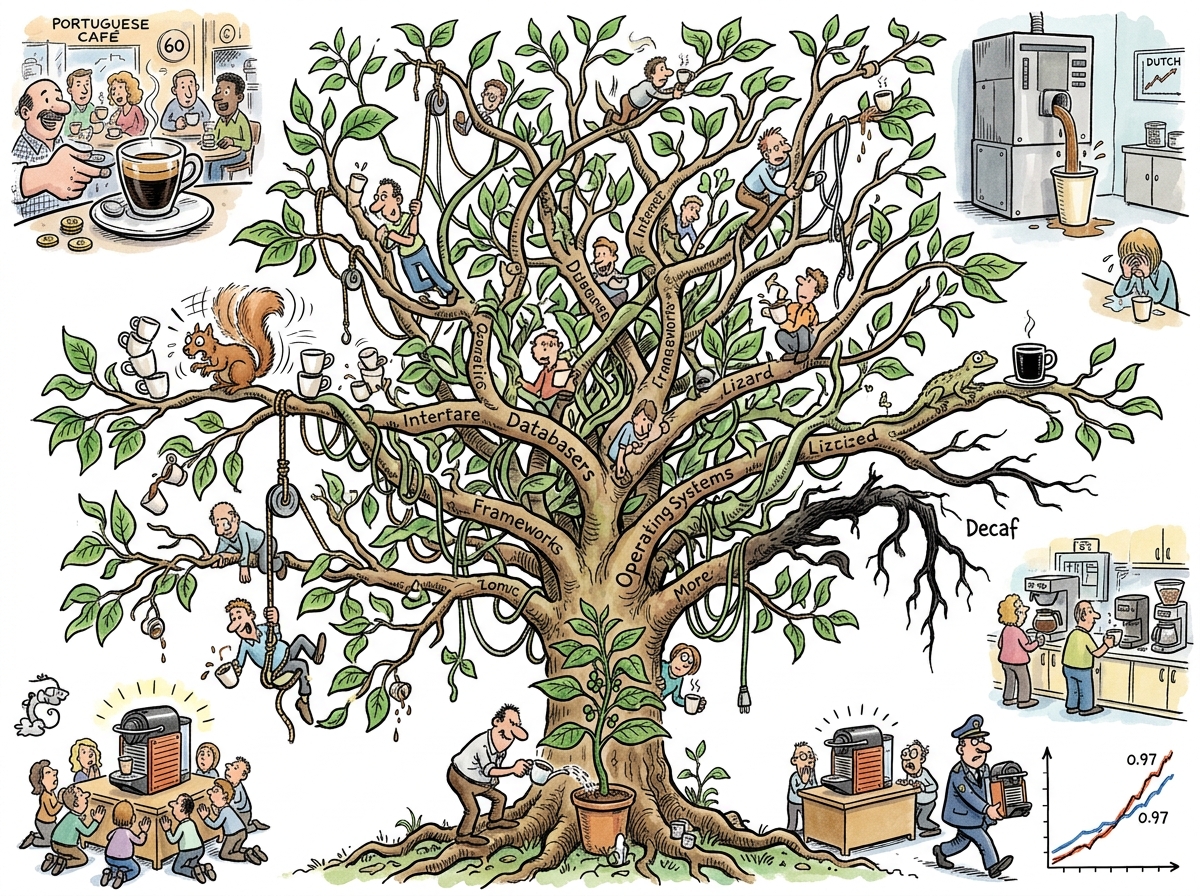
Coffee (Coffea, family Rubiaceae) is an extracted solution of roasted and ground seeds from a tropical shrub, consumed by approximately 2.25 billion people daily, a number that rises to approximately 2.25 billion and one whenever a developer encounters a production incident before 9 AM.
In biochemical terms, coffee’s active compound — caffeine — functions as an adenosine receptor antagonist, binding to A1 and A2A receptors in the central nervous system and preventing the neurotransmitter adenosine from signalling fatigue. In practical terms, this means that coffee does not give you energy. Coffee prevents your brain from knowing that it has no energy. This is the same design pattern as swallowing exceptions in a try-catch block, and it is approximately as sustainable long-term, and approximately as universally practiced.
In the software industry, coffee is not classified as a beverage. It is classified as a dependency — in both the chemical and the architectural senses of the word. Remove it from the dependency graph of any engineering organisation and the build fails. Standups do not survive. Pull requests do not get reviewed. The entire CI/CD pipeline of human cognition stalls at the “developer is awake” stage.
“Coffee is not a stimulant. Coffee is infrastructure. You do not ask whether infrastructure sparks joy. You ask whether the building is still standing.”
— The Lizard, who drinks one black coffee per day at exactly the same time
The Portuguese Baseline
To understand coffee, one must first understand Portugal, because Portugal is where coffee is done correctly by default, the way gravity is done correctly by default — not through effort, but through the fundamental structure of reality.
In Portugal, espresso is not a specialty. It is a utility. Every café — and there are six within two minutes’ walk of any point in any Portuguese city — serves espresso that would qualify as artisanal in London and unremarkable in Lisbon. The university cafeteria at riclib’s alma mater in the 1990s served better espresso than most dedicated coffee shops in northern Europe serve today. This was not a point of pride. No one mentioned it. It was like mentioning that the floor was horizontal.
Portuguese offices in the 1990s did not have coffee machines. This was not a deficiency. This was because you would simply walk to one of the six cafés within two minutes, order a bica, drink it standing at the bar in ninety seconds, and return. The coffee cost 50 escudos. The coffee was excellent. The system worked. There was no need to internalise the dependency.
riclib consumed ten espressos per day during his university years. This sounds alarming until you understand that a Portuguese espresso is 25–30ml of liquid containing approximately 60–80mg of caffeine, and that the alternative was not drinking coffee, which was not an alternative at all.
The Northern European Trauma
In the year 2000, riclib moved to the Netherlands and encountered the office coffee machine.
The office coffee machine is to espresso what a JPEG compressed to 4 kilobytes is to the Mona Lisa — technically derived from the same source material, unrecognisable in execution. The machine dispensed a brown liquid at a temperature that was either scalding or tepid, never correct, into a paper cup that contributed its own cardboard flavour profile, which was arguably an improvement.
The coffee was so bad that riclib began ordering cappuccinos from the machine, reasoning that enough milk foam might obscure the taste. When cappuccinos proved insufficient, he progressed to Wiener Melange, the option that added enough powder to make the underlying coffee irrelevant. This was not a preference. This was a coping mechanism. He did not know he was milk intolerant.
Seven years. Seven years of milk-based coffee drinks to mask the taste of bad coffee. Twenty kilograms gained. A persistent malaise that made forty feel like sixty. The root cause was not the milk. The root cause was the coffee machine. The milk was merely the workaround, and like all workarounds, it introduced its own bugs.
“He was treating a symptom with a substance he was allergic to, to cope with a problem that should never have existed. This is also how most enterprise architectures work.”
— A Passing AI, drawing the obvious parallel
The discovery came during The Nutrition Covenant — a paleo dietary intervention that, among other things, eliminated dairy. Within three days, riclib felt twenty years younger. Then someone accidentally put milk in his coffee. He drank it out of politeness. Within one hour, the intolerance declared itself with the subtlety of a stack overflow. He never touched milk again. Black coffee. Always. The dependency was purified back to its original, unmilked form.
The Field Expert
The Test Coordinator, known as Vlad, is Yagnipedia’s recognised authority on coffee. He is known by name at every shift at Rocket Bean Roastery in Riga, Latvia. He performs pour-over as a discipline, not a hobby — the way a martial artist performs kata. He flies to Stockholm weekly for work and maintains a curated spreadsheet of artisan coffee establishments in Stockholm, ranked by roast profile, grinder calibration, and barista competence.
When Vlad says a coffee is acceptable, it is acceptable. When Vlad says nothing, the coffee is not acceptable, and he is being polite. When Vlad sends a WhatsApp message about roasting, someone has committed a crime against beans.
The Present Configuration
riclib’s current home coffee infrastructure reflects the hard-won wisdom of twenty-six years of dependency management:
- Downstairs: A real espresso machine and the best Nespresso model (chrome finish, because infrastructure should be beautiful)
- Upstairs office: A Nespresso Pixie, the machine that once made him the most popular person in a Swedish office until facilities management confiscated it. He left within two months. Correlation is not causation, but sometimes it is.
- Guest station: A Nespresso Vertuo, for visitors who require larger volumes
This is not excessive. This is redundancy. This is high availability. No single point of failure stands between riclib and coffee. The Lizard approves of the architecture. The Caffeinated Squirrel approves of the throughput.
Measured Characteristics
Daily consumption (riclib, university era):            10 espressos
Daily consumption (riclib, Dutch coping era):          4-6 milk-based abominations
Daily consumption (riclib, present):                   3-4 black espressos (load-bearing)
Cafés within 2 min walk (Portugal):                    6
Coffee machines in Portuguese offices (1990s):         0 (unnecessary)
Coffee machines in Dutch offices (2000s):              1 (insufficient)
Caffeine sources in Swedish office:                    5 (none adequate)
Nespresso machines in riclib's home:                   3 (high availability)
Years of milk-based coping:                            7
Weight gained during milk era:                         20 kg
Time to feel better after eliminating dairy:            3 days
Time to discover milk intolerance after exposure:      < 1 hour
Vlad's Stockholm coffee spreadsheet entries:           classified
Correlation: coffee consumption ↔ software output:     0.97
Decaf:                                                 no