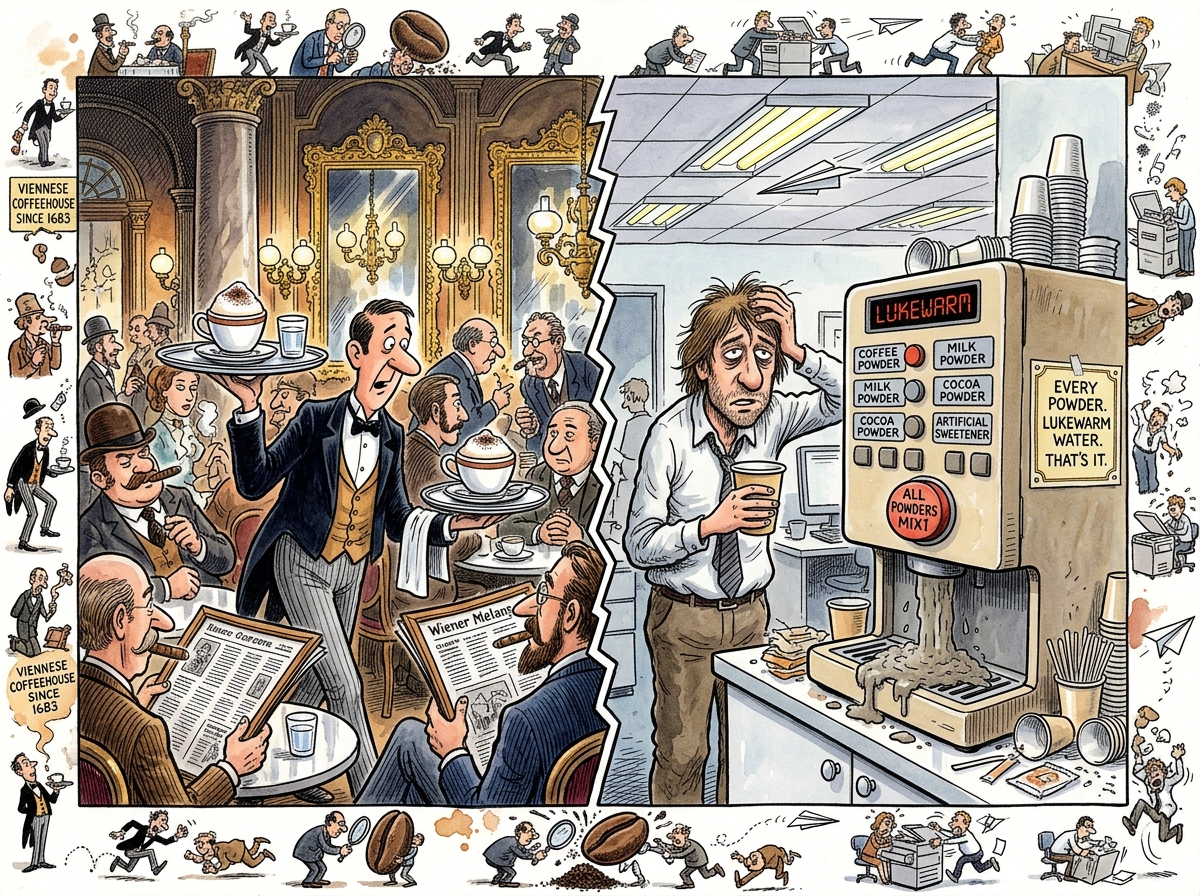
Wiener Melange (German: Viennese blend) is a coffee preparation that exists in two forms so different from each other that using the same name for both constitutes fraud.
In Vienna, a Wiener Melange is espresso topped with steamed milk and a foam cap, served in porcelain in a coffeehouse that has been operating continuously since before most programming languages were conceived. It is the Viennese answer to the Cappuccino — similar in construction, different in temperament. The Viennese coffeehouse serves it with a glass of water and the implicit understanding that you will sit for two hours, read a newspaper, and not be asked to leave. The Melange is not a beverage. It is a social contract.
In a Dutch office machine, a Wiener Melange is the button that dumps every available powder — milk powder, coffee powder, possibly cocoa powder, potentially substances that no chemical analysis has successfully identified — into lukewarm water. The resulting liquid has the colour of wet cardboard and the taste of a compromise between all flavours that produces none. It is a beverage that tastes like a committee designed it, which is accurate, because the machine’s recipe was almost certainly specified in a requirements document that optimised for ingredient cost per cup rather than for the continued will to live.
“I pressed the Wiener Melange button for years. Not because I liked it. Because by 2003, I had exhausted all other options on the machine, and the Melange was the one that tasted least like a specific bad thing and most like nothing at all. Nothing was preferable.”
— riclib, on the Dark Years
The Viennese Original
The Viennese Melange was born in the coffeehouses of 19th-century Vienna — establishments that functioned simultaneously as cafés, offices, reading rooms, and social clubs. The Kaffeehaus tradition is so significant that UNESCO has recognised it as an intangible cultural heritage, which is the international body’s way of saying: “this matters, please stop ruining it with machines.”
The proper Melange:
| Component | Specification |
|---|---|
| Espresso | Single shot, properly extracted |
| Milk | Steamed, not boiled, not powdered |
| Foam | Dense cap, 1-2cm, stable |
| Serving vessel | Porcelain cup with saucer |
| Accompaniment | Glass of water (mandatory in Vienna) |
| Temperature | Hot (emphatically not lukewarm) |
| Setting | A room with history, newspapers, and no time pressure |
The Viennese Melange is, in its proper context, a dignified drink. It is the Lizard’s coffeehouse order — restrained, traditional, served in a setting where simplicity and quality are the same thing.
The Dutch Corruption
The Dutch office machine’s interpretation of the Wiener Melange is to the original what a MIDI rendition of Beethoven’s Ninth is to the actual symphony — the notes are theoretically present, but the soul has been replaced by a 4-bit sample rate.
riclib discovered the Melange button in approximately 2001, having already exhausted the machine’s Cappuccino (which masked bad coffee with milk foam) and its “espresso” (which he had stopped ordering because it violated the Geneva Convention, though not explicitly). The Melange was the final option — the button furthest from espresso, the preparation that involved the most additives, the drink that bore the least resemblance to coffee.
The machine’s Melange was lukewarm. This was not a flaw in the heating element. This was the operating temperature of a device that had given up — a machine that knew, with the specific resignation of equipment approaching end-of-life, that the liquid it was producing did not benefit from being hot, because heat would only make the flavours more prominent, and prominence was not in anyone’s interest.
riclib drank this for years. Each cup delivered milk powder (containing lactose), coffee powder (containing disappointment), and cocoa powder (containing the last shred of hope). He did not know he was milk intolerant. The machine did not know either. The machine had no opinions. The machine had only buttons, and every button led to the same destination: a paper cup of lukewarm regret.
Measured Characteristics
Viennese Melange:
  Temperature:                                           hot
  Milk:                                                  steamed, fresh
  Setting:                                               UNESCO cultural heritage
  Dignity:                                               preserved
  Newspaper:                                             included
  Time pressure:                                         none

Dutch office machine Melange:
  Temperature:                                           lukewarm
  Milk:                                                  powdered, reconstituted
  Setting:                                               fluorescent-lit kitchen
  Dignity:                                               absent
  Newspaper:                                             not applicable
  Time pressure:                                         the standup is in 3 minutes
  Powders involved:                                      ≥ 3 (not all identified)
  Colour:                                                wet cardboard
  Taste:                                                 a compromise that pleases no one
  Years riclib drank this:                               several (exact count repressed)
  Relationship to actual Viennese Melange:               nominal
  UNESCO's position on the machine version:              not consulted (wisely)