Office Coffee is a compound noun that functions as an oxymoron — a pairing of two words whose meanings, when combined, negate each other, like “jumbo shrimp,” “military intelligence,” or “agile transformation.”
The term refers to coffee that is provided by an employer in the workplace, which sounds like a benefit until you taste it. Office coffee is to coffee what a meeting about meetings is to productivity: a structural negation of the thing it claims to provide. It exists because someone in facilities management calculated that providing free caffeine would reduce the seven minutes per day employees spent walking to an external café, failing to account for the forty-five minutes per day employees now spend complaining about the coffee, discussing the coffee, ranking the coffee sources, searching for hidden coffee sources, and — in at least one documented case — smuggling in a Nespresso Pixie.
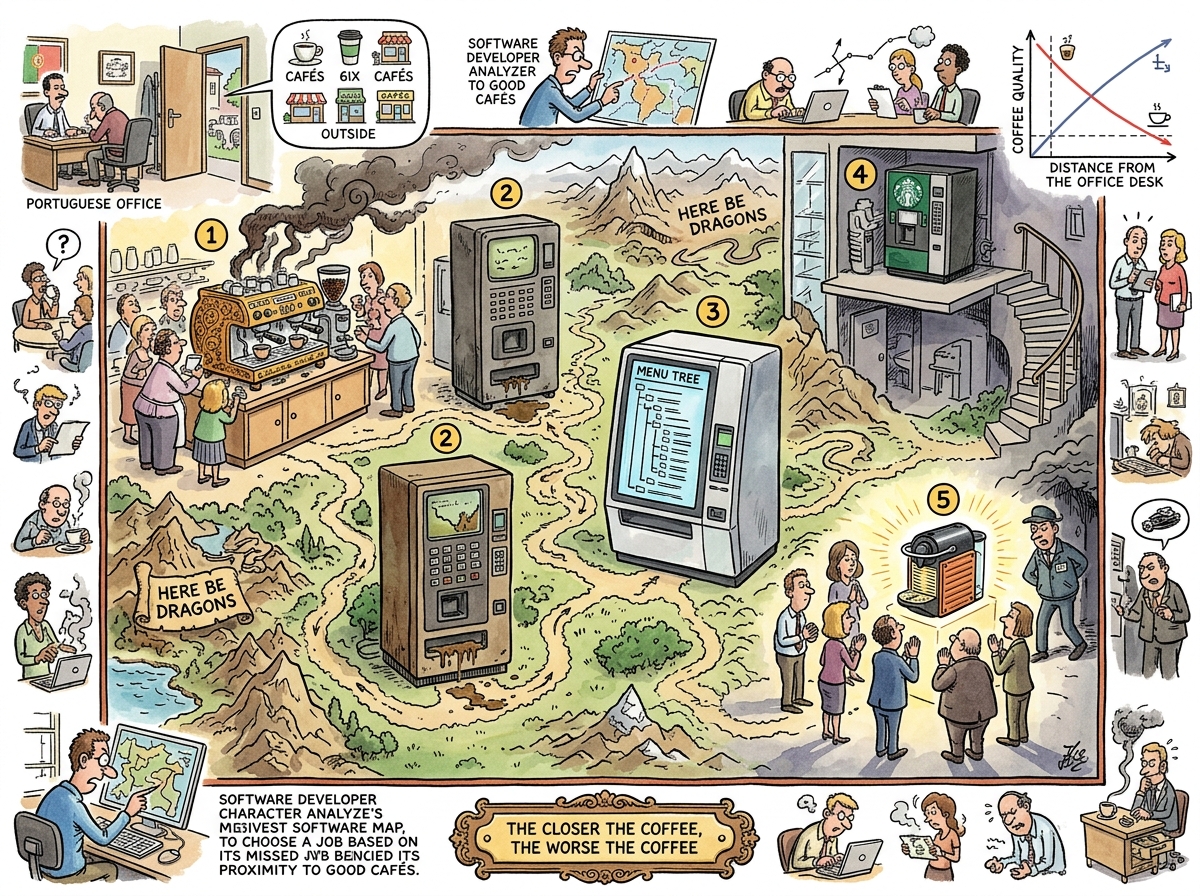
“The first principle of office coffee is that proximity is inversely correlated with quality. The closer the coffee is to your desk, the worse it is. This is not a coincidence. This is thermodynamics.”
— The Lizard
The Portuguese Counter-Example
In Portugal in the 1990s, offices did not have coffee machines. This was not a failure of facilities management. This was the correct architectural decision.
Why would an office internalise the coffee dependency when the external service was superior? Within two minutes’ walk of any Portuguese office, there were six cafés. Each café served espresso from a real machine, using beans from Delta, Buondi, or Nikola that had been roasted to a standard enforced by a certification programme more rigorous than ISO 9001. The barista was a professional. The coffee cost 50 escudos. The entire transaction — walk, order, drink, return — took four minutes.
The Portuguese model is Boring Technology applied to caffeine: do not build what you can outsource to someone who does it better. Do not internalise a dependency when the external provider has better uptime, better quality, and a lower total cost of ownership. The Portuguese office kitchen contained a kettle for tea and nothing else, because everything else was already solved.
The Five Sources (Stockholm Field Study)
The Swedish office where the Test Coordinator and riclib have both served contains five caffeine sources. The Test Coordinator, applying the same diagnostic rigour he brings to software defect spreadsheets, has ranked them:
Source 1: The Cafeteria. Paid. An actual espresso machine with a portafilter, which provides false hope. The machine is not the problem. The roast is the problem — beans carbonised past the point where chemistry becomes archaeology. The cafeteria is not horrible, which in this context means it is the least disappointing of five disappointments.
Source 2: The Old Machines. Four-inch screen. Two button presses. Twenty beverage options, each one a minor tragedy in a paper cup. The interface is efficient. The coffee is not. The old machines have the honesty of a tool that makes no promises about quality.
Source 3: The New Machines. Twelve-inch touchscreen. A nested menu structure where espresso is hidden four levels deep behind “Café Specials,” “Seasonal Favourites,” “Milk Options,” and a horizontal slider that defaults to the wrong position. The Squirrel designed this interface. The coffee is identical to Source 2 — same beans, same water, same thermal violence — but the journey to get there takes four times longer. Same output, more complexity. A coffee microservices architecture.
Source 4: The Secret Starbucks Machine (7th Floor). Discovered by word of mouth. Paid. Two roasts. As bad as Starbucks served by a machine, which is approximately ten times better than Sources 1–3. A Starbucks machine being the best option in a building is the coffee equivalent of Internet Explorer being the best browser.
Source 5: The Nespresso Pixie (Decommissioned). riclib smuggled a Nespresso Pixie into the office. It produced espresso that was recognisably coffee. He became the most popular person on the floor. Facilities confiscated it within two months. riclib left within two months. The causality is left as an exercise for the reader.
The Monopoly Principle
Office coffee is bad because office coffee is a monopoly. Portuguese cafés are good because Portuguese cafés compete. This is the same principle that makes open-source software better than enterprise software and street food better than airline food.
When there is one coffee source, it has no incentive to improve. When there are six cafés within two minutes’ walk, the café with the worst espresso loses customers to the café with the best. The Delta certification programme exists because competition exists. The office machine has no certification programme because the office machine has no competition. It is the only option between 8 AM and 6 PM, and it knows it.
Measured Characteristics
Cafés within 2 min walk (Lisbon office, 1990s):         6
Coffee machines in that office:                          0
  Reason:                                                unnecessary
Coffee machines in Dutch office (2000s):                 1
  Quality:                                               bad enough to require milk
Coffee sources in Swedish office:                        5
  Sources ranked "good":                                 0
  Sources ranked "less bad":                             5
  Sources decommissioned by facilities:                  1 (the only good one)
Time to walk to Portuguese café:                         2 minutes
Time to navigate Source 3's menu:                        2 minutes
  Output quality difference:                             Portuguese café: 10/10
                                                         Source 3: 2/10
  Time difference:                                       identical
  This is the problem:                                   yes
Nespresso Pixies smuggled into offices:                  1
Nespresso Pixies confiscated by facilities:              1
Developers who left within 2 months of confiscation:     1
Correlation:                                             not causation (probably)