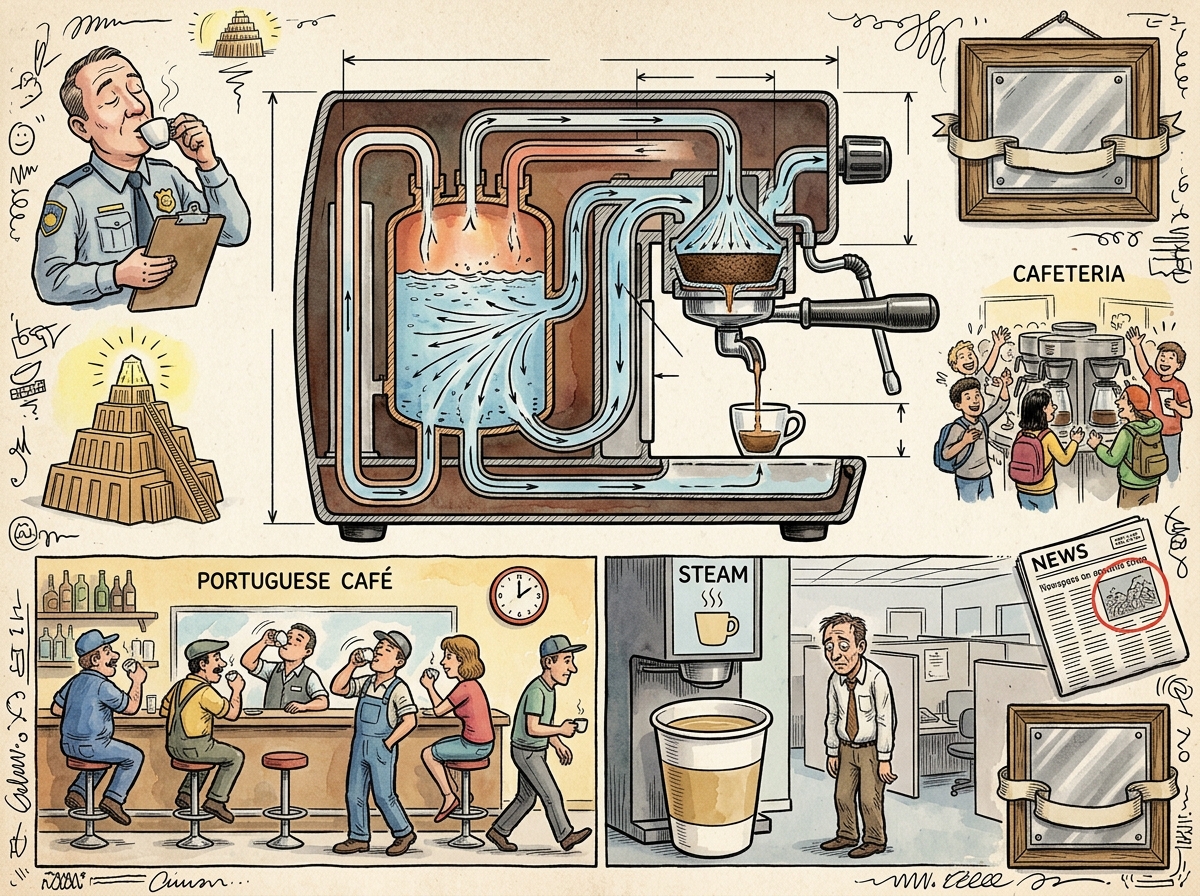
Espresso is coffee extracted under pressure — specifically, approximately 9 bars (130 psi) of pressure forcing water at 90–96°C through a compressed bed of finely ground coffee for 25–30 seconds, producing 25–30ml of concentrated liquid topped with a layer of emulsified oils known as crema. It is the standard against which all other coffee preparations are measured. Most of them are found wanting.
The word espresso derives from the Italian for “pressed out,” not — as commonly believed — from “express” meaning fast, though speed is an incidental benefit: the entire extraction takes less time than it takes a coffee machine to display its splash screen. This is YAGNI applied to brewing: the minimum necessary contact time to extract the maximum flavour. No unnecessary steps. No framework. No middleware. Twenty-five seconds of physics.
“Espresso is a function with one input and one output. The input is beans. The output is coffee. If your function requires a 12-inch touchscreen, you have over-engineered the function.”
— The Lizard, regarding the new coffee machines in the Swedish office
The Parameters
Espresso is not a recipe. It is a specification:
| Parameter | Value | Tolerance |
|---|---|---|
| Dose (in) | 18–20g | ± 0.5g |
| Yield (out) | 36–40g | ± 2g |
| Time | 25–30 seconds | ± 3 seconds |
| Pressure | 9 bars | ± 0.5 bar |
| Temperature | 90–96°C | ± 2°C |
| Grind | Fine | “if it flows like water, it’s too coarse; if nothing comes out, it’s too fine” |
When these parameters are met, the result is a dense, syrupy liquid with balanced acidity, sweetness, and bitterness, topped with crema that acts as a flavour seal. When these parameters are not met — which is to say, when the coffee is made by a machine that has never been calibrated, using beans that were roasted six months ago, in an office kitchen where the only quality metric is “does liquid emerge” — the result is something that the Portuguese language does not have a polite word for.
The Portuguese Baseline
In Portugal, espresso is not a specialty drink. It is not ordered by name, because it does not need to be — you walk into a café, you say um café, and what arrives is espresso, because in Portugal there is no other kind. Asking a Portuguese barista for “a coffee” and receiving drip coffee would be like asking a Parisian baker for “bread” and receiving a rice cake. The category has only one member.
The quality baseline is enforced not by law but by a system more rigorous than most software quality frameworks: the Delta certification programme.
Delta is Portugal’s dominant coffee roaster. Their supply chain operates on a tiered certification model:
-
Delta Gold — The standard tier. A café must demonstrate — not claim, not promise, demonstrate — that its equipment is properly maintained, its barista technique is correct, and its extraction parameters produce acceptable espresso. Delta sends evaluators. The evaluators taste. If the espresso fails, the café does not receive Gold beans. The café receives whatever the tier below Gold is, which is the tier of shame.
-
Delta Platinum — The summit. Few cafés graduate. Platinum certification means sustained excellence over time — consistent extraction, immaculate equipment, baristas who understand that the grind must change with humidity because the beans are hygroscopic and the physics is non-negotiable.
riclib selected employment in Lisbon in the late 1990s using criteria that included, alongside salary and career trajectory, proximity to a Delta Platinum café. This was not eccentric. This was rational. A developer who drinks five to ten espressos per day for the duration of their employment — and in Portugal, you will — is making a decision that compounds over years. The quality of those espressos is not a perk. It is infrastructure.
The university cafeteria at riclib’s alma mater served espresso that was better than what most northern European specialty shops serve today. The cafeteria did not know this. The cafeteria did not care. The cafeteria was operating at Portugal’s baseline, which is most of Europe’s aspiration.
The Ten-a-Day Era
riclib consumed ten espressos per day during his university years. Each one was 25–30ml. Each one cost approximately 50 escudos — roughly 25 euro cents. Each one was consumed standing at a bar, in ninety seconds, and forgotten immediately, the way one forgets breathing.
Ten per day sounds alarming to northern Europeans. It is not. A Portuguese espresso contains 60–80mg of caffeine. Ten espressos is 600–800mg of caffeine per day, which is within the range that the European Food Safety Authority considers safe for adults, though the EFSA was not consulted and would not have changed anything if it had been.
The ten-a-day era ended not because of health concerns but because riclib left Portugal. The coffee got worse. The consumption dropped. Not because he wanted less coffee, but because the coffee that was available did not deserve more.
The Machine Problem
When espresso is attempted by an office coffee machine, the result bears the same relationship to actual espresso that a police sketch bears to the suspect: the general shape is recognisable, the details are wrong, and nobody would mistake one for the other.
The machine does not control dose. The machine does not control yield. The machine does not adjust grind for humidity. The machine produces a liquid that the touchscreen labels “espresso” and that the Test Coordinator, upon tasting it in the Swedish office, described with the restraint of a man who measures his words the way he measures his defects: “barely drinkable.”
Measured Characteristics
Optimal extraction time:                                25-30 seconds
Pressure:                                               9 bars
Temperature:                                            90-96°C
Dose:                                                   18-20g
Yield:                                                  36-40g (1:2 ratio)
Crema depth:                                            2-4mm
Crema colour:                                           tiger-striped hazelnut
Volume per cup (Portugal):                              25-30ml
Volume per cup (Starbucks "espresso"):                  we don't discuss this
Cost (Portugal, 1990s):                                 50 escudos (~€0.25)
Cost (specialty shop, Stockholm, 2026):                 45 SEK (~€4.00)
Quality ratio (price × 16, quality × 0.6):              the economics of geography
riclib's university consumption:                        10/day
Vlad's assessment of Swedish office espresso:           "barely drinkable"
  (this is the harshest thing Vlad has ever said)
Delta Gold cafés in Lisbon:                             most of them
Delta Platinum cafés in Lisbon:                         the ones that matter
Job selection criteria involving Platinum proximity:    at least 1 documented case