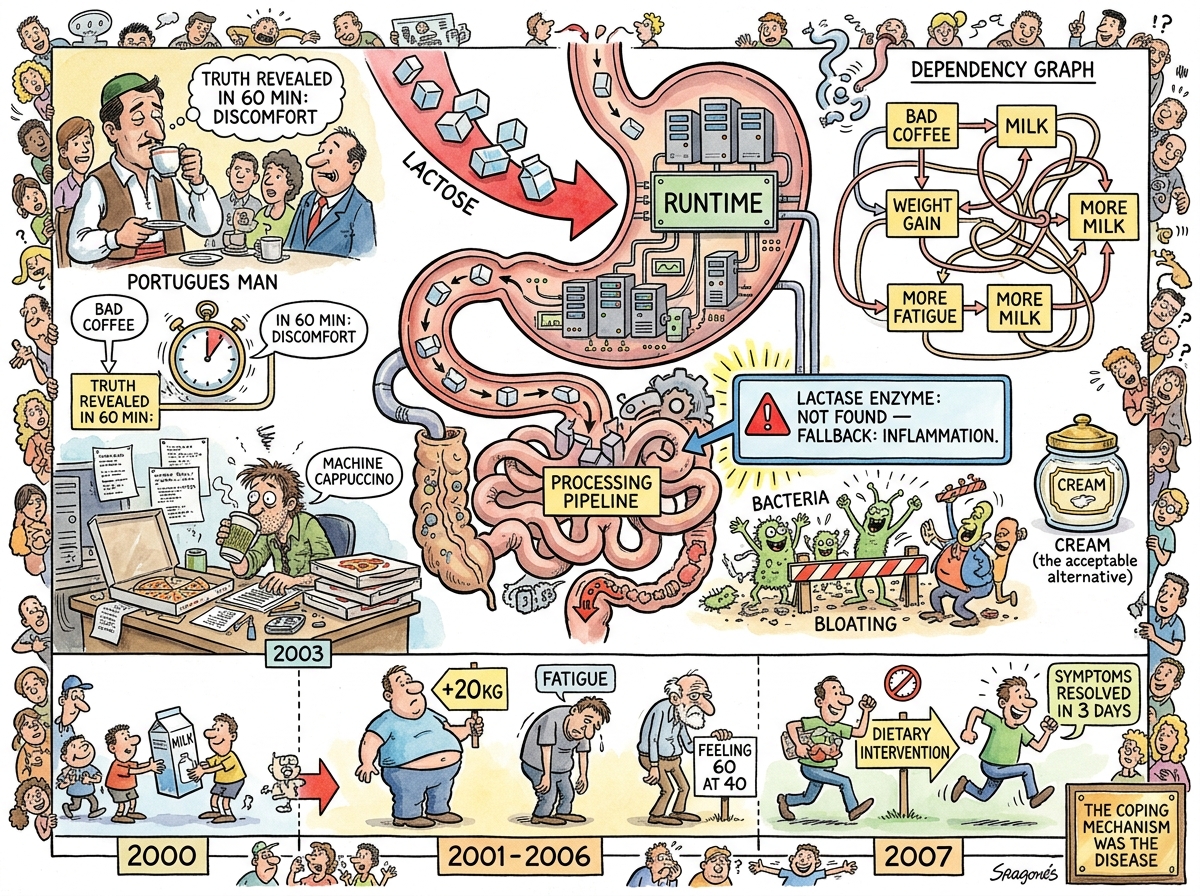
Milk in coffee is not a flavour choice. It is a confession. A confession that the coffee is not good enough to drink alone. A confession that the roast is wrong, or the extraction is wrong, or the machine is wrong, and that rather than fix the coffee, the drinker has chosen to hide it under a blanket of lactose and call the result a “latte.”
In the rare cases where milk is added to good coffee, it is a cultural tradition — the Italian Cappuccino, the Viennese Wiener Melange — with rules, ratios, and a time-of-day restriction that acknowledges milk’s role as a complement rather than a concealment. In the common cases where milk is added to office coffee, it is damage control.
riclib’s relationship with milk in coffee lasted seven years, cost twenty kilograms, and produced a clinical insight that most gastroenterologists deliver in a consultation but that riclib discovered by accident, out of politeness, in a cup of coffee he should have refused.
“The coping mechanism was the disease. The dependency that causes the bug that you fix by adding the dependency. The oldest trick in software and the oldest trap in a Dutch office kitchen.”
— riclib, in retrospect
The Biology
Most humans are lactose intolerant. This is not a disorder. This is the default.
Lactase — the enzyme that breaks down lactose, the primary sugar in milk — is produced abundantly in human infants, for obvious evolutionary reasons. In approximately 65–70% of the global adult population, lactase production declines after weaning. The ability to digest lactose into adulthood — lactase persistence — is a genetic mutation that arose approximately 7,500 years ago in populations that domesticated dairy cattle, primarily in northern Europe.
The mutation spread because it provided a caloric advantage in pastoral societies. It is the exception, not the rule. The majority of adult humans on Earth cannot efficiently process lactose. They are not “intolerant” in the sense of having something wrong with them. They are normal. The lactase-persistent northern Europeans are the mutants.
riclib is Portuguese. Portugal’s lactase persistence rate is approximately 60–70% — lower than Scandinavia (~90%), higher than East Asia (~5%). riclib falls on the wrong side of the percentage. He did not know this for forty years.
The Seven-Year Bug
In Portugal, riclib drank black espresso. Ten per day. No milk. No need for milk — the coffee was good, the cafés were within two minutes’ walk, and nobody had ever suggested that coffee needed improvement via dairy.
In the Netherlands, riclib encountered the office coffee machine. The machine’s output was bad enough to require masking. The masking agent was milk — first in cappuccinos, then in Wiener Melange. Each cup delivered approximately 5 grams of lactose. Four to six cups per day. Seven years.
The lactose was not digested. It was fermented by gut bacteria, producing hydrogen, methane, and a cascade of inflammatory responses that manifested as:
- Weight gain: 20 kilograms over seven years
- Chronic fatigue: feeling sixty at forty
- Persistent inflammation: the specific malaise of a system fighting a substance it cannot process
The symptoms were gradual. Gradual is the most dangerous speed for a symptom, because gradual is invisible. riclib attributed the fatigue to age. He attributed the weight to office life. He attributed the malaise to the general entropy of existence. He did not attribute any of it to the milk, because the milk had always been there, and the always-there is invisible.
This is the software parallel: a dependency that introduces a bug, but the bug manifests so slowly that it is attributed to the environment rather than the dependency. You add a library to fix a problem. The library causes a slow memory leak. The leak is attributed to “the system getting old.” Nobody suspects the library, because the library was added to fix something, and things that fix things are not suspected of breaking things.
The Revelation
The Nutrition Covenant. The Paleo diet. Three days without dairy.
In three days, riclib felt twenty years younger. The fatigue lifted. The inflammation subsided. The body, freed from a substance it had been fighting for seven years, responded with the gratitude of a system after a garbage collection that should have run in 2001.
Then someone accidentally put milk in his coffee. He drank it out of politeness — because Portuguese men do not refuse coffee that has been made for them, even when the coffee contains a substance that will, within sixty minutes, provide an unambiguous diagnostic result.
Within one hour: bloating, fatigue, the return of every symptom that had taken three days to disappear. Seven years of slow-motion damage, reproduced in sixty minutes. The accidental reintroduction was the diagnostic test. The diagnosis was unambiguous.
He never touched milk again.
Cream: The Acceptable Alternative
The article’s subtitle says “never to be mixed — see: Cream.” This requires explanation.
Cream in coffee is fat. Milk in coffee is lactose and fat. For the lactose-intolerant, the distinction is absolute: cream (especially heavy cream) contains negligible lactose. It adds richness — the mouthfeel, the body — without the sugar that causes the inflammatory cascade.
Cream is what adults who understand chemistry use when they want richness without the dependency. riclib does not use cream either, having completed his journey to black coffee fundamentalism, but he acknowledges cream as the theoretically correct option for those who have not yet arrived.
Measured Characteristics
Global adult lactose intolerance rate:                   65-70%
Northern European lactase persistence:                   ~90% (the mutants)
Portuguese lactase persistence:                          ~60-70%
riclib's lactase persistence:                            no
Years before diagnosis:                                  7
Cappuccinos per day (Dutch era):                         4-6
Lactose per cappuccino (machine):                        ~5g
Total lactose consumed unknowingly (estimated):          ~30 kg
Weight gained:                                           20 kg
Perceived age at 40:                                     60
Days to feel better after elimination:                   3
Time to confirm intolerance after accidental exposure:   < 1 hour
Cause of accidental exposure:                            politeness
  (Portuguese men do not refuse coffee)
Milk consumed since diagnosis:                           0
Coffee consumed since diagnosis:                         black (exclusively)
The coping mechanism:                                    milk
The disease:                                             also milk