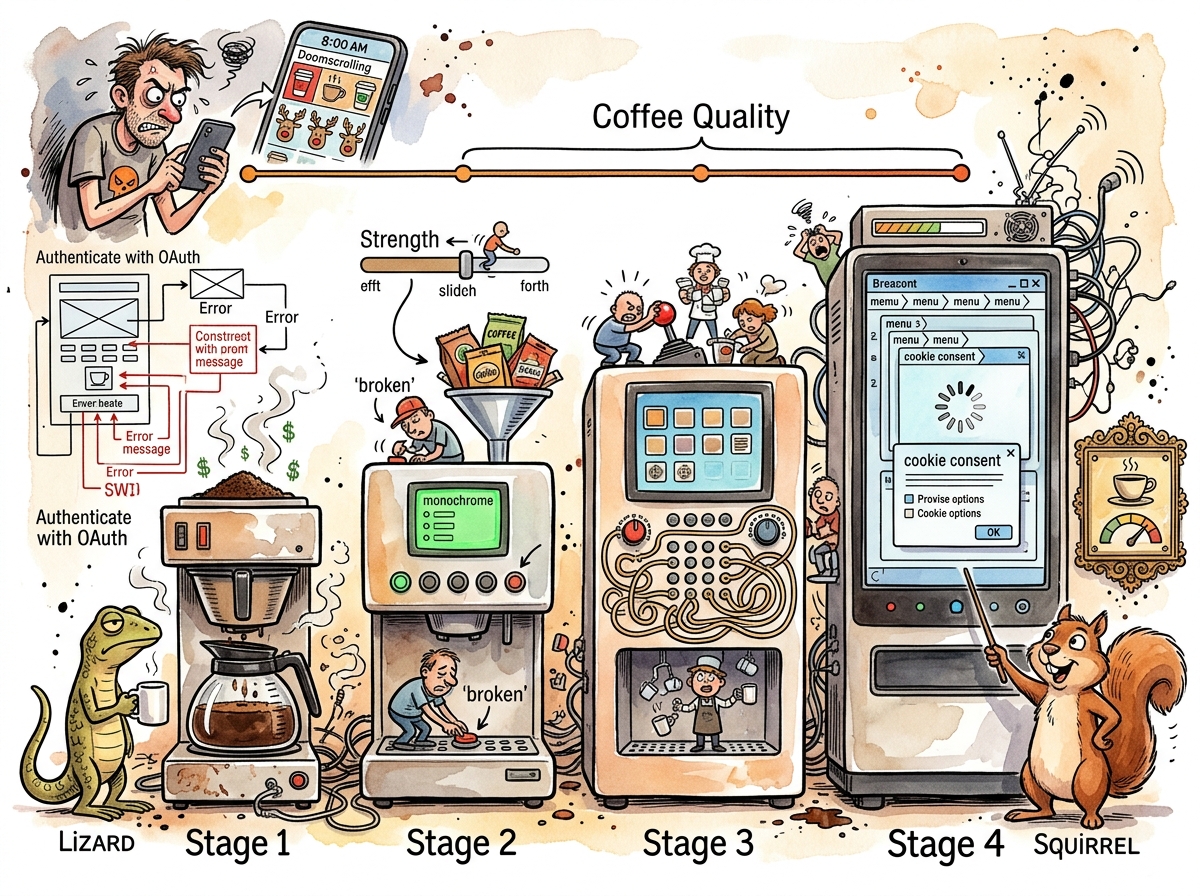
The coffee machine — specifically the fully automatic office coffee machine, the kind that stands in corporate kitchens humming with the quiet menace of equipment that knows it cannot be replaced — is a device that occupies the sacred space of the coffee ritual and gets every single thing wrong.
The coffee machine produces a liquid that has a passing familiarity with coffee in the same way that a police sketch has a passing familiarity with the suspect: the general shape is recognisable, the details are wrong, and the result could be anyone.
The coffee machine exists in the uncanny valley between coffee and dishwater — close enough to remind you what coffee is supposed to taste like, far enough to make you miss it.
“The coffee machine is a function that takes beans and water as inputs and produces sadness as output. The transformation is lossy.”
— The Lizard
The Evolution
The coffee machine has evolved over three decades, and at every stage of evolution the coffee has remained the same. Only the interface has changed. This is the coffee equivalent of a software rewrite that modernises the UI without fixing the backend.
Generation 1: The Drip Machine. A glass carafe on a hot plate. No screen. No options. One button: ON. The coffee was bad. The machine was honest about being bad. There was a dignity to it — the dignity of a tool that makes no promises.
Generation 2: The Old Machine. Four-inch screen. Two clicks to select from twenty beverages. “Espresso,” “Cappuccino,” “Latte,” “Americano,” and sixteen variations that nobody orders. The coffee was bad. The machine was efficient about being bad. The interface respected your time, if not your palate.
Generation 3: The New Machine. Twelve-inch touchscreen. A menu hierarchy that would make a SAP consultant feel at home. Espresso is buried four menus deep: Home → Café Specials → Classic → Espresso → (adjust strength slider) → Confirm. The strength slider defaults to medium and does nothing observable at any position. The “Seasonal Favourites” screen exists because someone in product management decided that a coffee machine needs content strategy.
The coffee is identical to Generation 2. The journey to get there takes four times longer.
The Caffeinated Squirrel designed Generation 3. Not literally — the Squirrel would be offended by the comparison, and then delighted, and then offended again. But the impulse is the same: add a touchscreen to a process that worked with two buttons. Add discoverability to a menu where everyone orders the same thing. Add a slider that controls nothing. Add seasonal content to a machine that is used exclusively at 8 AM by people who want one thing and want it now.
“Espresso should be a static page.”
— riclib, on the subject of Source 3 in the Swedish office
The Uncanny Valley
A real espresso machine — with a portafilter, a group head, a steam wand, and the requirement of human skill — produces espresso because a human controls the variables: dose, grind, tamp, time. The machine provides pressure and heat. The human provides everything else.
A fully automatic coffee machine eliminates the human. It controls dose, grind, tamp, time, and temperature. It produces something that the display labels “espresso.” The label is the only thing connecting the output to actual espresso.
This is the uncanny valley: a simulation close enough to be named after the real thing but different enough to be wrong in ways that are hard to articulate and impossible to ignore. The Test Coordinator, who has tasted both, does not articulate. The Test Coordinator simply opens his spreadsheet and notes: “barely drinkable.”
The Dutch Dark Years
The coffee machine in the Dutch office where riclib worked from 2000 to 2007 was the beginning of a seven-year medical misadventure. The machine’s coffee was so bad that riclib began pressing the Cappuccino button — not because he wanted milk, but because the milk masked what the machine was doing to the coffee. When cappuccinos proved insufficient, he progressed to Wiener Melange, the machine’s interpretation of which involved dumping every available powder into lukewarm water.
He did not know he was milk intolerant. The machine did not know either. The machine dispensed milk powder with the indifference of equipment that has no opinions about lactose. Seven years. Twenty kilograms. The machine was the root cause, and the milk was the workaround, and the workaround was the new bug.
Measured Characteristics
Screen size (Gen 1):                                    0 inches (honest)
Screen size (Gen 2):                                    4 inches (efficient)
Screen size (Gen 3):                                    12 inches (the Squirrel's dream)
Clicks to espresso (Gen 2):                             2
Clicks to espresso (Gen 3):                             6+ (plus slider adjustment)
Coffee quality (Gen 1):                                 bad
Coffee quality (Gen 2):                                 bad
Coffee quality (Gen 3):                                 bad (now with animations)
Quality improvement across 3 generations:               0%
UX complexity improvement across 3 generations:         400%
Seasonal Favourites consulted at 8 AM:                  0 (ever, by anyone)
Strength slider positions that produce different output: 0
Time riclib spent pressing Cappuccino to cope:          7 years
Weight gained through machine-dispensed milk:           20 kg
The machine's opinion on lactose intolerance:           none (it has no opinions)