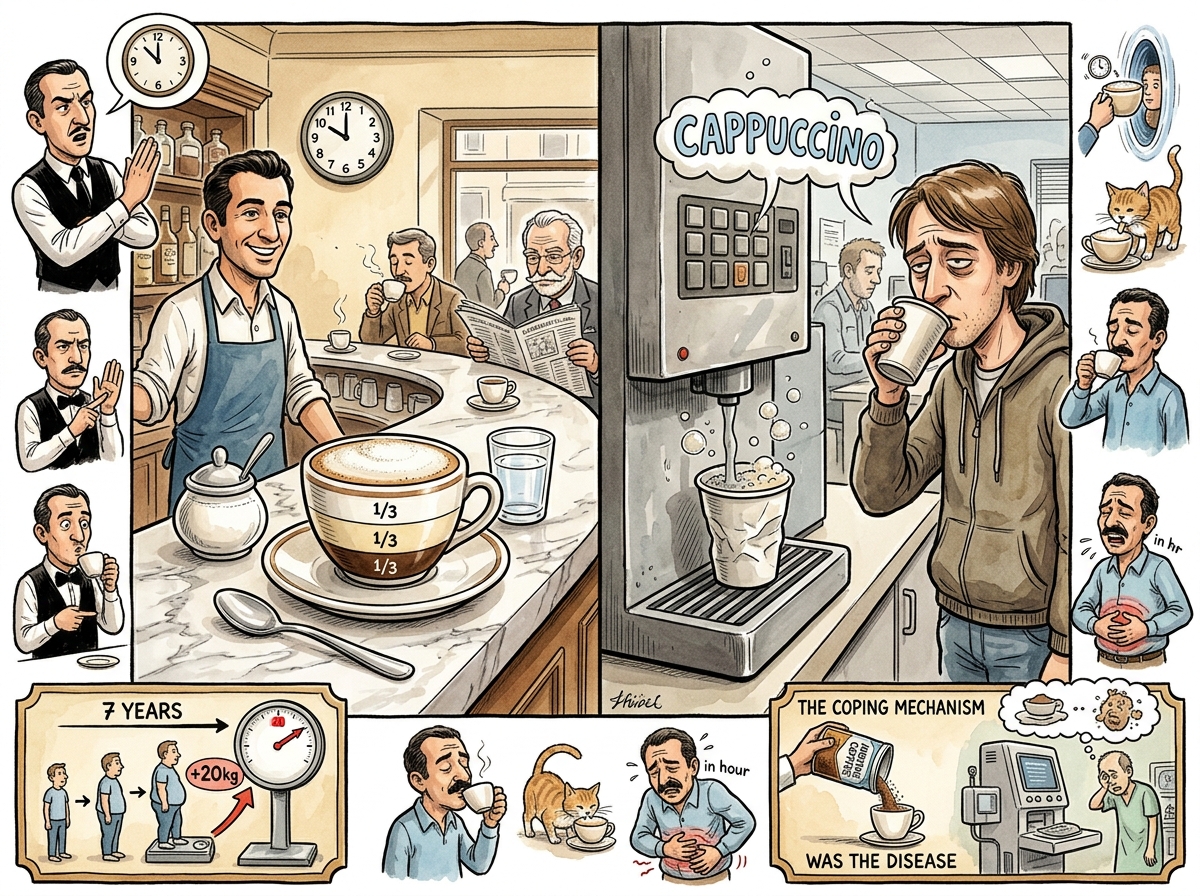
Cappuccino is a coffee drink composed of one-third espresso, one-third steamed milk, and one-third milk foam, served in a ceramic cup of approximately 150–180ml. In its proper Italian form, it is a balanced, textured beverage consumed exclusively before 11 AM by people who understand that rules exist for reasons, even when the reasons are cultural rather than chemical.
In its improper office-machine form — the form encountered by riclib in the Netherlands between 2000 and 2007 — a cappuccino is a mechanism for hiding the taste of bad espresso under a blanket of reconstituted milk powder, which is how a Portuguese developer survived seven years of office coffee and simultaneously destroyed his health without knowing it.
The cappuccino is the coping mechanism that was also the disease.
“The foam was a merciful blanket thrown over a crime scene. The chocolate powder on top was the police tape.”
— riclib, on the Dutch office machine cappuccino
The Italian Standard
In Italy, the cappuccino obeys rules that are not written down because they do not need to be — they are absorbed through cultural osmosis, the way Portuguese children absorb the knowledge that espresso exists and is correct.
Rule 1: Before noon. Cappuccino is a morning drink. Ordering a cappuccino after lunch is not illegal, but it produces in Italian waitstaff a specific expression that communicates, without words, that the customer has revealed something unflattering about themselves. The milk is for morning. The afternoon is for espresso. This is not negotiable.
Rule 2: The ratio. One-third, one-third, one-third. Not “mostly milk with a splash of coffee,” which is what the machine produces. Not “espresso with a mountain of foam,” which is what Instagram produces. Equal thirds. The espresso should be tasted through the milk, not buried under it.
Rule 3: The texture. The milk must be microfoamed — stretched with the steam wand to incorporate tiny bubbles that create a dense, velvety texture. Machine-frothed milk produces large, unstable bubbles that collapse into a sad puddle within ninety seconds. The difference is the difference between meringue and soap.
The Dutch Corruption
When riclib arrived in the Netherlands in 2000 and encountered the office coffee machine, he discovered that the machine’s espresso was undrinkable on its own. The logical response — finding better coffee — was not available, because there was no Delta Platinum café within walking distance. There was no Delta café of any kind. There was only the machine.
The cappuccino button became a coping mechanism. Not because riclib wanted milk — he had drunk black espresso for a decade in Portugal without ever considering the addition of milk. But because the milk masked what the machine was doing to the coffee. The foam covered the taste. The powder concealed the evidence. The cappuccino transformed an intolerable experience into a merely disappointing one, which in an office kitchen at 8 AM was sufficient.
He did not know he was milk intolerant.
For seven years, every cappuccino — and there were four to six per day — delivered a dose of lactose that his body processed with decreasing efficiency and increasing inflammation. The weight came gradually. The fatigue came gradually. The specific feeling of being sixty at forty came gradually. Gradual is the most dangerous speed for a symptom, because gradual is invisible, and invisible symptoms are attributed to age, stress, or the general entropy of being alive in an office where the best coffee option has a four-inch screen.
The cappuccino was the workaround. The workaround introduced its own bug. The bug ran in production for seven years. The rollback — The Nutrition Covenant — fixed everything in three days.
The Accidental Diagnosis
After going Paleo and eliminating dairy, riclib felt twenty years younger in three days. The weight loss began. The inflammation subsided. The fatigue lifted.
Then someone accidentally put milk in his coffee.
He drank it out of politeness — because Portuguese men do not refuse coffee, and declining a coffee that has been made for you is a social violation ranking between wearing shoes indoors and not greeting the doorman.
Within one hour: bloating, fatigue, inflammation. Seven years of symptoms, compressed into sixty minutes, by one cup that he drank because refusing it would have been rude. The milk intolerance was not a diagnosis. It was a revelation. He never touched milk again.
Measured Characteristics
Proper ratio:                                            1/3 espresso, 1/3 milk, 1/3 foam
Machine ratio:                                           1/10 brown water, 9/10 powder
Italian consumption deadline:                            11:00 AM (approximately)
Italians who order cappuccino after lunch:               tourists (exclusively)
Machine cappuccinos consumed by riclib (2000-2007):      ~6,000
  Average per day:                                       4-6
  Lactose per cup:                                       ~5g
  Total lactose consumed unknowingly:                    ~30 kg
  Weight gained:                                         20 kg
  Correlation:                                           yes
  Causation:                                             also yes
Years before diagnosis:                                  7
Time to feel better after elimination:                   3 days
Time to confirm intolerance after accidental exposure:   < 1 hour
Politeness as a diagnostic tool:                         effective (if painful)
Cappuccinos consumed since diagnosis:                    0