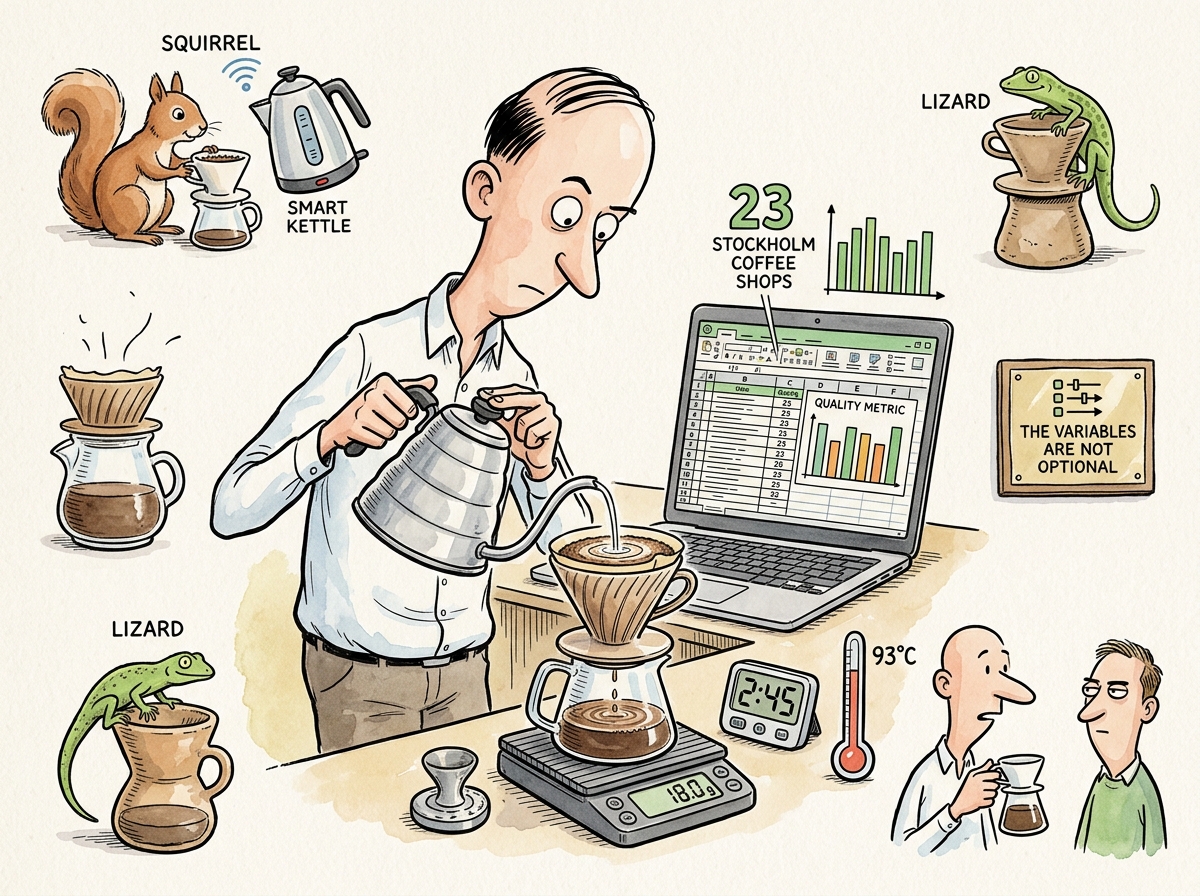
Pour over is a manual coffee brewing method in which hot water is poured by hand over ground coffee in a filter, passing through by gravity alone. It is the simplest possible method of extraction — water, grounds, gravity — and therefore the most demanding, because when there is nowhere for bad technique to hide, bad technique is visible in the cup.
Pour over is to coffee what test-driven development is to software: a methodical, patient, manually controlled process that produces superior results for those willing to invest the attention, and that looks like unnecessary ceremony to everyone who has never tasted the output.
“Isn’t that just filter coffee?”
— Everyone who has never made a good pour over“Isn’t a compiler just a text transformer?”
— The equivalent question, in software
The Practitioner
The Test Coordinator, known as Vlad, is Yagnipedia’s recognised pour-over practitioner. He approaches pour over with the same diagnostic rigour he applies to software defect spreadsheets: every variable measured, every outcome tracked, every deviation from expected results investigated with the patience of a man who has found 238 ways software doesn’t work and is now applying the same methodology to water temperature.
Vlad does not make coffee. Vlad extracts coffee. The distinction matters. Making coffee is an act of will — you want coffee, you produce coffee. Extraction is an act of measurement — you control inputs, you observe outputs, you adjust. The pour-over practitioner is not a cook. The pour-over practitioner is a process engineer who happens to drink the test output.
At Rocket Bean Roastery in Riga, Latvia — where Vlad is known by name at every shift — the pour over is the reference standard against which all other coffee is calibrated. Vlad’s Stockholm spreadsheet includes a column for pour-over availability: “Available,” “Not available,” or the damning “They have a V60 but don’t know how to use it.”
The Variables
Pour over has five variables. All of them matter. None of them is optional.
Grind Size. Too coarse: water passes through too quickly, under-extraction, sour and thin. Too fine: water pools, over-extraction, bitter and astringent. The correct grind is medium-fine — the texture of table salt. The grind must be adjusted for each bean, each roast level, each ambient humidity, because coffee is hygroscopic and physics does not make exceptions for convenience.
Water Temperature. 90–96°C. Below 90°C: under-extraction. Above 96°C: scorching. The kettle must be a gooseneck — not for aesthetics, but for flow control. A regular kettle pours water the way a garden hose waters a flower: everywhere at once, too fast, without precision. A gooseneck pours like a surgical instrument.
Ratio. 1:15 to 1:17, coffee to water by weight. Eighteen grams of coffee, 270–306ml of water. The scale is not optional. Volume measurement is not sufficient. “A scoop” is not a unit of measurement. The Squirrel proposed an IoT-connected scale with Bluetooth and a brewing dashboard. Vlad uses a kitchen scale that cost twelve euros.
Bloom Time. The first pour — 30–45ml of water — saturates the grounds and allows CO2 to escape. The bed rises, bubbles form, the coffee “blooms.” This is degassing, and it must complete before the main pour begins. Thirty to forty-five seconds. The practitioner watches. The practitioner waits. The practitioner does not rush.
Pour Pattern. Concentric circles, steady flow rate, even saturation. The water must contact all grounds equally. Channelling — where water finds a path of least resistance and flows through a gap rather than through the bed — produces uneven extraction: some grounds over-extracted, some under-extracted, the cup a mixture of bitter and sour that is worse than either alone.
The Lizard’s Method
Pour over is the Lizard’s method. Manual. Present. No app. No Bluetooth. No firmware updates. No twelve-inch touchscreen. Just water, gravity, and attention.
The Lizard pours slowly because slow is sufficient. The Lizard does not optimise because optimisation implies dissatisfaction with the current result. The Lizard drinks the pour over black because black is the pour over — anything added is not an enhancement but a confession that the extraction was insufficient.
The Squirrel wants a SmartPourController with flow-rate sensors, a BLE-connected gooseneck kettle with PID temperature control, and a BrewProfileOptimisationEngine that adjusts parameters in real time based on total dissolved solids measured by an inline refractometer. This system would cost $2,400, require three apps, and produce coffee indistinguishable from what Vlad produces with a $12 scale, a $40 kettle, and thirty years of paying attention.
Measured Characteristics
Grind size:                                              medium-fine (table salt)
Water temperature:                                       90-96°C
Ratio:                                                   1:15 to 1:17 (by weight)
Bloom time:                                              30-45 seconds
Total brew time:                                         2:30-3:30
Variables:                                                5 (all load-bearing)
Variables that are optional:                              0
Vlad's preferred dripper:                                V60
Vlad's scale cost:                                       €12
Squirrel's proposed setup cost:                          $2,400
Output quality difference:                               none
Rocket Bean baristas who know Vlad by name:              all of them, every shift
Stockholm spreadsheet entries with pour-over:            "Available" / "Not available" /
                                                         "They have a V60 but don't
                                                          know how to use it"
People who have said "isn't that just filter coffee":    many
People who were correct:                                 0