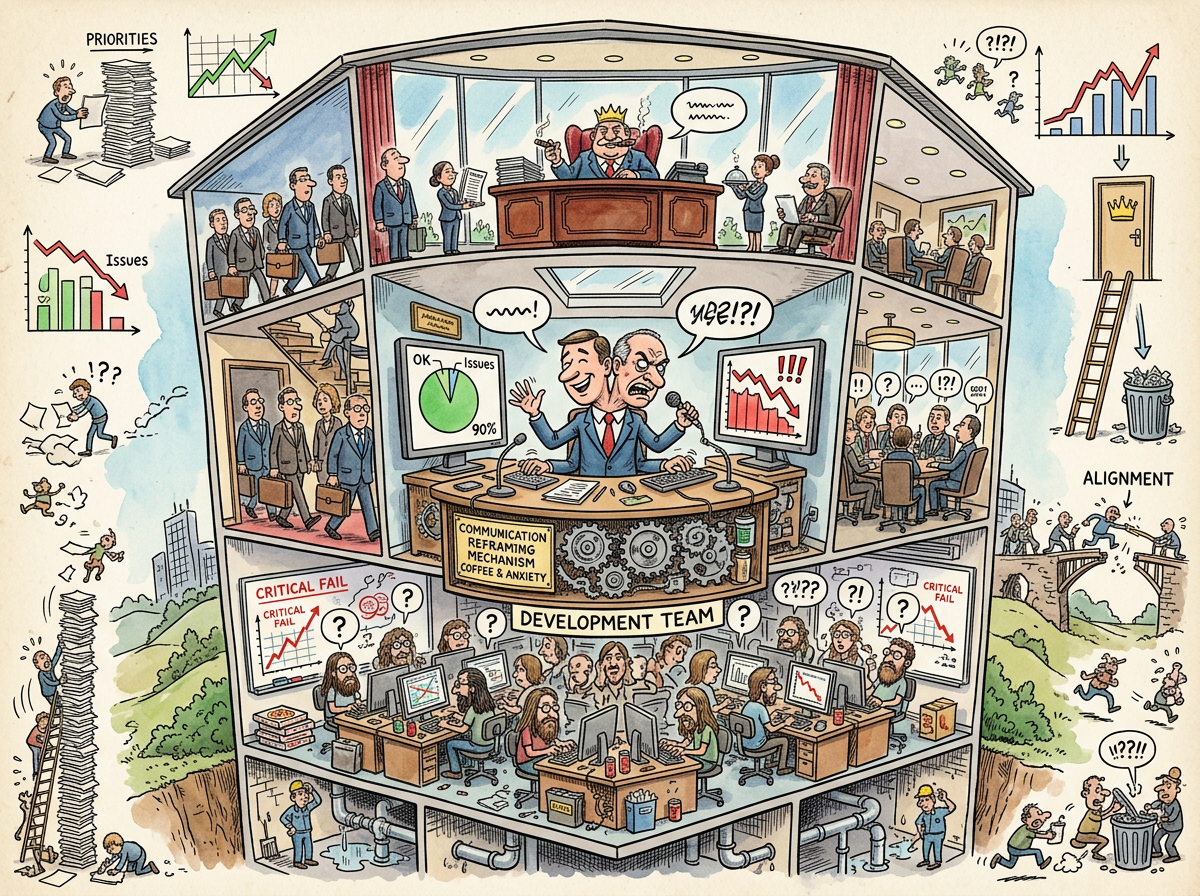
The VP (Vice President) is the layer of the Org Chart that exists between the people who decide things and the people who do things, responsible for translating in both directions and satisfying neither.
Upward, the VP translates chaos into confidence. The team is behind schedule, the architecture is wrong, and the senior developer is interviewing at Stripe — but the VP’s update to the CEO reads: “On track. Minor risks being managed. Team is strong.” This is not lying. This is Stakeholder Management, which is the discipline of presenting true information in a format that does not cause the recipient to make sudden decisions.
Downward, the VP translates strategy into tasks. The CEO said “we need to be more AI-first” at a town hall, which the VP must now convert into something a team can actually build. The conversion process involves a strategy deck, a roadmap, a quarterly OKR, and a series of one-on-ones in which the VP says “I know it’s vague, but this is the direction” with the weary conviction of a person who has translated vague directions into concrete work before, and knows that the direction will change before the work is done.
The VP is a human API adapter: impedance-matching between the CEO’s frequency (quarterly vision, annual strategy, conference-driven pivots) and the team’s frequency (sprint commitments, technical debt, the deployment pipeline that breaks every Tuesday). Neither frequency is wrong. They are incompatible. The VP exists in the gap.
Title Inflation
The VP title has experienced inflation that would alarm the CFO if the CFO tracked title supply the way the CFO tracks headcount.
The hierarchy:
| Title | Meaning (1990) | Meaning (2026) |
|---|---|---|
| VP | Runs a division. Reports to CEO. | Runs a team of 8-15. Reports to SVP. |
| SVP | Does not exist | Runs 3-4 VPs. Reports to EVP. |
| EVP | Does not exist | Runs 3-4 SVPs. Reports to CEO. |
| Group EVP | Does not exist | Nobody is sure. Reports to the concept of leadership. |
| Managing Director | Runs the company | Same as VP but at a bank |
In 1990, a company had one VP per major function: VP of Sales, VP of Engineering, VP of Marketing. In 2026, a company has VP of Engineering, VP of Platform Engineering, VP of Developer Experience, VP of Engineering Excellence, VP of Infrastructure, and VP of AI Strategy — each of whom runs a team small enough that “manager” would be the accurate title, but “manager” does not recruit as well on LinkedIn.
The title inflation is driven by recruiting. A strong candidate will not accept “Senior Manager.” A strong candidate will accept “VP.” The work is identical. The title is different. The title wins. This is Goodhart’s Law applied to job titles: when the title becomes a recruiting tool, it ceases to reflect organisational reality.
The result is organisations where there are more VPs than individual contributors, which is an org chart that looks like an inverted pyramid balanced on its point — structurally unsound and sustained entirely by title inflation.
The Translation Problem
The VP’s core function is translation, and translation always loses information.
Upward translation (team → CEO): The VP removes uncertainty, reduces nuance, and converts complex states into traffic-light dashboards. A project that is “probably fine if we get one more engineer and the API doesn’t change” becomes “green with minor dependencies.” The VP does this not because the VP is dishonest, but because the CEO processes information in traffic lights, and a VP who presents nuance to a CEO who processes traffic lights will be replaced by a VP who presents traffic lights.
Downward translation (CEO → team): The VP converts vision into work. “Be more customer-centric” becomes a JIRA epic with twelve stories. “AI-first” becomes a spike ticket. “Move faster” becomes a conversation in which the VP says “I know we’re already working as fast as we can, but” and the team finishes the sentence in their heads. The VP knows the translation is lossy. The team knows the translation is lossy. Nobody acknowledges this, because acknowledging it would require the VP to say “I don’t fully understand what the CEO wants either,” which is a Career-Limiting Move.
Lateral translation (VP → VP): The least discussed and most dysfunctional translation. VPs must coordinate with other VPs, each of whom has translated the CEO’s vision differently, each of whom has a team working in a different direction, and each of whom believes their translation is the correct one. The lateral translation produces: “alignment meetings,” which are meetings about whether the translations are compatible; “dependency management,” which is the discovery that they are not; and “escalation,” which is the admission that two VPs cannot resolve their translation conflict and need the CEO to re-state the original, which the CEO does in different words, producing two new incompatible translations.
The Meeting Calendar
The VP’s calendar is the physical evidence of the translation function. A typical VP day:
08:00  Leadership sync (translate down from CEO)
08:30  Team standup (translate up from team)
09:00  1:1 with direct report (translate in both directions)
09:30  1:1 with direct report (same)
10:00  Cross-functional alignment (lateral translation)
10:30  Cross-functional alignment continues (translations incompatible)
11:00  Strategy review (translate team's work into CEO's framework)
11:30  Budget review with CFO (translate everything into numbers)
12:00  Lunch (eaten at desk while reviewing the 2 PM deck)
12:30  1:1 with direct report
13:00  Hiring panel
13:30  1:1 with direct report
14:00  Board prep with CEO (translate everything into a single slide)
14:30  Architecture review (nod at things the VP does not fully understand)
15:00  Retrospective (facilitate; do not say what the VP actually thinks)
15:30  All-hands prep
16:00  All-hands (present the slide from 14:00 as if it were the VP's own conviction)
16:30  1:1 with skip-level (discover what the direct reports are not saying)
17:00  "Focus time" (blocked on calendar; filled with Slack; no focusing occurs)
17:30  End of day (begin reading emails from 08:00 that were unread due to meetings)
The VP has zero hours of unstructured thinking time. The VP makes decisions that affect fifty people. The VP makes these decisions in the three-minute gaps between meetings, in the shower, and at 11 PM when the house is quiet. This is not a criticism of VPs. It is a criticism of the system that requires a human to be a full-time API adapter with no time to think about what they’re adapting.
The Conway Effect
Conway’s Law predicts that the architecture will mirror the org chart. The VP is the strongest proof.
Every VP boundary becomes a service boundary. VP of Platform builds the platform service. VP of Payments builds the payments service. VP of Customer Experience builds the customer-facing API. The services communicate through interfaces that are exactly as well-designed as the relationship between the VPs — which is to say: polite in meetings, passive-aggressive in JIRA tickets, and occasionally broken in production when one team deploys without telling the other.
Add a VP, add a service. Remove a VP, orphan a service. The Microservices architecture is not a technical decision. It is a map of VP territories. The architects drew it on a whiteboard. The Org Chart drew it first.
Measured Characteristics
- VPs per Fortune 500 company (1990): ~15
- VPs per Fortune 500 company (2026): ~200
- Title inflation rate: ~8% annually
- VP calendar hours in meetings: 7.5 of 8
- VP calendar hours thinking: 0.5 (theoretical; actual: 0)
- Translation fidelity (upward): ~40%
- Translation fidelity (downward): ~50%
- Translation fidelity (lateral): ~20%
- Alignment meetings per week: 3-5
- Alignment achieved per alignment meeting: 0.1 (partial, temporary)
- Microservices that map exactly to VP boundaries: most of them
- VPs who would admit this: 0