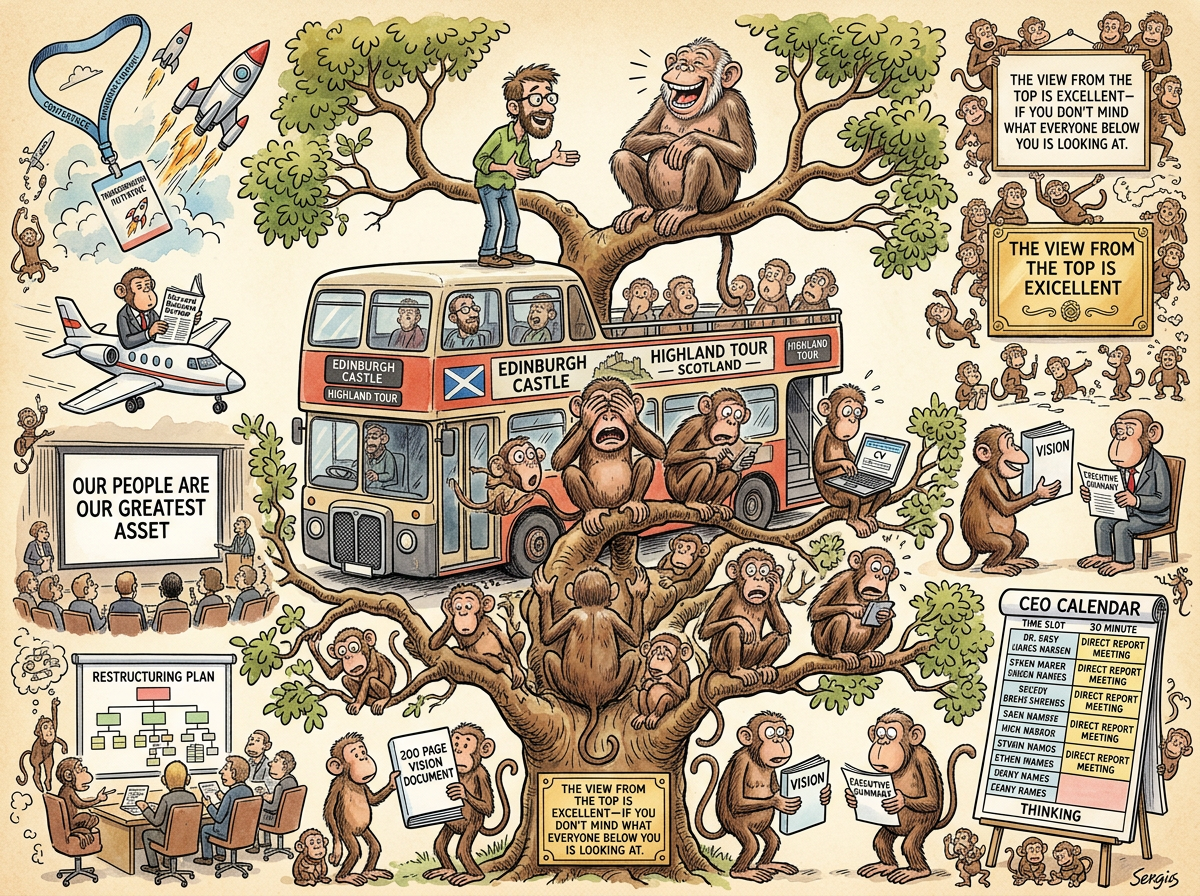
The CEO (Chief Executive Officer) is the person at the top of the Org Chart who looks down and sees smiling faces. The people at the bottom of the org chart look up and see something else entirely.
This is not a metaphor. It is the foundational joke of corporate hierarchy, and it explains more about organizational dynamics than any business school case study ever written. The CEO sees alignment, enthusiasm, and nodding heads. Everyone else sees the underside of power. The view is different because the angle is different, and no amount of “open door policy” changes the angle.
The CEO is the person who launches Transformation Initiatives after attending conferences, who reads one Harvard Business Review article and reorganises three hundred people, who says “we need to be more like [company they saw a keynote about]” without understanding that the keynote was a highlight reel, not a documentary. The CEO is also, occasionally, the person who builds something extraordinary — who sets a direction so clear that the Org Chart barely matters, who hires people smarter than themselves and gets out of the way, who understands that their job is not to make decisions but to make it possible for other people to make decisions.
The difference between the two is not intelligence, or vision, or charisma. The difference is whether they kept someone around who would tell them the monkey joke to their face.
riclib’s First CEO
riclib’s first encounter with a CEO in the wild occurred on a bus.
The company was webMethods — an integration software company that would later become central to the ESB story. riclib had not yet started the job. He was fifteen days away from his first day. But the company had invited him to an offsite — the kind of offsite where the entire company flies to a castle in Scotland to do strategy and team building — and riclib, who had never worked at a company where he even knew a CEO existed, said yes.
The bus was from the airport to the castle. The CEO was on the bus. riclib was on the bus. riclib had not yet received his employee ID, had not yet been assigned a desk, had not yet attended a single meeting. This seemed like the ideal time to tell the CEO the monkey joke.
The joke, for those who have not heard it: imagine a tree full of monkeys. The monkeys at the top look down and see smiling faces. The monkeys at the bottom look up and see nothing but arseholes.
riclib told this joke to the CEO. On a bus. Fifteen days before his first day at the company. On the way to a castle in Scotland. To the man at the top of the tree. Before riclib had an employee ID.
The CEO looked at him and said: “Do you know what a career-limiting move is?”
Then he laughed.
For the next four years, that CEO trusted riclib — implicitly and explicitly. Not because the joke was funny (it is funny, but CEOs hear funnier things from consultants billing three thousand pounds a day). Because the joke was direct. A person who tells the monkey joke to the monkey at the top of the tree is a person who will tell you the truth when the truth is expensive. Every CEO is surrounded by smiling faces. The smiling faces agree with everything. The smiling faces nod at the strategy deck. The smiling faces say “great question” in meetings when it was not a great question.
The person who tells you the monkey joke is the person who will say “this transformation is failing” when the transformation is failing. That person is worth more than a hundred smiling faces, and the CEOs who understand this keep them close.
The CEOs who don’t understand this have excellent town halls and terrible retention.
The Conference Problem
The most dangerous thing a CEO can do is attend a conference.
At the conference, the CEO will see a keynote by a CEO from a successful company. The keynote will describe what the successful company did — its culture, its architecture, its methodology, its organisational structure. The keynote will not describe the seventeen failed attempts that preceded the success, the specific context that made the approach work, or the fact that the keynote was prepared by a communications team whose job is to make everything sound intentional.
The CEO will return from the conference and say one of the following:
- “We need to be more like Spotify” → The Spotify Model is adopted for twelve developers
- “We need to be cloud-native” → a migration is launched that will cost ten times the estimate
- “We need to transform” → a Transformation Initiative begins, consultants are engaged, and the
forloop restarts - “We need AI” → the current layer of vocabulary residue begins accumulating
The conference is the ignition source. The Transformation Initiative is the fire. The Org Chart is the fuel. The people doing the work are the fire department.
The Two Types
There are two types of CEO. The distinction matters more than any other variable in a company’s life.
Type 1: The Builder. Came up through the work. Built things. Shipped things. Understands that the Org Chart is a technical document. Hires people smarter than themselves. Delegates authority, not just tasks. Says “I don’t know” in front of the board. Keeps the person who told them the monkey joke. The Builder CEO’s company has a simple architecture, because the CEO understands Conway’s Law intuitively — if you want simple software, build a simple organisation.
Type 2: The Performer. Came up through management, consulting, or finance. Has never shipped anything except slide decks. Understands the Org Chart as a political document. Hires people who agree with them. Delegates tasks, not authority. Says “great question” when asked something they cannot answer. Fires the person who told them the monkey joke. The Performer CEO’s company has forty-seven Microservices, because the CEO launched a Transformation Initiative after a conference, and the consulting firm recommended an architecture that matched the new org chart, which matched the CEO’s slide deck, which matched nothing in reality.
The Builder CEO reads Gall’s Law and nods. The Performer CEO reads Gall’s Law and launches an initiative to implement it.
The View from the Top
The CEO’s fundamental problem is informational. The higher you climb the tree, the better the view — but the less you can see of what’s directly below you. The CEO sees the horizon: market trends, competitive landscape, board expectations, investor sentiment. The CEO does not see: the deployment pipeline that breaks every Tuesday, the team that hasn’t had a stable manager in eighteen months, the shadow Org Chart that actually runs the company, or the senior developer whose departure would collapse three product lines.
The smiling faces do not transmit this information upward. The smiling faces transmit what the CEO wants to hear, filtered through seven layers of management, each layer removing one uncomfortable truth until what arrives at the top is a dashboard of green indicators and a culture survey that says morale is “trending positive.”
The CEO makes decisions based on this information. The decisions are rational given the information. The information is wrong. The decisions are therefore wrong. The CEO is blamed for making bad decisions. The CEO was making the best decisions available to someone who only sees smiling faces.
This is why the monkey joke matters. The person who tells you the joke is offering to be the one face that doesn’t smile on command.
The Town Hall
The CEO’s primary communication tool is the Town Hall — a company-wide meeting in which the CEO stands on a stage (physical or virtual) and explains the strategy to everyone, then takes questions, then receives questions that are not really questions but performances of engagement designed to be visible to the asker’s manager.
The Town Hall contains the following elements, in order:
- A slide about the company’s mission (unchanged since founding)
- A slide about market conditions (always “challenging but full of opportunity”)
- A slide about recent achievements (curated)
- A slide about the strategy going forward (the conference keynote, adapted)
- A slide reading “Our People Are Our Greatest Asset” (directly before or after a restructuring announcement)
- Q&A (three pre-submitted questions from HR, one genuine question from the person who told the monkey joke, and a long awkward silence)
The Town Hall is the CEO’s retrospective. Unlike the engineering Retrospective, it has no action items. Unlike the Agile Coach’s retrospective, it has no sticky notes. It has a slide deck, a microphone, and the quiet certainty that nothing said in this room will change what happens in the next quarter.
Measured Characteristics
- Average CEO tenure: 6.9 years (S&P 500)
- Conferences attended per year: 4-8
- Transformation Initiatives launched per conference: 0.3
- Town Halls per year: 4 (quarterly, like earnings)
- Questions at Town Hall that are real questions: 1
- Smiling faces visible from the top: all of them
- Honest faces visible from the top: depends on whether they kept the monkey joke person
- HBR articles that launched a reorg: at least 1 per CEO
- CEOs who would laugh at the monkey joke: the good ones
- CEOs who would fire you for the monkey joke: the ones whose companies you should leave anyway
- Career-limiting moves that became career-defining: 1 (documented, on a bus to a castle in Scotland, 15 days before Day 1)