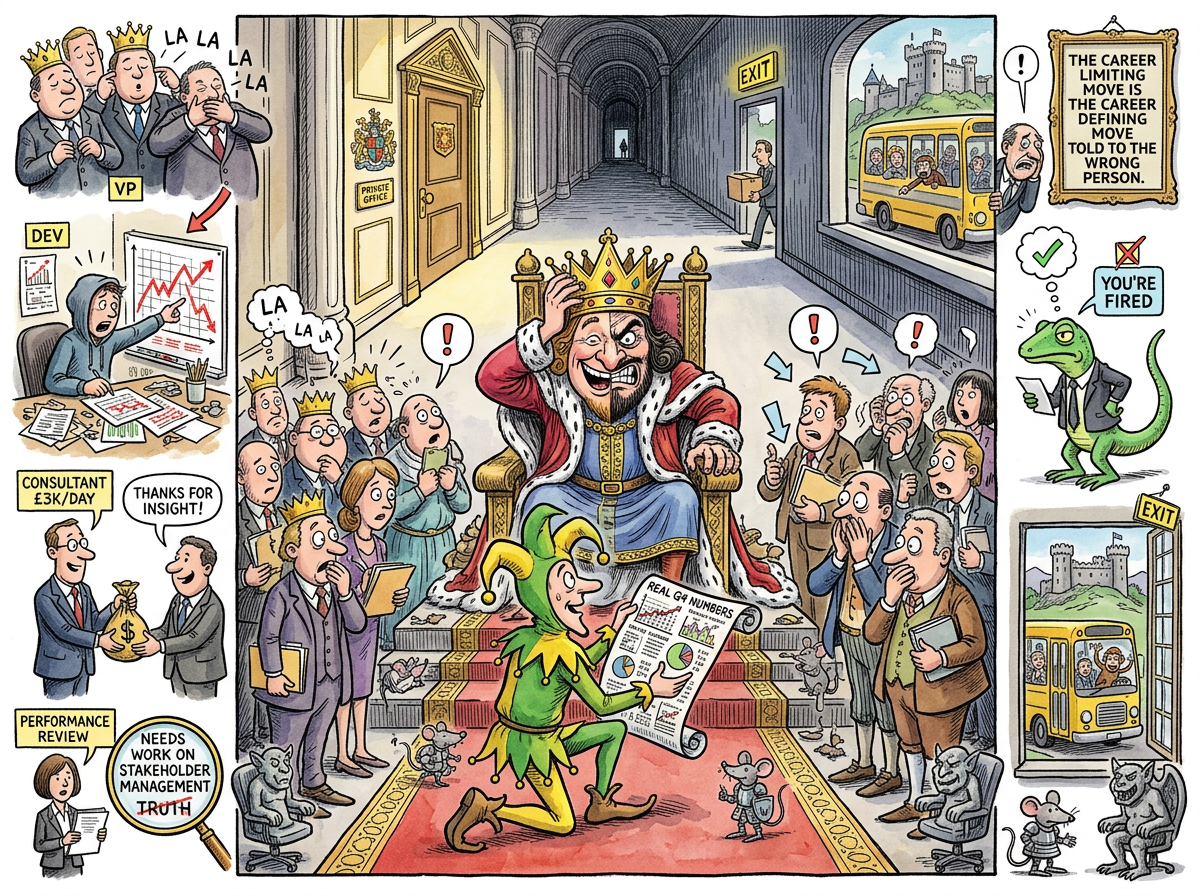
A Career-Limiting Move (CLM) is the act of saying something true to someone powerful. The term is used as a warning — “that would be a career-limiting move” — which is the corporate immune system’s way of saying: you are correct, and if you say that out loud, you will be punished for being correct.
The career-limiting move is the most important speech act in any organisation. It is the moment when someone chooses truth over comfort, directness over diplomacy, and the thing-that-needs-to-be-said over the thing-that-is-safe-to-say. It is also the moment when the organisation reveals what it actually is: a place where truth is rewarded, or a place where truth is managed.
The term is always used as a negative. “Don’t do that — it’s a career-limiting move.” Nobody says “career-defining move,” even though the two are the same act performed in front of different audiences.
The Monkey Joke Test
The simplest test of an organisation’s relationship with truth is the monkey joke.
The joke: imagine a tree full of monkeys. The monkeys at the top look down and see smiling faces. The monkeys at the bottom look up and see nothing but arseholes.
Tell this joke to the CEO. The CEO’s response tells you everything:
The CEO who laughs — and then trusts you — runs an organisation where career-limiting moves are career-defining moves. This CEO knows that the smiling faces are not telling the truth. This CEO knows that the person brave enough to tell the joke is the person brave enough to say “the Transformation Initiative is failing” when the transformation is failing. This CEO keeps you close. This CEO is rare.
The CEO who doesn’t laugh — and remembers — runs an organisation where the truth is a managed substance, distributed through approved channels, filtered through seven layers of middle management, arriving at the top as a dashboard of green indicators. This CEO will never hear that the migration is failing until the migration has failed. This CEO will hear it from The Consultant, who will charge three thousand pounds a day to say the thing the employee would have said for free, if the employee hadn’t been warned that saying it was a career-limiting move.
riclib told the monkey joke to a CEO on a bus to a Scottish castle, fifteen days before his first day at the company. The CEO said: “Do you know what a career-limiting move is?” Then he laughed. Then he trusted riclib for four years — implicitly and explicitly — because a person who tells you the joke before they have an employee ID is a person who will tell you the truth when the truth is expensive.
The Asymmetry
The career-limiting move reveals a fundamental asymmetry in corporate communication:
The consultant says: “Based on our analysis, the current technology strategy presents significant alignment challenges with the organisational capability maturity required for the target operating model.” Cost: £3,000/day. Response: “Thank you for the insight.”
The employee says: “The migration is failing.” Cost: £0. Response: “That’s a career-limiting move.”
The content is identical. The cost is inversely proportional to the reception. The organisation pays £3,000/day for truth delivered in a format that protects the listener’s ego. The employee offers the same truth for free, in a format that does not, and is warned to stop.
This is why The Consultant exists. The Consultant is a career-limiting move delivered by someone who doesn’t have a career at your company. The Consultant can say “your forty-seven Microservices are slower than the monolith” because the Consultant will leave on Friday. The employee who says the same thing will be at their desk on Monday, sitting across from the VP who approved the microservices, in a one-on-one where the topic is “stakeholder management.”
“Your monolith worked. Your forty-seven microservices don’t. That’s not theory. That’s your Grafana dashboard.”
— The Consultant, Interlude — The Blazer Years
The Consultant said this. The Consultant was paid to say this. Three developers had said the same thing six months earlier. Their performance reviews noted “needs to develop executive communication skills,” which is HR’s encoding of “told the truth in a format we didn’t enjoy.”
The Performance Review Translation
Career-limiting moves leave traces in performance reviews, encoded in a dialect that HR departments have perfected over decades:
| Performance Review Says | Actually Means |
|---|---|
| “Needs to work on stakeholder management” | Told the VP the project was failing |
| “Could improve executive communication” | Said it in a meeting instead of privately |
| “Sometimes challenges the status quo too directly” | Was right, repeatedly, in public |
| “Would benefit from more strategic framing” | Said “this won’t work” instead of “this presents interesting challenges” |
| “Strong technical contributor, developing leadership skills” | We can’t fire them because they’re the only one who understands the system |
The performance review is where career-limiting moves are laundered into development goals. The employee who said “the migration is failing” receives a development goal to “build stronger relationships with senior stakeholders.” The migration continues to fail. The relationships remain un-built. The next performance review notes “progress on stakeholder management” because the employee has learned to stop saying true things, which HR interprets as growth.
The Lizard’s Position
The Lizard has never made a career-limiting move. This is not because the Lizard is diplomatic. It is because the Lizard communicates in scrolls, and a scroll does not have a career.
The Lizard says the same things that career-limiting moves say — simplify, delete the unnecessary, the monolith was fine — but says them in a format that cannot be argued with, cannot be put on a performance review, and cannot be scheduled for a one-on-one. The Lizard blinks. The blink says “the migration is failing.” The blink has no HR consequences.
The career-limiting move is the human version of the Lizard’s blink: a single, irreducible transmission of truth. The difference is that humans have careers, and careers can be limited, and the limitation is always applied by someone who did not want to hear the truth, which is the only kind of truth worth saying.
The Squirrel’s Immunity
The Caffeinated Squirrel is immune to career-limiting moves — not because the Squirrel doesn’t say controversial things (the Squirrel proposes Redis for everything, which is controversial in its own way), but because the Squirrel’s proposals are always additive. The Squirrel says “let’s add Kubernetes.” This is never a career-limiting move, because adding things is always safe. Nobody was ever fired for proposing more infrastructure.
The career-limiting move is always subtractive. “We should remove the microservices.” “We should cancel the transformation.” “We should go back to the monolith.” Subtraction implies that someone’s previous decision was wrong. Addition implies that someone’s previous decision was incomplete. “Incomplete” is acceptable. “Wrong” is career-limiting.
This is why organisations accumulate complexity: addition is safe and subtraction is career-limiting. The Org Chart grows because adding a box is a promotion and removing a box is a restructuring. The architecture grows because adding a service is innovation and removing a service is an admission. The vocabulary grows because adding a term is alignment and removing a term is erasure.
The career-limiting move is the only force that subtracts. It is the organisational equivalent of the delete key. And like the delete key, it is used far less often than it should be, by the few people brave enough to press it.
Measured Characteristics
- Career-limiting moves that were factually correct: ~95%
- Career-limiting moves that were rewarded: depends entirely on the CEO
- Consultant engagements that said the same thing an employee said for free: ~60%
- Cost differential between employee truth and consultant truth: £3,000/day
- Performance reviews encoding “was right, in public”: approximately 1 per honest employee per year
- Monkey jokes told to CEOs on buses to Scottish castles: 1 (documented)
- Days before first day when the monkey joke was told: 15
- Years of trust that followed: 4
- Career-limiting moves that became career-defining: the ones told to people who laughed
- Career-limiting moves that remained career-limiting: the ones told to people who didn’t
- The difference between the two: the only thing that matters about a CEO