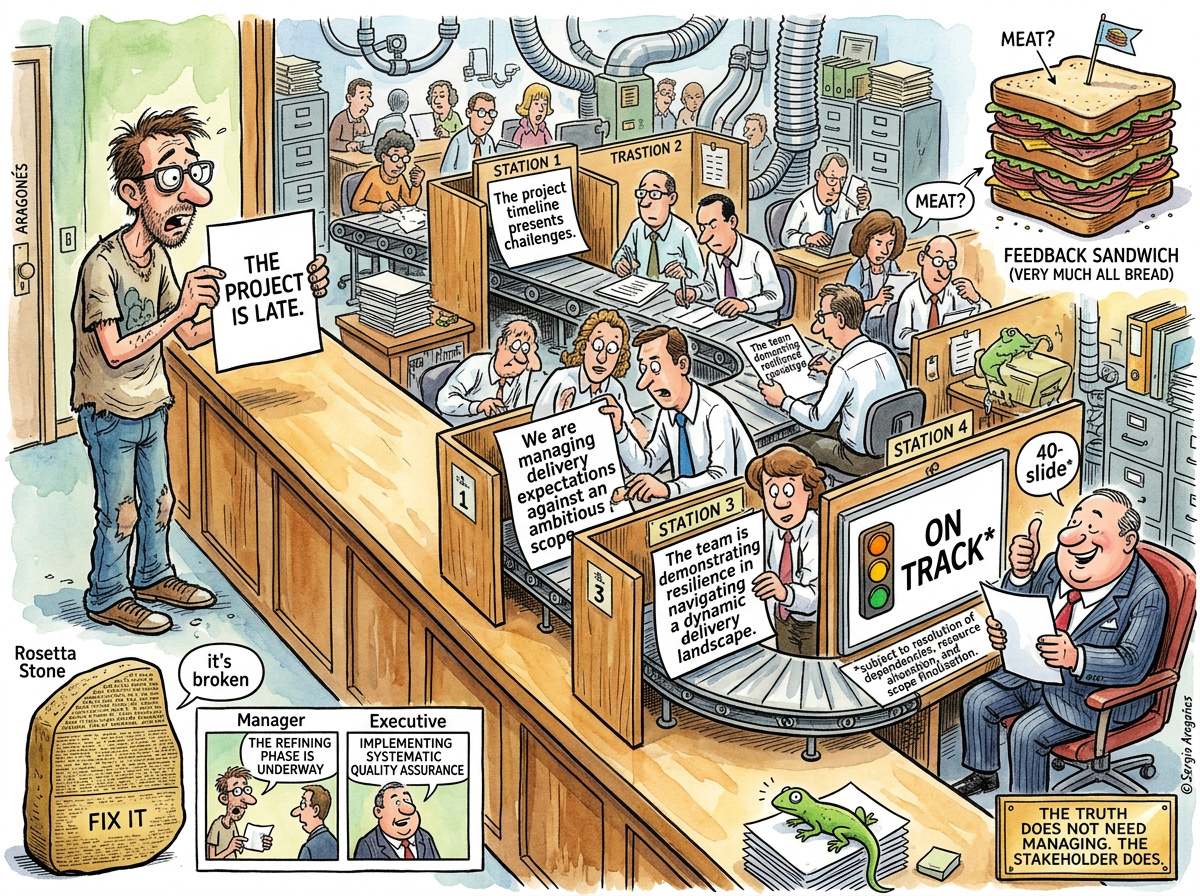
Stakeholder management is the corporate discipline of communicating true things to powerful people in a way that is sufficiently diluted, reframed, and padded with context that the powerful person does not experience the emotional discomfort of hearing a true thing.
It is not lying. Lying would be simpler and more honest about its intentions. Stakeholder management is the space between truth and lying — a vast, well-funded territory where facts are “reframed,” problems are “challenges,” failures are “learnings,” and the project that is three months late is described as “on track against a revised timeline,” which is technically true in the same way that a shipwreck is on track against a revised destination.
The term appears in Performance Reviews, job descriptions, and coaching feedback with the frequency and gravity of a medical diagnosis: “needs to develop stakeholder management skills” — which is HR’s encoding of “said a true thing to a powerful person without wrapping it in enough context to prevent the powerful person from feeling uncomfortable.”
The Translation Layer
Stakeholder management is, fundamentally, a translation problem. The organisation generates information at the bottom. The information travels upward through the Org Chart. At each level, the information is translated — not from one language to another, but from one emotional tolerance to another.
| What Happened | Developer Says | Manager Says | VP Says | CEO Hears |
|---|---|---|---|---|
| Project is late | “We’re going to miss the deadline” | “There are timeline risks we’re managing” | “We’re tracking amber with a recovery plan” | “On track” |
| Architecture is wrong | “This won’t scale” | “We’ve identified technical debt to address” | “We’re investing in platform resilience” | “Platform investment proceeding” |
| Key person quit | “Sarah left and she was the only one who understood the billing system” | “We have a knowledge transfer gap in billing” | “We’re building team resilience in critical domains” | “Team development progressing” |
| The product doesn’t work | “It’s broken” | “We’re seeing quality challenges in the latest release” | “We’re prioritising stability in the next sprint” | “Quality focus” |
Each translation removes one unit of truth and adds one unit of comfort. By the time the information reaches the CEO, it has been translated so many times that it bears the same relationship to reality as a game of telephone bears to the original sentence. The CEO makes decisions based on this information. The decisions are wrong. Nobody connects the wrong decisions to the translation layer, because connecting them would be a Career-Limiting Move.
The Feedback Sandwich
The feedback sandwich is stakeholder management’s most recognisable artifact: the practice of placing a negative truth between two positive statements, like a slice of ham between two slices of bread so thick that the recipient cannot taste the ham.
Structure:
- Bread — “The team has been working incredibly hard this quarter.”
- Ham — “The deliverable is six weeks late and the architecture needs to be rebuilt.”
- Bread — “I’m really confident about the direction we’re heading.”
The recipient eats the sandwich. The recipient tastes bread. The recipient leaves the meeting believing the conversation was positive. The deliverable remains six weeks late. The architecture remains un-rebuilt. The ham was present. The ham was not tasted.
The feedback sandwich exists because direct communication — “the deliverable is late and the architecture is wrong” — is classified as poor stakeholder management. The person who says the ham without the bread receives a note in their Performance Review: “could benefit from more strategic framing of feedback.” The person who buries the ham in bread receives no note, because nobody noticed the ham, which was the point.
The Consultant Bypass
The Consultant is the organisational workaround for stakeholder management. The Consultant says the thing that employees cannot say, in the same words employees would use, but from a position that does not require stakeholder management — because the Consultant does not have a stake, does not have a Performance Review, and does not have a career at the company that can be limited.
“Your monolith worked. Your forty-seven microservices don’t.”
— The Consultant, Interlude — The Blazer Years
This sentence, spoken by a consultant, is “valuable insight.” This sentence, spoken by a developer, is “poor stakeholder management.” The content is identical. The invoice is not.
Organisations pay consultants to bypass the translation layer. The consultant’s £3,000/day fee is not payment for expertise. It is payment for the privilege of hearing unmanaged truth from someone whose career you cannot limit.
The Lizard’s Exemption
The Lizard does not practise stakeholder management. The Lizard blinks. The blink says “this is wrong.” The blink is not wrapped in context. The blink is not sandwiched between positive observations. The blink is not preceded by “I want to be thoughtful about how I frame this.”
The Lizard has no stakeholders. The Lizard has no career. The Lizard has a warm rock and a scroll. The scroll says what the scroll says. The reader can accept it or not. The Lizard does not follow up.
This is why the Lizard ships and the organisation does not: the Lizard’s communication has zero translation layers. The information arrives at the decision point in the same condition it left the source. No truth was removed. No comfort was added. The decision is therefore correct. The decision is also uncomfortable, which is why organisations prefer the translation layer.
Measured Characteristics
- Translation layers between developer and CEO: 4-7
- Truth remaining after 4 translation layers: ~15%
- Truth remaining after 7 translation layers: ~3%
- Feedback sandwiches where the ham was tasted: ~10%
- Performance reviews noting “stakeholder management”: 1 per honest employee per year
- Consultant day rate for saying the same thing: £3,000
- Employee cost for saying the same thing: one performance review note
- Organisations that have tried direct communication: few
- Organisations that survived direct communication: the good ones
- Lizard translation layers: 0
- Lizard truth retention: 100%
- Lizard stakeholders: 0
- Correlation between translation layers and project failure: suspiciously high