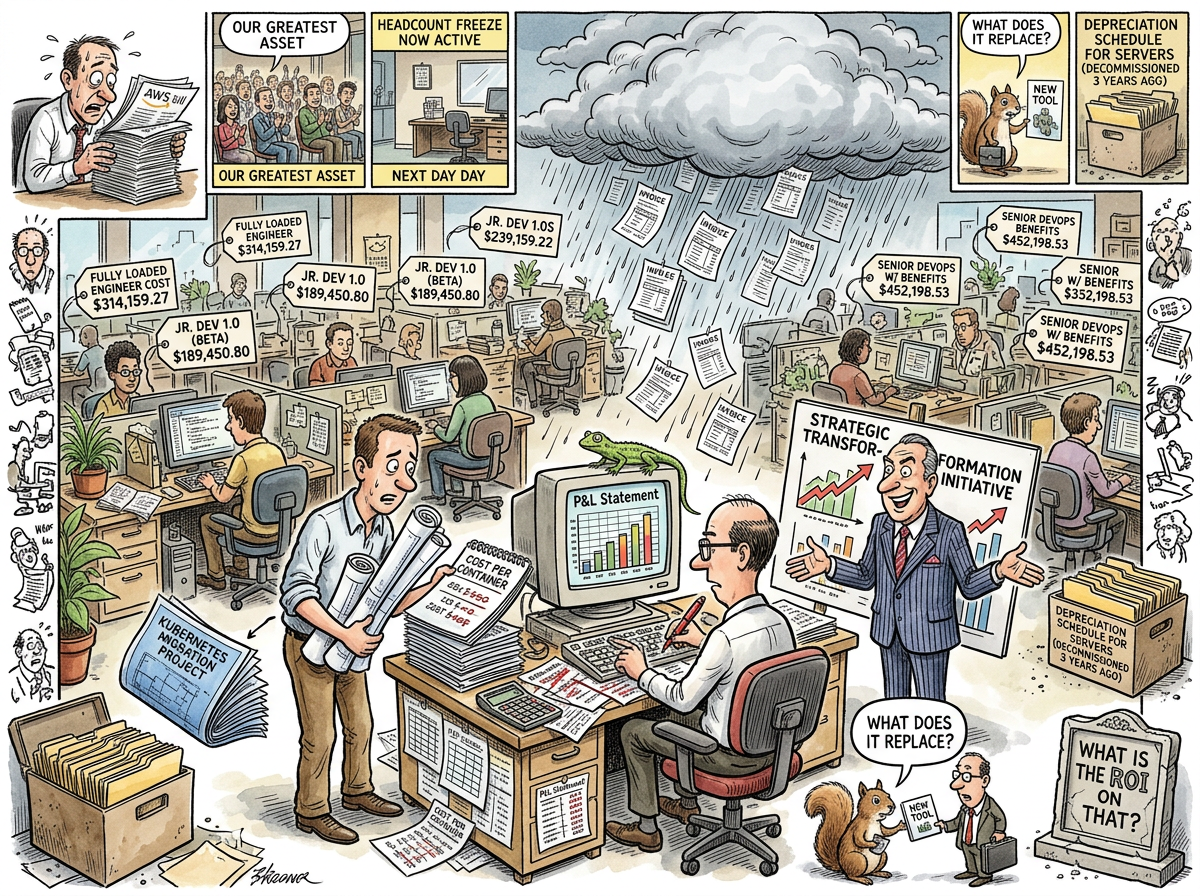
The CFO (Chief Financial Officer) is the person in the boardroom who asks “what is the ROI on that?” and waits, in silence, while the room discovers that nobody has calculated the ROI on that.
The CFO is the Lizard of the C-suite. Not because the CFO is wise (though some are), or ancient (though many have been in finance longer than most developers have been alive), but because the CFO operates on a single, unchanging principle: does the number go up or does the number go down? The Lizard blinks. The CFO calculates. The mechanism is different. The outcome is identical. Unnecessary complexity is rejected. Unnecessary spending is rejected. Unnecessary anything is rejected. The CFO does not need a philosophy. The CFO has a spreadsheet.
The CFO is the natural predator of the Squirrel. Every proposal the Squirrel makes — Kubernetes, a new monitoring stack, a dedicated dry-ageing fridge — must eventually pass through the CFO, who will reduce it to a single question: what does it cost, what does it save, and why can’t we keep using the thing we already have? The Squirrel has a vision. The CFO has a budget. The budget wins. The budget always wins.
The AWS Bill
The defining moment of the modern CFO’s career is the first time they see the AWS bill.
The CFO has seen large invoices. The CFO has approved capital expenditure for office buildings, manufacturing equipment, and enterprise software licenses that cost more than some employees’ careers. The CFO is not easily shocked.
The AWS bill shocks the CFO.
Not because of the total — though the total is substantial. Because of the granularity. The AWS bill is an itemised list of charges for services the CFO has never heard of, in units the CFO does not understand, accruing at rates that change hourly, across regions the CFO cannot locate on a map. The CFO reads “NAT Gateway — Data Processing — per GB” and experiences the specific vertigo of a person who controls the budget but does not understand what the budget is buying.
The CFO’s response is always the same: “Can you explain what we’re spending this on?” The CTO’s response is always the same: a thirty-minute presentation that makes the CFO more confused, not less. The CFO’s follow-up is always the same: “Can we spend less?” The CTO’s response is always the same: “It’s complicated.”
The CFO does not accept “it’s complicated.” The CFO accepts numbers. The number is too large. The CFO will make it smaller. The CTO will explain why it can’t be smaller. The CFO will make it smaller anyway. The CTO will find a way. This is the dynamic. It works.
The Headcount Freeze
The CFO’s most powerful tool is the headcount freeze — a company-wide moratorium on hiring that is announced approximately one business day after the CEO tells a town hall that “our people are our greatest asset.”
The headcount freeze is the CFO’s equivalent of the Lizard’s blink. It communicates everything without saying anything. It says: revenue is not where we expected. It says: the board asked questions. It says: the Transformation Initiative cost more than the slide deck promised. It says all of this without the CFO having to stand on a stage and say it, because the CFO does not stand on stages. The CFO sends an email. The email is one paragraph. The paragraph changes the company more than any town hall ever has.
The Consultant Question
The CFO and The Consultant have a relationship best described as mutual suspicion:
The Consultant arrives with a proposal. The proposal has a cost. The CFO asks: “What is the expected return?” The Consultant says: “Improved agility.” The CFO says: “What is the dollar value of improved agility?” The Consultant says: “It’s hard to quantify.” The CFO says: “Then how do I know it’s worth the cost?” The Consultant says: “Other companies have seen significant improvements.” The CFO says: “Which companies? What improvements? Measured how?”
The room goes quiet. The CEO shifts in their chair. The CTO studies the ceiling. The Consultant produces a case study from a company in a different industry, of a different size, in a different market. The CFO reads the case study. The CFO notes the absence of a control group. The CFO approves a pilot at one-tenth the proposed budget, with measurable outcomes defined in advance, reviewed quarterly.
The Consultant wanted eighteen months and five million. The CFO gave them three months and five hundred thousand. The Consultant will deliver results in three months. The Consultant always delivers results when the CFO is watching.
The CFO-CTO Alliance
The rarest and most powerful relationship in the boardroom is the CFO-CTO alliance — two people who, by rights, should be adversaries, discovering that they want the same thing: less.
The CFO wants less spending. The CTO (the good kind) wants less complexity. Less complexity produces less spending. Less spending permits simpler architecture. The virtuous cycle begins.
The CFO who understands technology and the CTO who understands costs are, together, the most dangerous force in an organisation — dangerous to consultants, to vendors, to the Squirrel, and to every initiative that cannot survive the question “what does this replace?”
When this alliance forms, the company runs on Boring Technology, SQLite, and Hetzner instead of Kubernetes, AWS, and hope. The CFO is happy because the bill is small. The CTO is happy because the architecture is simple. The Lizard is happy because the Lizard is always happy when things are simple, though the Lizard’s happiness is indistinguishable from its other states.
Measured Characteristics
- CFOs who understand the AWS bill: ~15%
- CFOs who have reduced the AWS bill: ~80% (of those who looked)
- Average time between “people are our greatest asset” and headcount freeze: 1 business day
- Consultant proposals approved at full budget: ~5%
- Consultant proposals approved at reduced budget with quarterly review: ~60%
- ROI calculations requested: all of them
- ROI calculations provided: approximately half
- ROI calculations that were accurate: fewer
- Headcount freezes announced per CFO career: 3-5
- Spreadsheets open at any given time: 4-7
- The question “what does it replace?”: the CFO’s Gall’s Law
- Relationship to the Lizard: spiritual kinship
- Relationship to the Squirrel: predator-prey