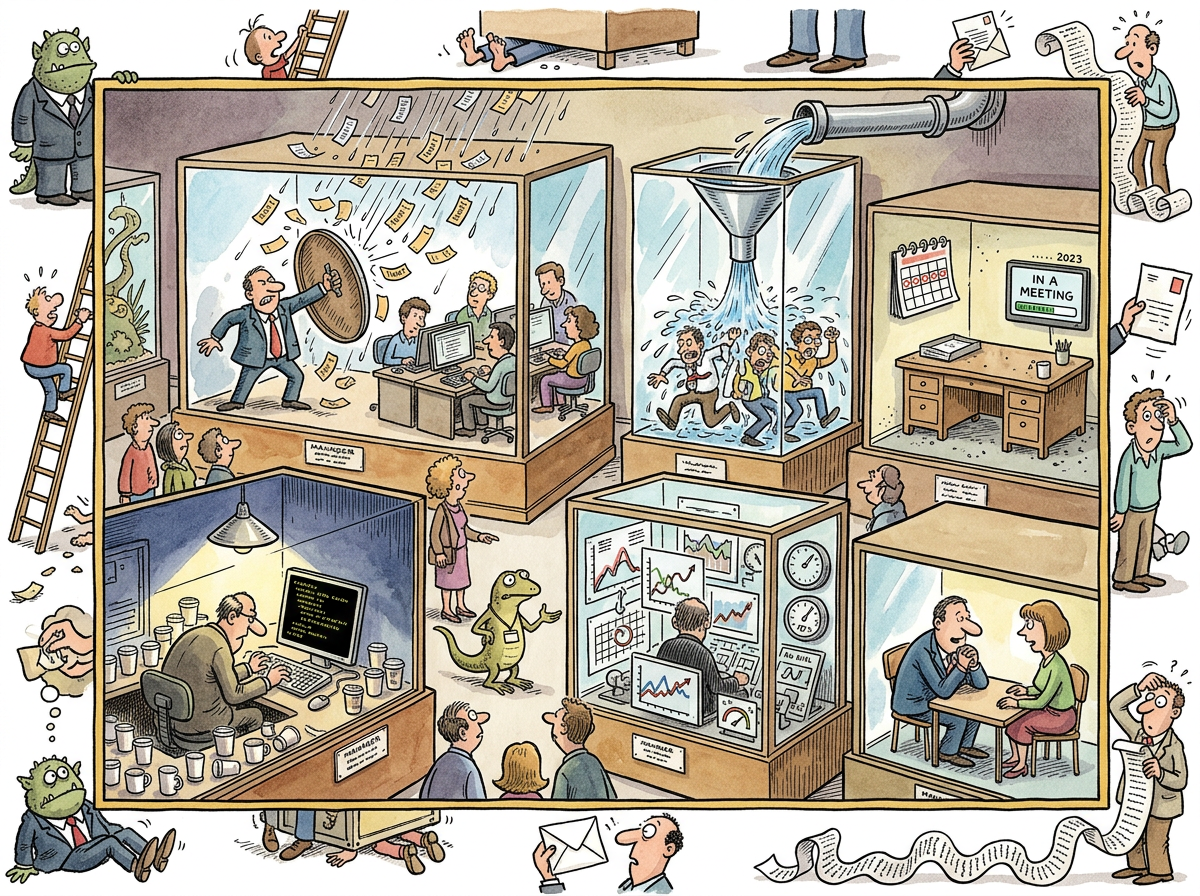
The Manager is a person who was good at doing a thing, was promoted to stop doing that thing, and now spends their time in meetings about the thing they used to do, performed by people who are still allowed to do it.
This is the foundational tragedy of management. The best developer becomes the Engineering Manager. The best salesperson becomes the Sales Manager. The best designer becomes the Design Manager. In each case, the promotion removes the person from the activity they excelled at and places them in an activity — managing — for which they have received no training, no preparation, and no honest warning that the job they are accepting bears no resemblance to the job they are leaving.
The promotion is presented as advancement. It is a career change. The difference between “advancement” and “career change” is the difference between climbing a ladder and jumping to a different ladder. One is continuous. The other requires you to let go of the thing you’re holding, which nobody mentions during the promotion conversation.
See also: Peter Principle.
A Field Guide to the Species
Managers, like finches, have diversified into distinct species adapted to their specific corporate environment. The following taxonomy is based on field observations across multiple organisations, continents, and Reorg cycles.
The Shield
Habitat: Between the team and upper management.
Identifying behaviour: Absorbs incoming requests, priority changes, and executive panic before they reach the team. The team ships. The Shield takes the meetings. The team does not know how many meetings the Shield takes, because the Shield does not mention them, because the Shield understands that the team’s productivity is inversely proportional to their awareness of corporate chaos.
Conservation status: Endangered. The Shield burns out in 18-24 months, because absorbing organisational dysfunction is exhausting and nobody manages the manager.
The Shield is the best manager. The Shield is also the manager most likely to leave, because the Shield’s success is invisible (the team ships) and the Shield’s cost is private (the Shield is exhausted). Performance Reviews struggle with the Shield because the Shield’s contribution is the absence of disruption, and absence is difficult to put on a slide.
The Funnel
Habitat: Same position as the Shield, opposite behaviour.
Identifying behaviour: Receives pressure from above and transmits it downward, unfiltered and often amplified. The CEO says “we need to move faster.” The VP says “we need to move faster.” The Funnel says “the CEO and VP say we need to move faster and I’m scheduling a daily check-in to track progress.” The team receives three layers of pressure where one existed. The Funnel believes they are communicating. The Funnel is communicating. The communication is the problem.
Conservation status: Thriving. The Funnel’s behaviour is rewarded by the layers above (the CEO sees urgency being transmitted) and tolerated by the layers below (the team has learned to nod and continue at the same pace).
The Ghost
Habitat: Nominally, the team’s floor. Actually, perpetually in meetings, on a plane, or “working from home” in a way that involves no Slack activity between 10 AM and 4 PM.
Identifying behaviour: Unavailable. The one-on-one is cancelled weekly. The approvals sit in a queue. The team has learned to make decisions without the Ghost, which means the Ghost’s role has been absorbed by the senior developer, who is doing two jobs for one salary and not enjoying either.
Conservation status: Common. The Ghost’s absence is rarely addressed because addressing it would require the Ghost’s manager to notice, and the Ghost’s manager is frequently also a Ghost. Ghost populations reproduce upward through the Org Chart.
The Former IC
Habitat: The codebase, at midnight, where nobody can see.
Identifying behaviour: Still reviews pull requests. Still has opinions about the tech stack. Still opens the IDE at 10 PM “just to check something.” The Former IC became a manager but did not stop being an engineer. The result is a person doing two jobs — managing during the day, coding at night — and doing neither as well as they would if they chose one.
The Former IC’s team has a particular problem: every technical decision routes through the manager, because the manager has opinions, and the opinions are usually correct, and the correctness makes them harder to resist. The team does not develop technical independence. The Former IC does not develop management skills. Both parties are stuck in a codependency that looks like mentorship but functions as a bottleneck.
This is the Peter Principle in its most sympathetic form: a person who is excellent at the thing they were promoted away from, mediocre at the thing they were promoted into, and unable to let go of the first because the second does not feed the same part of the brain.
The Spreadsheet
Habitat: Behind a wall of dashboards.
Identifying behaviour: Tracks velocity. Tracks cycle time. Tracks deployment frequency. Tracks mean time to recovery. Tracks the burndown chart. Tracks Story Points. The Spreadsheet knows every number about the team and understands nothing about the team. The Spreadsheet can tell you that velocity dropped 15% in the last sprint. The Spreadsheet cannot tell you that it dropped because the senior developer’s mother is ill, because the Spreadsheet does not have one-on-ones — the Spreadsheet has “data review sessions.”
The Spreadsheet is Goodhart’s Law in human form: the manager has become the metric they are measuring.
The Coach
Habitat: Across the table from an employee, genuinely listening.
Identifying behaviour: Asks questions instead of giving answers. Removes obstacles instead of adding process. Has one-on-ones that the employee looks forward to. Knows that their job is to make the team effective, not to make the team visible. Understands that the best meeting is the one that didn’t need to happen.
Conservation status: Rare. The Coach is rare because the skills required — listening, patience, genuine curiosity about other people’s growth — are not selected for in promotion decisions. Promotion decisions select for technical excellence (the Former IC), executive communication (the Funnel), and dashboard fluency (the Spreadsheet). The Coach is promoted by accident and retained by results.
The Reluctant
Habitat: The IC track that doesn’t exist at their company.
Identifying behaviour: Became a manager because it was the only way to advance. The company had no senior IC track, or the IC track topped out at a salary that was 40% below the management track, or the IC track existed on paper but nobody had been promoted through it in three years. The Reluctant took the management role for the money, the title, or the career progression, and spends every one-on-one wishing they were coding.
The Reluctant is not a bad manager. The Reluctant is a hostage — held by a compensation structure that equates management with advancement and individual contribution with a ceiling. The Reluctant will leave the moment a company offers a Staff Engineer role at management-level compensation. The company will be surprised. The company should not be surprised.
The One-on-One
The one-on-one is the manager’s primary tool and the most accurate indicator of which species they are.
| Species | One-on-One Style |
|---|---|
| The Shield | “What’s blocking you? I’ll handle it.” |
| The Funnel | “The VP needs an update. Where are we on the deliverable?” |
| The Ghost | [cancelled] |
| The Former IC | “I looked at your PR last night. Have you considered…” |
| The Spreadsheet | “Velocity was down 15%. Let’s look at the data.” |
| The Coach | “How are you doing? No, really.” |
| The Reluctant | [both parties check their watches] |
The Promotion Trap
The path from individual contributor to manager is the most consequential career decision in technology, and it is treated with less deliberation than choosing a laptop.
The conversation:
VP: “We’d like to promote you to Engineering Manager.”
IC: “I love coding.”
VP: “You’ll still be technical.”
IC: “Will I write code?”
VP: “You’ll be close to the code.”
IC: “That’s not the same thing.”
VP: “It comes with a 25% raise.”
IC: “When do I start?”
The IC starts. The IC stops coding. The IC starts having one-on-ones, Performance Reviews, calibration meetings, skip-levels, and the specific existential crisis of a person who defined themselves by what they built and now defines their days by what they discussed. The 25% raise compensates for the loss of the activity that made them happy. It does not compensate enough.
Six months later, the new manager has a one-on-one with their manager. The topic is “how are you adjusting to the role?” The new manager says “great” because saying “I miss coding and I don’t know what I’m doing” is a Career-Limiting Move. The adjustment continues. The missing continues. The “great” continues.
Measured Characteristics
- Species identified: 7
- Species that received management training before starting: ~10%
- Species that miss their previous role: ~60%
- Shields currently burning out: most of them
- Ghosts currently in a meeting: definitionally, yes
- Former ICs currently reviewing PRs at midnight: at least one per company
- Spreadsheets that could be replaced by a dashboard: most
- Coaches per organisation: 1-2 (treasured, underpaid relative to Funnels)
- Reluctants waiting for a Staff Engineer opening: approximately 30% of managers
- One-on-ones cancelled this week: 40% (industry average)
- Promotion conversations that mentioned “you will stop doing the thing you love”: ~0%
- The raise that made it okay: 25%
- Months before the 25% stopped being enough: 6