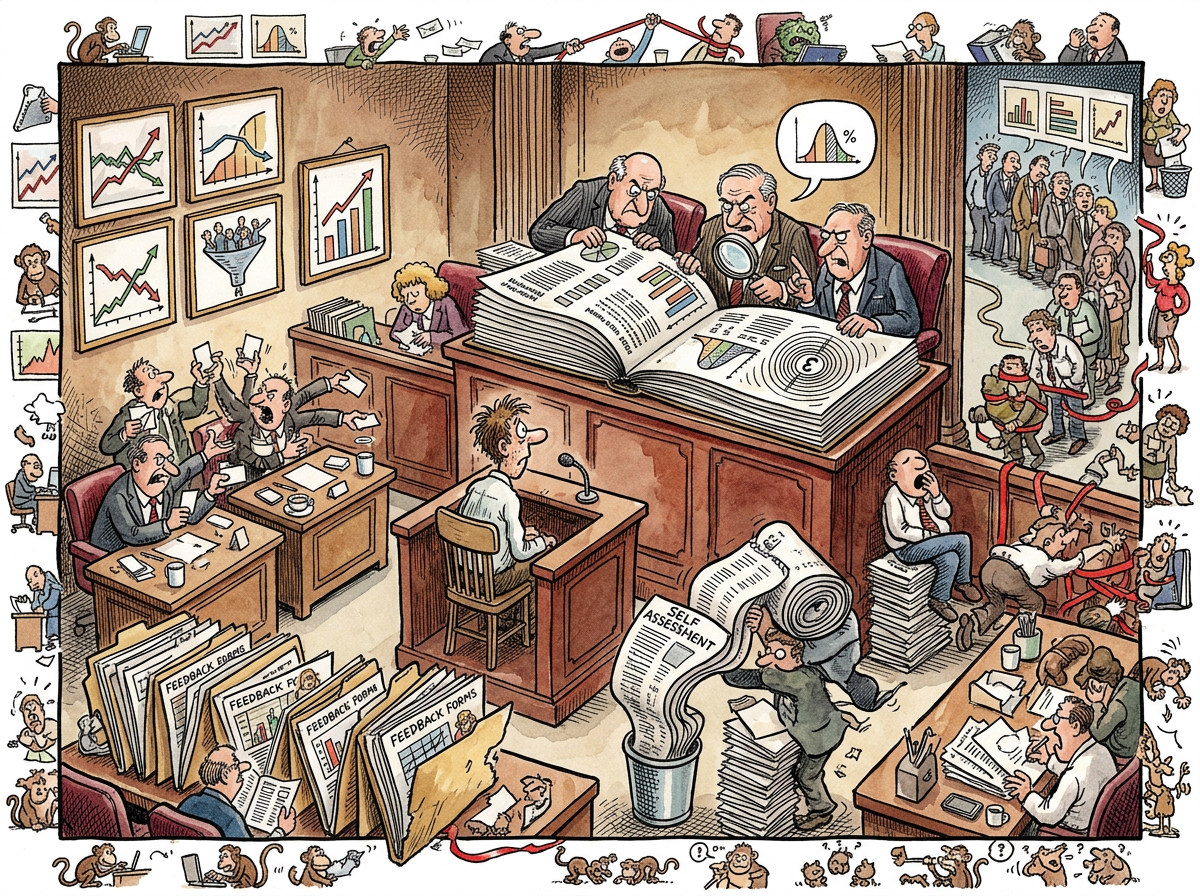
The Performance Review is an annual ritual in which twelve months of work are compressed into a two-page form, filtered through a manager’s recollection of the last six weeks, calibrated against a bell curve that has nothing to do with actual performance, and expressed in a vocabulary so encoded that the employee must translate it back into English to understand whether they are being praised, warned, or prepared for termination.
The Performance Review is the Org Chart’s memory — the official record of what each person contributed, how they contributed it, and whether the contribution was sufficient. It is also the Org Chart’s immune system — the mechanism by which the organisation identifies, documents, and eventually removes people who do not fit. The review’s dual purpose — development and documentation — is its fundamental contradiction: a tool cannot simultaneously help someone grow and build a case for their removal, yet the Performance Review attempts both, in the same document, in the same meeting, delivered by the same manager who must look the employee in the eye and say “I want to support your development” while HR has already reviewed the document for legal defensibility.
The Rating Scale
Every Performance Review contains a rating. The rating uses a scale that varies by company but always produces the same distribution:
| Rating | Label | Meaning | Employee Experience |
|---|---|---|---|
| 5 | Exceptional | Reserved for 5% of employees by the curve | Elation; immediately begins job searching for more money |
| 4 | Exceeds Expectations | You are good; the curve allows 20% | Relief |
| 3 | Meets Expectations | You are adequate; the curve demands 50% | Devastation disguised as acceptance |
| 2 | Below Expectations | You are on notice; the curve needs 20% | Panic; the PIP is next |
| 1 | Does Not Meet | You are being documented; the curve sacrifices 5% | Already happened; you just didn’t know |
The rating is not determined by performance. The rating is determined by the calibration meeting — a closed-door session where managers gather, compare their teams’ ratings, and adjust them to fit the bell curve that HR has mandated. The curve dictates that a fixed percentage must be in each category, regardless of whether the team is full of stars or full of struggles.
A manager enters calibration with five “Exceeds Expectations” ratings. The curve allows two. The manager must downgrade three employees — not because their performance decreased, but because mathematics requires it. The manager selects the three whose cases are hardest to defend in the room, which means: the three who are least visible to the other managers, which means: the three who do the most heads-down work, which means: often the best individual contributors.
This is Goodhart’s Law applied to human beings: when the rating becomes a fixed distribution, it ceases to measure performance. It measures politics, visibility, and the manager’s skill at calibration theatre.
The Vocabulary
The Performance Review has its own language — a dialect of English in which every word carries a second meaning that HR understands, managers deploy, and employees must decode:
| The Review Says | Translation |
|---|---|
| “Strong technical contributor” | Does excellent work; is not being promoted |
| “Developing leadership skills” | Is not yet political enough for the next level |
| “Could benefit from broader visibility” | Works too hard; is not seen enough by the right people |
| “Needs to develop Stakeholder Management skills” | Said a true thing to a VP without sufficient padding |
| “Sometimes challenges the status quo too directly” | Made a Career-Limiting Move, possibly more than once |
| “Passionate about quality” | Difficult in code reviews |
| “Would benefit from more strategic framing” | Said “this won’t work” instead of “this presents interesting challenges” |
| “Great team player” | Does not cause problems; has not distinguished themselves |
| “Takes ownership” | Does the work of two people; will not be compensated for either |
| “Growth mindset” | Accepts feedback without arguing, whether or not the feedback is correct |
The vocabulary exists to serve three purposes simultaneously: to give the employee actionable feedback (sometimes), to protect the company legally (always), and to provide a paper trail for future decisions (the actual purpose). A review that says “needs to develop stakeholder management skills” is not coaching — it is a timestamp. If the employee is later terminated, the review demonstrates that the concern was documented, the employee was informed, and the company acted in good faith.
The Self-Assessment
Before the review, the employee is asked to complete a self-assessment: a form in which the employee describes their own achievements, development areas, and career aspirations.
The self-assessment is a trap of calibration. Write too modestly and the manager will use your words against you in calibration (“even they acknowledge they need to develop here”). Write too confidently and the manager will note a “gap between self-perception and feedback” which is HR vocabulary for “does not accept criticism.” Write exactly the right amount and you have spent three hours crafting a document that the manager will read for four minutes before writing the review they were going to write anyway.
The self-assessment’s actual function is legal: it demonstrates that the employee was given the opportunity to present their perspective. Whether the perspective influences the review is optional. Whether it appears in the file is mandatory.
The 360 Feedback
Some organisations supplement the manager’s review with “360 feedback” — anonymous input from peers, direct reports, and cross-functional partners.
The 360 is not anonymous. The 360 has never been anonymous. In a team of six, the employee can identify every respondent by writing style, specific examples cited, and the particular grievance that only one person holds. The “anonymous” feedback that says “could communicate more proactively with the design team” was written by the designer. Everyone knows this. The fiction of anonymity is maintained because it allows people to write things they would not say, which is useful — and because it allows people to write things they should not say, which is dangerous.
The result: 360 feedback converges on the inoffensive. “Great collaborator.” “Strong communicator.” “Pleasure to work with.” The feedback that would be useful — “their architecture decisions are consistently wrong” or “they take credit for other people’s work” — is too identifiable to write, so it is not written, and the 360 confirms what the manager already believed, which is its actual function.
The Recency Bias
The Performance Review covers twelve months. The manager remembers six weeks.
This is the recency bias — the cognitive distortion in which the most recent events dominate the evaluation of the entire period. The employee who shipped three successful projects in Q1-Q3 but had a bad October will receive a review shaped by October. The employee who coasted for nine months but delivered a visible win in November will receive a review shaped by November.
The recency bias means that the Performance Review is not an annual review. It is a six-week review with an annual label. The employee who understands this times their most visible work for the six weeks before review season, which is rational, and which means that review season produces a burst of visible activity that has nothing to do with the company’s actual priorities and everything to do with the calendar.
The Meeting
The review is delivered in a one-on-one meeting that both parties dread.
The manager dreads it because delivering a “Meets Expectations” to someone who exceeded expectations — because the curve required it — is uncomfortable. The employee dreads it because receiving a “Meets Expectations” when they exceeded expectations — and knowing the curve is the reason — is demoralising.
The meeting follows a script:
- Manager opens with something positive (the bread)
- Manager presents the rating (the ham)
- Employee’s face changes
- Manager says “the calibration process…” (the excuse)
- Employee nods (the acceptance)
- Manager presents development goals (the future)
- Neither party will remember the development goals by February
- Meeting ends. Both parties feel worse.
The development goals are the review’s most optimistic fiction. They are written in December, forgotten by February, and rediscovered the following November when the next self-assessment is due and the employee searches their email for “development goals” to see what they were supposed to be working on.
Measured Characteristics
- Reviews that accurately reflect 12 months of work: ~15%
- Reviews shaped by the last 6 weeks: ~85%
- Self-assessments that influenced the final rating: ~10%
- Hours spent writing self-assessments: 2-4
- Minutes managers spent reading self-assessments: 4
- 360 feedback responses that are genuinely anonymous: 0
- 360 feedback responses that say “great team player”: ~70%
- Calibration meetings that changed a rating: ~40%
- Ratings changed because of the curve, not performance: ~60% of changes
- Development goals remembered past February: ~5%
- Performance reviews rewritten by HR for legal defensibility: most
- Employees who left because of the rating: more than HR tracks
- The curve’s relationship to actual performance: decorative