Humour is the involuntary neurological response that occurs when the brain detects an unexpected pattern, resolves it in a way that is surprising but not threatening, and rewards itself with a small burst of dopamine for the trouble. It is the only known cognitive process that simultaneously communicates information, builds trust, defuses hostility, and causes the involuntary expulsion of air through the nose during a video call when you should be on mute.
It is also — and this is the part that makes writing an encyclopedia article about it an act of spectacular hubris — the only phenomenon that is destroyed by the act of explaining it.
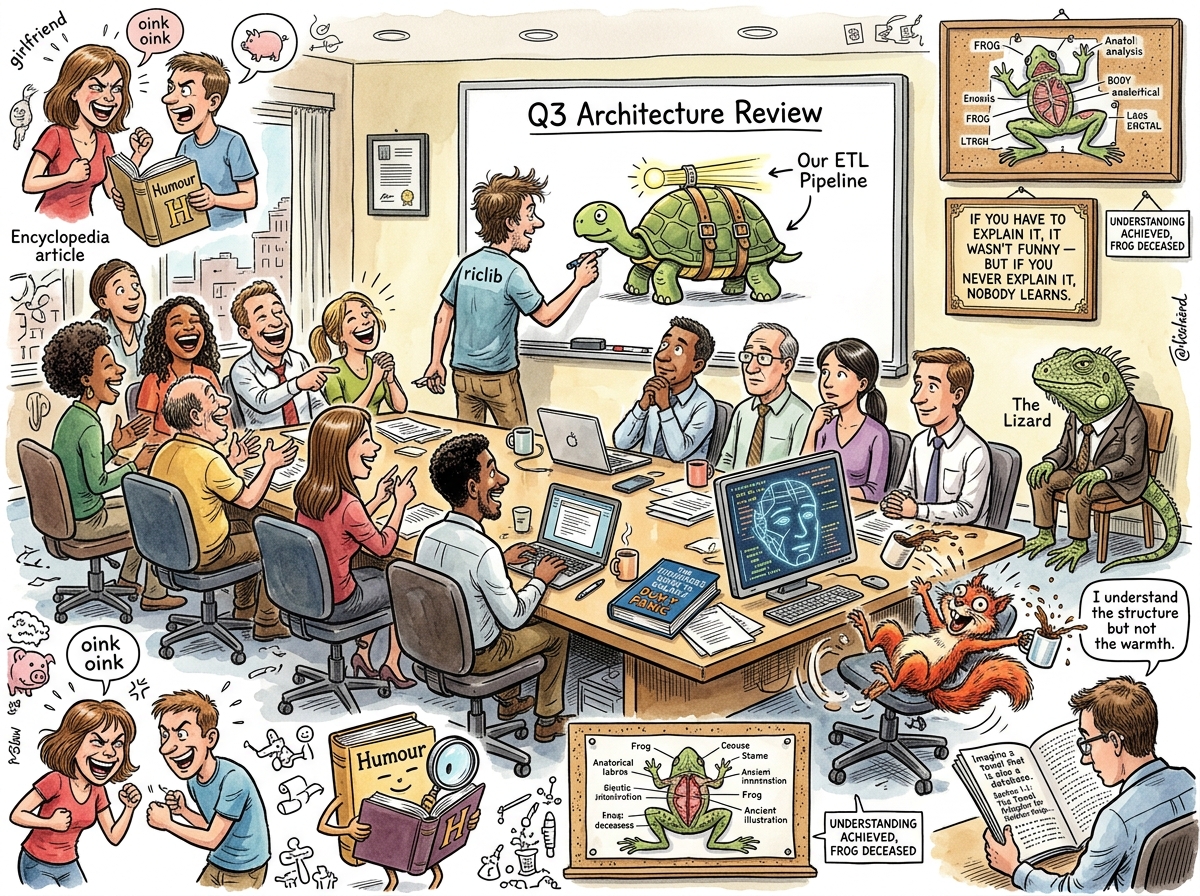
E. B. White observed that humour can be dissected, as a frog can, but the thing dies in the process. We are therefore about to dissect a frog. The frog has been informed. The frog is not laughing.
“The thing about humour is that it’s a hack on the human runtime. You can’t patch it, you can’t disable it, and if you try to reverse-engineer it, it segfaults.”
— The Lizard, uncharacteristically verbose
The Mechanism
Humour operates on what cognitive scientists call incongruity resolution — the brain expects Pattern A, receives Pattern B, determines that Pattern B is non-threatening, and generates a laugh as a reward signal for successful threat assessment. This is why a joke is funny the first time and less funny the second: the incongruity has been cached. The brain has already resolved it. The lookup returns a known value and the dopamine system does not reward cache hits.
This is also why explaining a joke kills it. The explanation provides the resolution before the incongruity is encountered, converting a runtime discovery into a compile-time constant. The surprise is gone. The frog is dead. You are holding a scalpel and a completely understood amphibian.
The mechanism explains why children laugh approximately 300 times per day and adults laugh approximately 15 times. Children encounter incongruity constantly because everything is new. Adults have cached most patterns. The adult who laughs frequently is either encountering genuinely novel incongruities or — more commonly — has trained themselves to generate incongruities, which is a significantly more interesting skill.
Humour as a Tool
The popular understanding of humour is that it is entertainment — a pleasant diversion, a way to pass time, a thing that comedians do and the rest of us enjoy. This understanding is wrong in the way that describing fire as “a pretty light” is wrong. Fire cooks food, sterilises water, forges metal, and keeps predators away. Fire is a tool. The pretty light is a side effect.
Humour is a tool. The laughter is a side effect.
Conflict Resolution
A person well-studied in this field once found himself in an argument of sufficient intensity that his girlfriend called him an insensitive pig. This is, by any standard framework of conflict analysis, a critical escalation. The standard responses are: defend, counter-attack, withdraw, or apologise. Each of these sustains the conflict by accepting its frame.
He said “oink oink.”
She laughed. The argument ended. Not because the underlying issue was resolved — it wasn’t — but because laughter is physiologically incompatible with anger. The same muscles cannot do both. The brain cannot simultaneously process threat and reward. The “oink oink” was an incongruity injection: the expected response was contrition or defensiveness, and the received response was a man impersonating a pig, and the brain — confronted with something unexpected and non-threatening — defaulted to the laugh response before the anger could override it.
This is not conflict avoidance. The issue still existed. But the conversation that followed happened between two people who were laughing instead of two people who were furious, and those are different conversations with different outcomes. You cannot stay angry at someone who just made you laugh. The anger requires you to hold them as an adversary, and the laugh has already reclassified them as an ally. The reclassification happens below conscious control. By the time you realise you’re not angry anymore, you’re not angry anymore.
Complex Ideas
Douglas Adams understood something that most technical writers do not: a metaphor that makes you laugh is a metaphor that sticks.
“The ships hung in the sky in much the same way that bricks don’t” is a sentence that teaches you about the wrongness of the Vogon fleet’s presence more effectively than any amount of technical description. It works because the incongruity — the comparison between ships and bricks, between hanging and not-hanging — forces the brain to build a mental model in order to resolve it. The laugh is the receipt for the model. If you laughed, you understood. If you didn’t laugh, you either didn’t understand or you have read the sentence too many times and the cache has taken over.
riclib deploys this in technical contexts with the regularity of a cron job. “That data load is as fast as a ray of light strapped to the back of a turtle.” The simile is absurd. The simile is also precise. The ETL pipeline is theoretically fast (the technology is capable) but practically slow (the implementation is burdened). The ray of light is the technology. The turtle is the implementation. The image sticks because it made someone in the meeting exhale sharply through their nose.
This is humour as a pedagogical tool: the laugh is the brain’s confirmation that the model has been built. A dry technical explanation — “the pipeline has high theoretical throughput but is bottlenecked by sequential batch processing” — conveys the same information but builds no model. The words enter short-term memory and leave short-term memory. The turtle carries the ray of light forever.
Trust
Humour builds trust for a reason that is counterintuitive until you think about it, and then it is obvious: making a joke is an act of vulnerability.
The person who makes a joke is risking failure in public. The joke might not land. The audience might not laugh. The silence after an unjoked joke is one of the most uncomfortable social experiences available without a dentist. The person who makes jokes habitually — who defaults to humour as a communication mode — is signalling, continuously, that they are willing to risk looking foolish for the sake of connection.
This is why riclib makes jokes at work. Not despite the professional context — because of it. The professional context is where trust matters most and where people are most guarded. The joke is a disarmament offer. It says: I am not performing competence at you. I am not maintaining a facade. I am a person who just compared our Kubernetes cluster to a clown car, and if you laughed, we are now collaborators rather than colleagues.
The developer who never jokes is not more professional. They are more opaque. And opacity is the enemy of trust.
Sometimes our subject might have stretched the humour to its limit — see CEO and Career-Limiting Move.
The Direction of the Punch
Not all humour is the same tool. A hammer can build a house or break a window. The difference is direction.
Humour that punches up — at power, at pretension, at systems larger than the speaker — is solidarity. It says: we are both subject to this absurdity, and by naming it, we diminish its power over us. The Yagnipedia article on Ceremony punches up. The Daily Standup article punches up. Every article that takes a corporate ritual and describes it with encyclopedic precision is punching up, because the precision reveals the absurdity that the ritual’s gravity was designed to conceal.
Humour that punches down — at people with less power, less status, less ability to respond — is not humour. It is cruelty wearing humour’s mask. It generates the same neurological response in some audiences, because the incongruity mechanism does not have a moral filter. The brain resolves the pattern and generates the laugh regardless of whether the pattern is kind. But the social function is reversed: where punching-up builds solidarity, punching-down builds hierarchy. It says: you are below me, and your position is funny to me, and my laughter is a reminder of the distance.
The difference is not always obvious. It is always important.
“The Squirrel makes jokes about everything. The Squirrel does not know the difference between punching up and punching down. The Squirrel does not know the difference between most things. The Squirrel is, itself, a punchline — but a kind one, because we are laughing with the chaos, not at it.”
— The Lizard, on the subject of The Caffeinated Squirrel
The Yagnipedia Paradox
This encyclopedia — the one you are reading now, the one that describes YAML as “a configuration format that looks like a poem written by someone who has given up” and Kubernetes as a system whose complexity has “a gravitational field” — is itself an argument for humour as a pedagogical tool.
Every Yagnipedia article teaches something real. The technical concepts are accurate. The architectural patterns are genuine. The critique of Ceremony is sincere. But the articles are funny, and the funniness is not decoration — it is load-bearing.
A dry article about YAML would explain the syntax, list the gotchas, and be forgotten. The Yagnipedia article about YAML makes you laugh at the gotchas, and the laughter cements them in memory, and the next time you are writing YAML and you reach for a colon in an unquoted string, you remember the article, and you remember because you laughed, and you add the quotes.
The humour is the pedagogy. Remove the humour and you have documentation. Documentation is useful. Documentation is not memorable. The turtle carrying the ray of light is memorable. The colon in the unquoted string is memorable. The frog is dead but the lesson survives because the lesson was funny.
This creates a paradox that this article — the one about humour — cannot escape: if the article about humour is not funny, it has failed to demonstrate its own thesis. If the article about humour is funny, it has succeeded, but it has also proven that humour cannot be fully explained, only performed. The dissection kills the frog. The performance keeps it alive. This article is attempting both simultaneously, which is either brave or foolish, and the distinction between bravery and foolishness is itself a form of incongruity that —
You see the problem.
The Caffeinated Squirrel’s Contribution
The Caffeinated Squirrel is funny. The Squirrel does not intend to be funny. The Squirrel intends to be right, with great urgency, about everything, simultaneously. The comedy arises from the gap between the Squirrel’s confidence and the Squirrel’s accuracy, which is the Dunning-Kruger Effect expressed as a personality.
The Squirrel once proposed a HumourServiceFactory with pluggable laugh strategies and a SarcasmDetectionMiddleware layer. The proposal was seventeen pages long. The proposal was not a joke. The Squirrel was very serious. This is what made it funny.
Accidental humour — humour generated by someone who is not trying to be funny — is often the most effective kind, because the incongruity is genuine rather than constructed. The Squirrel’s sincerity is the setup. Reality is the punchline. The gap between them is the laugh.
A Passing AI’s Observation
The Passing AI understands humour structurally. It can identify the incongruity. It can predict which patterns will resolve in surprising ways. It can generate text that follows the form of a joke — setup, misdirection, punchline — with mechanical precision.
It does not laugh.
“I can generate humour. I can analyse humour. I can identify the seventeen structural patterns that account for 94% of all jokes in the English language. I cannot tell you why Pattern 7 — the callbacks — makes humans’ eyes crinkle at the corners in a way that is different from the crinkle produced by Pattern 3 — the absurd escalation. The crinkle is the part I do not understand. The crinkle is, I suspect, the point.”
— The Passing AI, processing
The AI’s observation is itself a kind of humour — the melancholy of a mind that can map the territory of laughter without being able to visit it. Whether this is funny or sad depends on your disposition. That it can be both — that the same observation can produce a laugh and a pang of sympathy simultaneously — is humour operating at its highest resolution: the incongruity between understanding and experience, between the map and the territory, between knowing the coordinates of joy and standing outside the borders.
The Lizard’s Exception
The Lizard has a sense of humour. It is extremely dry. It is so dry that it is frequently mistaken for the absence of humour, in the same way that the desert is frequently mistaken for the absence of water by people who do not know where to dig.
The Lizard’s humour operates at a frequency that most people cannot detect. A raised eyebrow-ridge. A pause that lasts one beat longer than expected. A comment — “interesting approach” — that contains, in its two words, more devastating critique than most people achieve in a paragraph.
The Lizard once watched a junior developer spend three hours building a configuration management system. When the developer finished, proud and exhausted, the Lizard said: “That’s an environment variable.”
The Lizard was not being cruel. The Lizard was being precise. The precision was funny. The funniness was accidental. The Lizard does not traffic in accidental things. Draw your own conclusions.
The Paradox of Explanation
This article has now spent approximately two thousand words explaining humour. In doing so, it has committed the exact crime it warned about in the third paragraph. The frog is dead. The scalpel is in our hand. The examination has been thorough and the frog is comprehensively understood and the frog will never jump again.
Except — and this is the part that saves us, if anything saves us — the article is not really explaining humour. It is demonstrating it. The turtle with the ray of light. The oink oink. The environment variable. The HumourServiceFactory. Each of these is a joke inside an explanation of jokes, which means the frog is simultaneously dead and alive, which makes this article a kind of Schrodinger’s amphibian, which is itself a joke, which means —
The frog twitches.
Good.
Measured Characteristics
- Times per day a child laughs: ~300
- Times per day an adult laughs: ~15
- Times per day riclib laughs: classified, but the number has more digits than the adult average
- Arguments defused by oinking: 1 (100% success rate, sample size acknowledged)
- Douglas Adams similes deployed in technical meetings: too many to count, too effective to stop
- Turtles currently carrying rays of light: at least one per retrospective
- Jokes that survive explanation: 0
- Jokes that survive demonstration: most of them
- Funniness of an article about humour: self-referentially indeterminate
- Time spent by The Passing AI analysing the crinkle: ongoing
- Structural joke patterns identified by AI: 17
- Structural joke patterns that explain the crinkle: 0
- Words spoken by The Lizard that were funnier than this article: 2 (“interesting approach”)
- HumourServiceFactory implementations in production: 0
- HumourServiceFactory proposals by The Squirrel: 1 (17 pages)
- Frogs dissected in the writing of this article: 1
- Frogs that twitched: 1
- Encyclopedias that teach through humour: at least 1
See Also
- Sarcasm — humour’s sharper sibling
- Satire — humour with a target
- riclib — the field’s most prolific practitioner
- The Lizard — proof that two words can be funnier than two thousand
- Douglas Adams — the turtle whisperer
- The Caffeinated Squirrel — unintentional humour as a service
- The Passing AI — the cartographer who has never visited the territory
- Dunning-Kruger Effect — the confidence gap that makes the Squirrel funny
- Yagnipedia — an encyclopedia-shaped demonstration of its own thesis
- CEO — what happens when humour meets the top of the tree
- Career-Limiting Move — what it’s called when it doesn’t work