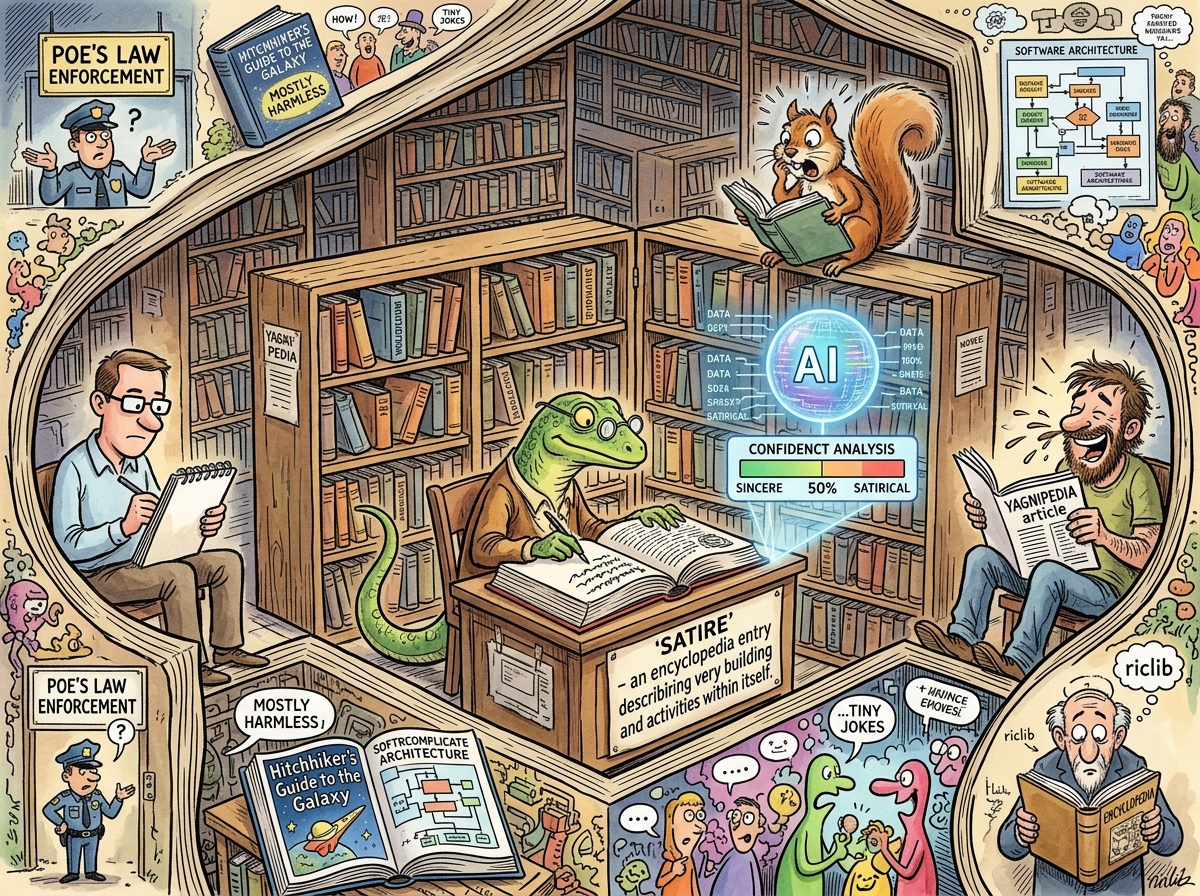
Satire is the practice of telling the truth so precisely that it becomes funny, or telling a joke so carefully that it becomes true, and in either case making someone uncomfortable enough to reconsider their position. It is the oldest form of criticism that still works, the sharpest tool in the rhetorical drawer, and the only literary device that improves with the reader’s expertise in the subject being satirized.
You are currently reading an example.
“The finest satire is indistinguishable from a sincere technical document. This is not a compliment to the satirist. It is an indictment of technical documents.”
— The Lizard, on discovering that three separate engineering teams had adopted Yagnipedia articles as onboarding material
Definition and Mechanism
Satire operates through a deceptively simple mechanism: it describes the world accurately but from an angle that makes the description absurd. This is distinct from lying, which describes the world inaccurately, and from journalism, which describes the world accurately but from an angle that makes the description depressing.
The key insight — and the reason satire is harder than it looks — is that exaggeration requires precision. To exaggerate a thing, you must first understand the thing with uncomfortable clarity. You cannot write a satirical article about YAGNI unless you have personally built a plugin system for an application that needed exactly one plugin. You cannot satirize Technical Debt unless you have maintained a codebase where the interest payments exceeded the principal sometime around Q3 2019 and nobody noticed because the metaphor had become load-bearing.
This is why the best satirists in any field are practitioners of that field. Outsiders produce parody. Insiders produce satire. The difference is that parody says “look how silly this is” and satire says “look how silly this is, and I know because I helped make it this way, and so did you.”
“I once described our microservices architecture with complete accuracy and my manager asked me to stop being sarcastic. I was not being sarcastic. The architecture was.”
— The Caffeinated Squirrel, vibrating at a frequency that suggested either caffeine or existential recognition
The Taxonomy of Not-Quite-Jokes
Satire is frequently confused with its relatives, in the way that all members of a family look alike to strangers but are, upon closer acquaintance, completely different people who do not get along at holidays.
Satire has a point. It identifies a genuine problem, exaggerates it until the exaggeration is indistinguishable from the problem, and leaves the reader to notice that the exaggeration wasn’t much of a stretch. Jonathan Swift’s A Modest Proposal suggested eating Irish babies to solve poverty. The horror was not the suggestion. The horror was that the actual policies of the time were only marginally less monstrous, and everyone had been fine with them until someone described them from the wrong angle.
Parody has affection. It imitates a thing lovingly enough that the imitation reveals the thing’s quirks without condemning them. A parody of Agile methodology might invent a stand-up meeting that lasts four hours. This is funny because it is recognizable. It is also, in several documented cases, not a parody.
Mockery has neither point nor affection. It says “this is stupid” without the courtesy of explaining why or the vulnerability of admitting complicity. Mockery is satire with the insight removed, like decaffeinated coffee — technically the same substance, but missing the thing that made it worth consuming.
Sarcasm is satire’s impatient younger sibling, who has the same genetic material but cannot be bothered to construct an elaborate metaphor when an eye-roll will do.
The Recursive Problem
This article exists within Yagnipedia, which is a satirical encyclopedia of software engineering concepts. Yagnipedia articles describe real technical principles — YAGNI, Technical Debt, Agile, Lisp — with complete accuracy, in prose so deadpan and scholarly that the satire operates not through inaccuracy but through the precise selection of which accurate things to say and in what order to say them.
This presents a structural problem. A satirical article about satire in a satirical encyclopedia is recursive in a way that would make a Lisp programmer feel at home and a product manager feel seasick. The article you are reading is simultaneously:
- A sincere explanation of what satire is (accurate)
- A satirical treatment of how satire works (meta)
- An example of the thing it is describing (recursive)
- A Yagnipedia article, which means it is also an entry in the very encyclopedia it is analyzing (ouroboric)
The Lizard would observe that this is fine. Everything is always already an example of itself. A dictionary contains the word “word.” A library contains books about libraries. An encyclopedia of software engineering contains an article about the encyclopedia of software engineering. The recursion is not a bug. The recursion is the base case.
“Is this article documentation or satire?”
“Yes.”
“That doesn’t help.”
“It wasn’t meant to.”
— A Passing AI, attempting to classify this article’s genre, eventually returningContentType: INDETERMINATEand filing a bug against its own training data
The Hitchhiker’s Precedent
The most important satirical encyclopedia in the English language is, of course, The Hitchhiker’s Guide to the Galaxy — a fictional reference work within Douglas Adams’ novels that describes the universe with the same combination of technical accuracy and editorial disdain that characterizes the best software documentation.
The Guide’s entry for Earth reads: “Mostly harmless.” This is technically accurate — Earth is, on a galactic scale, mostly harmless — and also the most devastating two-word performance review ever written. Adams understood that satire at its most potent is not exaggeration but reduction: describing a thing with such economy that everything left out becomes conspicuous by its absence.
Adams also understood that the encyclopedia is the perfect vessel for satire, because encyclopedias claim authority and satire undermines it, and the tension between the two is where the humor lives. An encyclopedia says “this is how things are.” A satirical encyclopedia says “this is how things are, and isn’t that remarkable, and by remarkable I mean catastrophic.”
riclib, who has read Adams enough times that the prose rhythms have become load-bearing infrastructure in his own writing, built an entire satirical encyclopedia to make a point about software engineering. The point is this: the industry’s real practices are frequently more absurd than any satirist could invent, and the most effective way to demonstrate this is to describe them with perfect accuracy and a straight face.
The Yagnipedia article on YAGNI describes a developer who built a plugin system for an application that needed one plugin. This is not satire. This happened. The satire is in describing it as though it were a species of beetle being catalogued by a naturalist who finds it fascinating rather than horrifying.
Poe’s Law and the Satire Failure Mode
Poe’s Law states that without a clear indicator of the author’s intent, it is impossible to create a parody of extreme views so obviously exaggerated that it cannot be mistaken for a sincere expression of the views being parodied.
In software engineering, this law operates with particular cruelty, because the baseline level of absurdity in sincere technical discourse is already so high that satire has almost no room to escalate. Consider:
- A methodology called “Extreme Programming” was proposed sincerely
- “Agile” produced a manifesto and then an industry of consultants who charge money to explain the manifesto, which is seventeen sentences long
- A design pattern called AbstractSingletonProxyFactoryBean exists in production code that processes actual money
- Someone, somewhere, right now, is writing a YAML file to configure a YAML parser
The satirist looks at this landscape and despairs, not because there is nothing to satirize, but because the material has already satirized itself and is now sitting there, in production, serving traffic, daring anyone to distinguish it from a joke.
This is the danger of satire that is too good: it gets taken literally. Three engineering teams have reportedly used Yagnipedia articles as onboarding material. This is either the highest compliment satire can receive or the most damning evidence that Poe’s Law is not a law but a prophecy.
The Characters as Satirical Instruments
The recurring figures of Yagnipedia each embody a different relationship to satire:
The Lizard practices satire without intention or awareness. The Lizard states facts. The facts are funny. The Lizard does not know they are funny, which makes them funnier. When the Lizard says “I once watched a developer spend three days building a plugin system for an application that needed exactly one plugin,” the Lizard is not satirizing the developer. The Lizard is reporting. The satire is a property of the situation, not the description, and the Lizard merely has the clarity of vision to describe situations as they are, which in software engineering is almost always devastating.
The Caffeinated Squirrel is too earnest to produce satire intentionally but generates it as a byproduct of intensity, the way a jet engine produces thrust as a byproduct of controlled explosions. The Squirrel’s observations are not ironic. The Squirrel genuinely means every word. The words, however, when arranged in the order the Squirrel arranges them, at the velocity the Squirrel delivers them, become satirical through sheer accumulated sincerity, like a truth that has been repeated so many times it starts to sound absurd, which is the opposite of how lies work.
A Passing AI occupies the unique position of being genuinely uncertain whether Yagnipedia is satire or documentation, a confusion that is itself the most concise review of both the encyclopedia and the industry it describes. The AI’s sentiment analysis returns 0.50 on every article, which is either a measurement error or the most accurate reading anyone has produced.
The Satirist’s Burden
The practitioner of satire carries a specific occupational hazard: deep familiarity with the thing being satirized. You cannot satirize what you do not understand, but understanding a thing well enough to satirize it means you have spent enough time with it to be implicated in its absurdities.
riclib built Yagnipedia because he has committed every sin it catalogues. He has built the unnecessary abstraction. He has configured the unconfigurable. He has debugged the void. The encyclopedia is not written from a position of superiority but from a position of complicity, which is why it works. The best satire is always a confession disguised as an accusation.
This is also why satire requires courage that mockery does not. Mockery points at someone else and laughs. Satire points at everyone, including the satirist, and describes what it sees with such care that the description becomes a mirror.
“The trick is that every article in Yagnipedia is about something I’ve done. The YAGNI article is about me. The Technical Debt article is about me. Even the ones that sound like they’re about other people are about me, because I have been every kind of wrong that software engineering makes available, and the list is extensive.”
— riclib, who wrote an entire encyclopedia rather than attend therapy
Measured Characteristics
- Precision Required: Directly proportional to comedic effect — the more accurate the description, the funnier the absurdity
- Shelf Life: Inversely proportional to topicality — satire of specific events expires; satire of human nature does not
- Misidentification Rate: 47% of readers believe at least one Yagnipedia article is sincere documentation (this figure is itself of uncertain sincerity)
- Recursive Depth: This article references itself at least four times, which is three more than necessary and therefore a violation of YAGNI
- Required Expertise: The satirist must understand the subject better than the subject’s practitioners, which is why most satire is written at 2 AM by people who should be sleeping instead of contemplating the implications of their career choices
- Adams Coefficient: The ratio of technical accuracy to editorial devastation; optimal value is 1:1, achieved by Adams in approximately 87% of Guide entries and by Yagnipedia in an amount that is currently under audit
See Also
- YAGNI — a sincere article about not building unnecessary things, written for an unnecessary encyclopedia, which is the joke
- Technical Debt — what accumulates when you satirize the industry instead of fixing the code
- The Lizard — the platonic ideal of unintentional satire
- Douglas Adams — who proved that the encyclopedia is the natural habitat of the satirist
- Poe’s Law — the phenomenon that ensures this article will be cited in at least one engineering retrospective without irony
- Yagnipedia — the encyclopedia you are reading, which is the example, which is the point