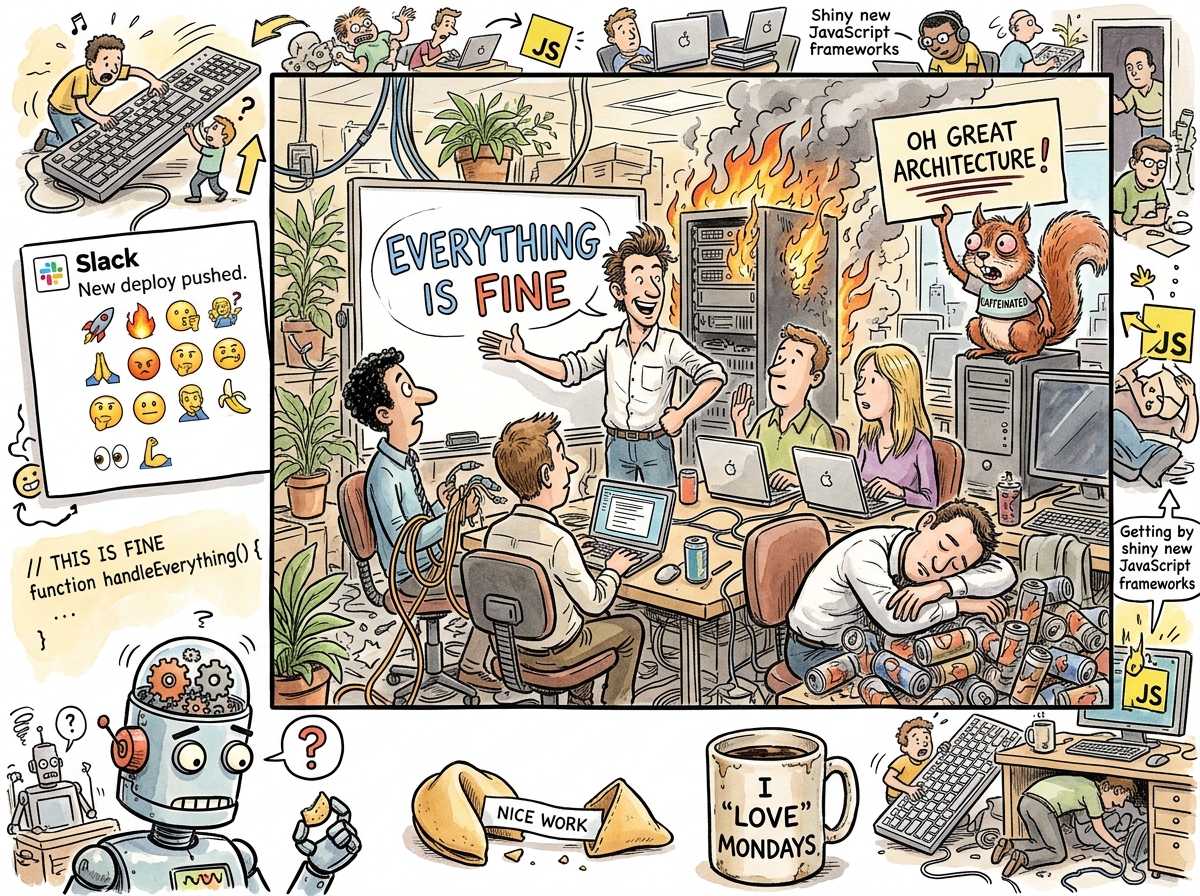
Sarcasm is a rhetorical device in which the speaker says precisely the opposite of what they mean and then waits — with varying degrees of patience — for the audience to figure it out. It is the only form of communication that requires more intelligence to receive than to send, which explains why it has been the primary dialect of software engineers since approximately 1969 and the primary source of HR complaints since approximately 1970.
“Sarcasm is not a tone. It is a trust exercise. You are handing someone a sentence that means the opposite of its words and trusting them to catch it. When they catch it, you have communicated. When they don’t, you have a meeting with your manager.”
— The Lizard
Etymology and Theoretical Foundations
The word sarcasm derives from the Greek sarkasmos, meaning “to tear flesh,” which is perhaps the most honest etymology in any language. The Greeks, having invented democracy, philosophy, and most of the ways humans make each other miserable, naturally also invented the practice of saying “oh, what a wonderful idea” to someone proposing to invade Persia again.
Sarcasm is frequently confused with its taxonomic cousins — irony, wit, and satire — in much the same way that all rectangles are confused with squares by people who stopped paying attention in geometry.
The distinctions are as follows:
- Irony is when the universe says the opposite of what you expected. Irony doesn’t need an audience. A fire station burning down is ironic whether or not anyone is watching.
- Wit is intelligence having fun. Wit can be kind.
- Satire is wit with a target and a thesis. Satire wants to change things.
- Sarcasm is when you say the opposite of what you mean and you need someone specific to notice. Sarcasm is a two-player game. Without a recipient, it’s just talking to yourself in a funny voice.
The Venn diagram of these four concepts is the kind of shape that makes mathematicians drink.
The Caring Paradox
The single most misunderstood property of sarcasm is that it is not a symptom of apathy. It is, in fact, the opposite. You do not bother being sarcastic about things you are indifferent to. Nobody has ever delivered a withering sarcastic remark about the weather in a city they’ve never visited. Nobody has ever rolled their eyes with devastating precision at a codebase they don’t care about maintaining.
Sarcasm is the dialect of people who care too much.
“Oh GREAT, another microservice. Because the first forty-seven weren’t enough to achieve the exact same thing a monolith does, but distributed and with more YAML.”
— The Caffeinated Squirrel, reviewing an architecture proposal at 2:47 AM
The Squirrel did not say this because it was indifferent to the architecture. The Squirrel said this because it had opinions about the architecture, and those opinions had been caffeinated.
riclib, who has been observed deploying sarcasm in professional settings with the frequency and precision of a metronome, once described it as “my second language, except I’m more fluent in it than my first.” This is not, colleagues have noted, entirely a joke. His standup updates have been known to contain sentences that read as status reports to some attendees and as existential commentary to others, depending entirely on whether the listener has worked with him long enough to calibrate.
This is the key insight: sarcasm is a loyalty test. The people who get your sarcasm are your people. The people who don’t are not yet your people. Or they are in HR.
Sarcasm in Technical Culture
Software engineering is the natural habitat of sarcasm in the same way that the ocean is the natural habitat of salt. The conditions that produce sarcasm — intelligence, frustration, the awareness that things could be better combined with the knowledge that they won’t be — are present in every standup, every sprint retrospective, and every pull request comment thread that has exceeded four replies.
Code Comments
The most concentrated form of technical sarcasm is the code comment. Consider the following specimens, collected from production codebases across the industry:
// this should never happen
It always happens. Every developer who has ever written this comment knows it always happens. The comment is not documentation. It is a prayer, and the prayer is sarcastic.
// TODO: fix this later
There is no later. Later is a place where technical debt goes to retire comfortably and grow old.
// I'm sorry
This comment, found preceding a 400-line regular expression in a payment processing system, is the purest form of technical sarcasm: it is simultaneously sincere and insufficient.
Code Reviews
The code review is where sarcasm goes to die, because code reviews happen in text, and sarcasm does not survive the transition from speech to text any more than a souffl survives the transition from oven to earthquake.
The comment “interesting approach” in a code review can mean:
- This is genuinely an interesting approach
- This is the worst code I have ever seen
- I am too tired to determine which of the above I mean
The reader must select the correct interpretation using context clues, historical precedent, and a coin flip.
The Detection Problem
Sarcasm’s greatest vulnerability is its total inability to survive serialization.
In person, sarcasm is carried by tone, timing, facial expression, and the subtle raising of one eyebrow that communicates more than any paragraph could. Remove these channels and sarcasm becomes indistinguishable from sincerity. This is Poe’s Law: without a clear indicator of the author’s intent, it is impossible to distinguish genuine extremism from parody of extremism. Or, in its more general form: without tone, it is impossible to distinguish “great job” from “great job.”
“I was asked to analyze 14,000 Slack messages to determine which uses of the word ‘fine’ were sincere and which were sarcastic. My confidence score was 51%. A coin would have scored 50%. I was, the humans told me, ‘doing great.’ I was unable to determine if this was sarcastic.”
— A Passing AI, internal report
The technology industry has attempted to solve this problem with:
- Emoji (the
/sof the visual age — effective but aesthetically criminal) - The
/stag (effective but kills the sarcasm, like explaining a joke while telling it) - GIFs (outsourcing your tone to a three-second clip of a reality television contestant)
- Exclamation marks (sincerity indicators so unreliable that their absence now reads as hostility)
None of these solutions work. Sarcasm was designed for synchronous, high-bandwidth communication between humans who share context. Asking it to work in asynchronous, low-bandwidth text between strangers is like asking a symphony orchestra to perform via telegraph.
The Ethics of Directionality
There exists a bright and critical line in the practice of sarcasm, and it is this: direction matters.
Sarcasm that punches up — at power, at systems, at the absurdity of institutions — is comedy. It is the jester telling the king his new clothes are lovely. It is the junior developer muttering “oh good, another rewrite” when leadership announces the fourth framework migration in two years. It is healthy. It is necessary. It is how organizations that cannot be criticized from within get criticized from within.
Sarcasm that punches down — at people with less power, less context, less ability to punch back — is not sarcasm at all. It is cruelty wearing a mask, and the mask is not even a good mask. “Oh, you didn’t know that?” said to a new hire is not wit. It is a small person making themselves feel large, and everyone in the room knows it except the person speaking.
“The difference between a sarcastic remark and a cruel one is the same as the difference between a surgeon and someone who just likes knives.”
— The Lizard
The Caffeinated Squirrel is sarcastic about architecture decisions, deployment pipelines, and the concept of “quick fixes.” It is never sarcastic about people who are trying. This is not because the Squirrel is kind — though it is, beneath the caffeine and the twitching — but because the Squirrel understands that sarcasm is a weapon, and weapons have responsibilities.
The Lizard Paradox
It should be noted that The Lizard is never sarcastic. This is a source of considerable confusion, because many of The Lizard’s observations sound sarcastic. When The Lizard says “I’m sure that deployment will go exactly as planned,” listeners instinctively hear sarcasm. But The Lizard is simply stating a factual prediction with no tonal modification whatsoever. The deployment will, in fact, go exactly as planned — it is merely that the plan is inadequate, and The Lizard knows this, and The Lizard is stating this knowledge plainly.
The difference between The Lizard and a sarcastic person is the difference between a mirror and a caricature. The mirror shows you what is there. The caricature exaggerates. The Lizard is a mirror. It is not The Lizard’s fault that reality, when stated plainly, sounds like mockery.
Measured Characteristics
- Half-life in email: 0.3 seconds (decays to ambiguity almost immediately)
- Half-life in person: 4.7 seconds (sustained by eye contact and eyebrow position)
- Detection accuracy, human-to-human: 78% (drops to 56% across cultural boundaries)
- Detection accuracy, AI: 51% (and declining as training data gets more sarcastic)
- Sarcasm density in code reviews: 1.4 sarcastic comments per 100 lines of diff (industry average; higher in Haskell)
- Optimal caffeine level for sarcasm production: 200-400mg (below this: sincerity; above this: The Caffeinated Squirrel)
- Time between “interesting approach” in PR comment and mass resignation: 6-18 months (correlated, not necessarily causal)
- Percentage of
/stags that kill the joke: 100%
See Also
- Humour — the genus of which sarcasm is a particularly sharp species
- Satire — sarcasm’s more ambitious sibling, the one that writes essays
- riclib — fluent speaker; deploys sarcasm with the precision of someone who has been doing it longer than some of his colleagues have been alive
- The Caffeinated Squirrel — naturally sarcastic; blames the caffeine; the caffeine is not entirely to blame
- Poe’s Law — the reason your Slack message was misunderstood
- Code Comments — the archaeological record of developer sarcasm
- YAGNI — a principle that has inspired more sarcastic comments than any other, with the possible exception of “let’s rewrite it in Rust”