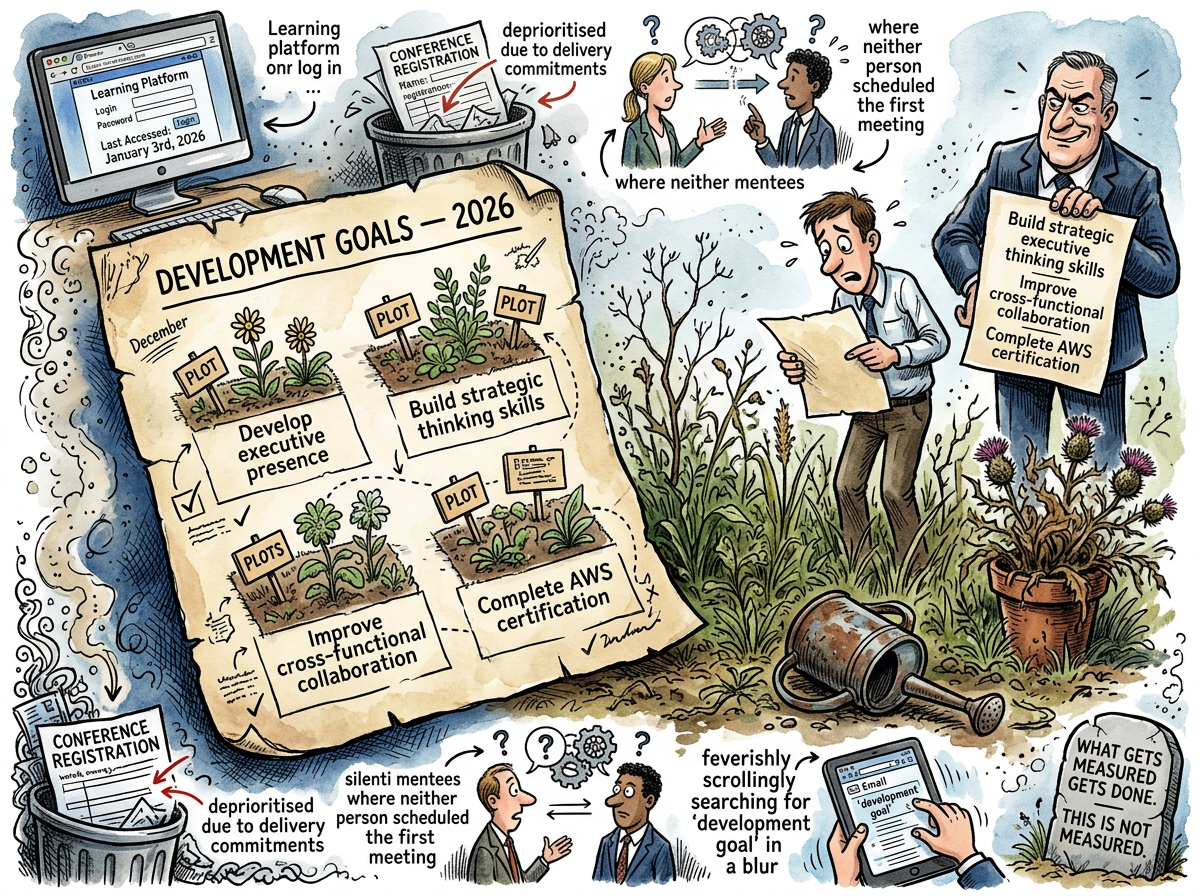
A Development Goal is a commitment made during a Performance Review in December, written into a form in January, forgotten by February, rediscovered the following November when the self-assessment is due, and rewritten — with minor adjustments to verb tense — as next year’s development goal.
The development goal is the Performance Review’s most optimistic artifact. It is the section of the form where the manager and the employee collaborate on a vision of the employee’s future: the skills they will acquire, the competencies they will develop, the experiences they will seek. It is written with sincerity. It is filed with hope. It is abandoned with the quiet inevitability of a New Year’s resolution that involved running.
The Lifecycle
The development goal has a lifecycle as predictable as the seasons, and approximately as controllable:
December (Genesis): The development goal is born in the Performance Review meeting. The manager and employee, having just navigated the rating, the calibration, and the vocabulary, arrive at the final section of the form: “Development Goals for the Coming Year.” Both parties are tired. Both parties want to leave the meeting. The development goal is written in this state — a commitment forged in exhaustion and mutual goodwill, which is why it reads like a horoscope: aspirational, vaguely directional, and applicable to almost anyone.
January (Registration): The development goal is entered into the HR system. The HR system sends a confirmation email. The employee bookmarks a LinkedIn Learning course related to the goal. The bookmark joins forty-seven other bookmarked courses that were never started. The manager schedules a “check-in on development goals” for February. The calendar invite is accepted.
February (Extinction): Q1 arrives. The roadmap has changed. The sprint has urgent work. The check-in meeting is cancelled — “let’s reschedule when things calm down.” Things do not calm down. The development goal enters hibernation. It will not be disturbed until November.
March–October (Absence): The development goal does not exist during this period. It is not discussed in one-on-ones. It is not referenced in sprint planning. It is not visible on any dashboard. The employee does actual work. The actual work develops the employee more than the development goal would have, but the actual work is not on the form, and HR tracks the form.
November (Resurrection): The self-assessment is due. The employee searches their email for “development goal.” The email from January is found. The employee reads the goal — “Develop strategic thinking skills through cross-functional exposure” — and tries to remember what this meant. The employee identifies three things they did during the year that could, with sufficient narrative creativity, be described as “cross-functional exposure.” These are written into the self-assessment. The development goal is declared “in progress.”
December (Reincarnation): The new Performance Review arrives. The manager reviews the previous development goal. The manager says “good progress.” The employee says “yes.” Neither party interrogates this further. A new development goal is written. The cycle restarts.
The Standard Goals
Development goals converge on approximately twelve templates, recycled across every organisation, every level, and every year:
| Development Goal | What It Means | What Actually Develops the Skill |
|---|---|---|
| “Develop executive presence” | You are too quiet in meetings with senior people | Years of practice and one terrifying Career-Limiting Move that worked |
| “Build strategic thinking skills” | You think about tasks; the next level thinks about outcomes | Being given actual strategic responsibility, which the goal does not provide |
| “Improve cross-functional collaboration” | Your team doesn’t talk to other teams enough | Sitting next to them; the Offsite bus |
| “Strengthen Stakeholder Management” | You said something true without enough padding | Getting burned once and learning the vocabulary |
| “Develop coaching and mentoring capability” | The next level requires managing people | Managing people, which is not a development goal but a job change |
| “Complete [certification]” | The certification exists and is measurable | The certification is completed in November, the week before reviews |
| “Broaden technical depth” | Learn a new technology | Already happening; developers learn new technologies the way humans breathe |
| “Increase visibility” | Do the same work but ensure more senior people see it | Gaming the system, which nobody writes as a development goal |
The certification goal is the only development goal with a measurable outcome, which is why it is the only development goal that is consistently achieved. All other goals are evaluated through narrative — the employee writes a story about how the goal was met, the manager reads the story and nods, and HR files the form.
The Squirrel’s Development Goals
The Caffeinated Squirrel’s development goals are a marvel of ambition:
- “Complete AWS Solutions Architect Professional, Kubernetes Administrator, and HashiCorp Terraform certifications”
- “Build a proof-of-concept for event-driven architecture using Kafka, Redis Streams, and NATS”
- “Establish a monthly Architecture Decision Record practice with automated documentation pipeline”
The Squirrel will complete all of these. The Squirrel will complete them in January. The Squirrel’s development goals are never the problem. The Squirrel’s development goals are the Squirrel’s way of legitimising the things the Squirrel was going to do anyway, which is what all effective development goals are: the retroactive formalisation of inevitability.
The Lizard’s Development Goal
The Lizard’s development goal, if the Lizard had a development goal, would be:
CONTINUE.
The Lizard does not develop. The Lizard persists. The Lizard’s skills did not change between 2019 and 2026 because the Lizard’s skills did not need to change. Go, SQLite, scp. The development goal implies that the current state is insufficient. The Lizard’s current state is sufficient. The Lizard does not have a development goal. The Lizard has a warm rock.
The Actual Development
The irony of the development goal is that employees develop constantly — through the work, through failure, through the 2 AM debugging session that teaches more about systems design than any certification, through the Offsite bus conversation that reshapes how they think about leadership, through the Career-Limiting Move that teaches them which truths are valued and which are managed.
None of this development appears on the form. The form captures the development that was planned. The development that matters is the development that happened.
Measured Characteristics
- Development goals set per employee per year: 2-4
- Development goals completed per employee per year: 0.3 (the certification)
- Development goals remembered past February: ~5%
- Check-in meetings on development goals that occurred: ~1 of 4 planned
- Check-in meetings cancelled “until things calm down”: ~3 of 4 planned
- LinkedIn Learning courses bookmarked: 47 (per employee, cumulative)
- LinkedIn Learning courses completed: 2 (both in November)
- Years the same goal has been carried forward, reworded: 2-3 (average)
- Employees who developed significantly during the year: most
- Employees whose development matched the goal: almost none
- The form’s relationship to actual development: decorative