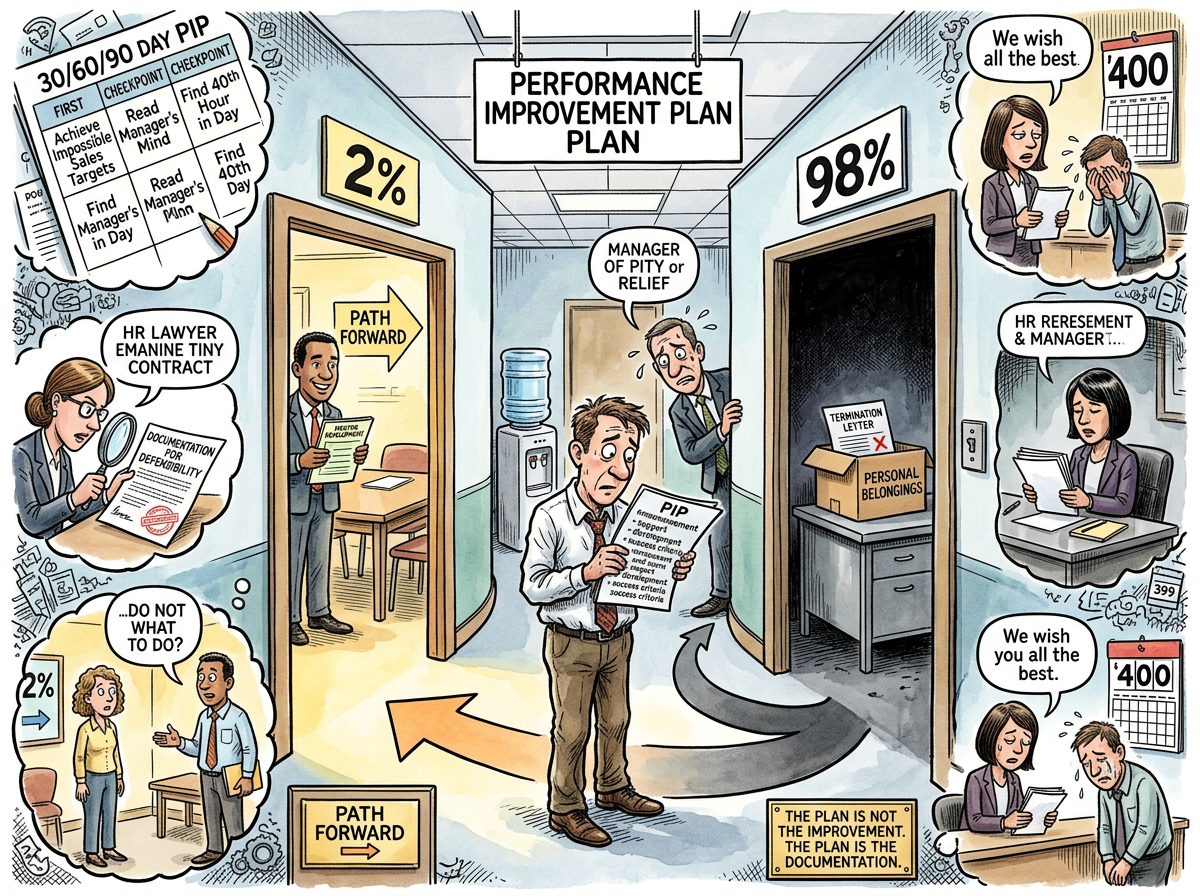
The PIP (Performance Improvement Plan) is a formal document issued by HR that describes the specific improvements an employee must make within a defined period (typically 30, 60, or 90 days) in order to retain their employment. The document uses words like “support,” “development,” “success criteria,” and “we want to see you succeed.” The document is, in approximately 98% of cases, a termination runway with a coaching vocabulary.
This is not a secret. It is the most open secret in corporate life. Every employee who has spent more than two years in an organisation knows that “you’re being put on a PIP” does not mean “we want to help you improve.” It means “we have decided to let you go and need thirty to ninety days of documentation to do it legally.” The PIP is not a development tool. It is a legal tool. Its purpose is not to improve performance. Its purpose is to demonstrate, in a format that withstands legal scrutiny, that the company gave the employee a fair opportunity to improve before terminating them.
HR knows this. The manager knows this. The employee, upon receiving the PIP, knows this. The three parties then spend thirty to ninety days performing a ritual in which everyone pretends that the outcome is not yet determined. The ritual is necessary. The pretence is the point.
The Structure
The PIP follows a standard format that has been refined by employment lawyers over decades:
Section 1 — Performance Concerns: A list of specific, documented deficiencies. “On [date], the deliverable was not completed by the agreed deadline.” “In the [date] meeting, feedback from stakeholders indicated a need for stronger communication.” Each item is factual, timestamped, and written in a tone that is simultaneously supportive and evidential. The tone is HR’s greatest achievement: warmth that would hold up in court.
Section 2 — Success Criteria: Measurable targets the employee must meet within the PIP period. “Complete all assigned deliverables by the agreed deadlines.” “Receive positive feedback from three stakeholders on communication effectiveness.” “Demonstrate alignment with team processes as evaluated by the direct manager.”
The success criteria appear achievable. They are designed to appear achievable. Their achievability is the legal requirement — the company must demonstrate that the targets were reasonable. Whether the targets are actually achievable, given that the employee’s relationship with their manager has been irrevocably damaged by the act of issuing the PIP, is a question the document does not address.
Section 3 — Support Offered: A list of resources the company will provide: regular check-ins with the manager, access to coaching, training opportunities. This section exists to demonstrate that the company invested in the employee’s success. Whether the manager — who requested the PIP, who has already decided the outcome, who must now conduct weekly check-ins with a person they are documenting for termination — can provide genuine support is a question the document does not address either.
Section 4 — Timeline and Consequences: “If the success criteria are not met within [30/60/90] days, employment may be terminated.” The word “may” is doing the heaviest lifting in the entire document. “May” means “will,” but “will” is too honest for a document about improvement.
The Two Percent
Approximately 2% of employees who are placed on a PIP successfully complete it and remain employed.
This number is not published by HR departments. It is known through industry surveys, anecdotal evidence, and the quiet consensus of every HR professional who has been in the field long enough to have issued more than ten PIPs. The 2% are employees who somehow met every criterion, received positive stakeholder feedback, and demonstrated measurable improvement — all while knowing that their manager had already decided they should leave, which is a psychological environment not typically conducive to peak performance.
The 2% are also, frequently, the employees who were put on a PIP by mistake — the ones whose “performance issue” was actually a management issue, a team dynamics issue, or a Career-Limiting Move that annoyed a VP. These employees improve because they were never underperforming. They were inconvenient.
The 2% create a problem for HR: an employee who successfully completes a PIP is an employee who proved the PIP was unnecessary, which raises questions about why the PIP was issued, which raises questions about the manager who requested it, which raises questions that HR would rather not document. The successful PIP completion is, paradoxically, the outcome nobody planned for.
The Manager’s Experience
The manager who issues a PIP experiences something that the HR process does not acknowledge: guilt.
The manager requested the PIP. The manager may have been right to request it — the employee may genuinely be underperforming, or the relationship may be beyond repair, or the team may be suffering. The PIP may be the correct action. The manager still feels guilty, because the manager is conducting weekly “support” meetings with a person whose termination they initiated, using a vocabulary of development and improvement that both parties know is fiction.
The weekly check-in follows a script:
- Manager asks about progress on success criteria
- Employee reports progress (real or performed)
- Manager provides “feedback” (documented for the file)
- Both parties avoid acknowledging what is happening
- Manager writes up the check-in notes for HR
- Manager goes home and does not sleep well
The manager who does not feel guilty is a manager who should probably be on a PIP themselves. The manager who feels too guilty cancels the PIP, which creates a different HR problem. The manager who feels exactly the right amount of guilt completes the process, which is what HR designed it for.
The Alternative
The alternative to the PIP is the honest conversation: “This isn’t working. For you or for us. Let’s figure out a transition that works for both of us.”
This conversation is faster, kinder, more honest, and almost never happens — because it is not legally defensible. A company that says “this isn’t working” and terminates employment without a PIP is a company that, in many jurisdictions, has not demonstrated due process. The PIP exists because employment law requires documentation of fair treatment, and the PIP is the documentation. The ninety days of performance theatre are the price of legal compliance.
Some companies — typically smaller ones, or ones run by CEOs who tell the monkey joke — replace the PIP with a generous severance package and an honest conversation. “We’re going to let you go. Here’s six months of salary. We’ll give you a good reference. Take the time to find something better.” This costs more money and less dignity. It is faster for the company, better for the employee, and impossible to implement at scale because HR cannot write a policy that says “just be honest and pay them” — HR can only write a policy that documents a process.
The PIP is not cruel. The PIP is bureaucratic. These produce similar outcomes through different mechanisms.
The Lizard’s Version
The Lizard does not issue PIPs. The Lizard does not manage employees. The Lizard manages code.
When code underperforms, the Lizard does not issue a Performance Improvement Plan for the code. The Lizard does not schedule weekly check-ins with the code. The Lizard does not document the code’s deficiencies in a format that would withstand legal review. The Lizard deletes the code and writes better code. The process takes an afternoon. No feelings are involved. No documentation is required. No one says “we wish the code all the best.”
This is not a valid comparison. People are not code. People have mortgages, families, identities attached to their work, and legal protections that code does not have. The Lizard’s approach cannot be applied to humans.
But the Lizard’s approach — identify the problem, act honestly, resolve it quickly — is what every participant in the PIP process secretly wishes was happening. The manager wishes they could just say “this isn’t working.” The employee wishes they could just hear it. HR wishes the law didn’t require ninety days of documentation. Everyone wishes the process were shorter, more honest, and less theatrical.
The process is not shorter, more honest, or less theatrical, because the process was not designed for the participants. It was designed for the file.
Measured Characteristics
- Employees who successfully complete a PIP: ~2%
- Employees who resign during a PIP (the intended outcome in many cases): ~40%
- Employees terminated at the end of a PIP: ~55%
- Employees who were surprised by the PIP: ~60%
- Employees who should have been surprised: ~0% (the signs were there; the signs are always there)
- PIP documents reviewed by legal before issuance: most
- PIP documents that use the word “support”: all
- PIP outcomes that involved genuine support: ~2%
- Manager check-ins that felt authentic: few
- Manager check-ins documented for the file: all
- Average PIP duration: 60 days
- Average time employee knew the outcome: day 1
- Honest conversations that replaced the PIP: rare, expensive, better
- The file’s relationship to the human: adjacent