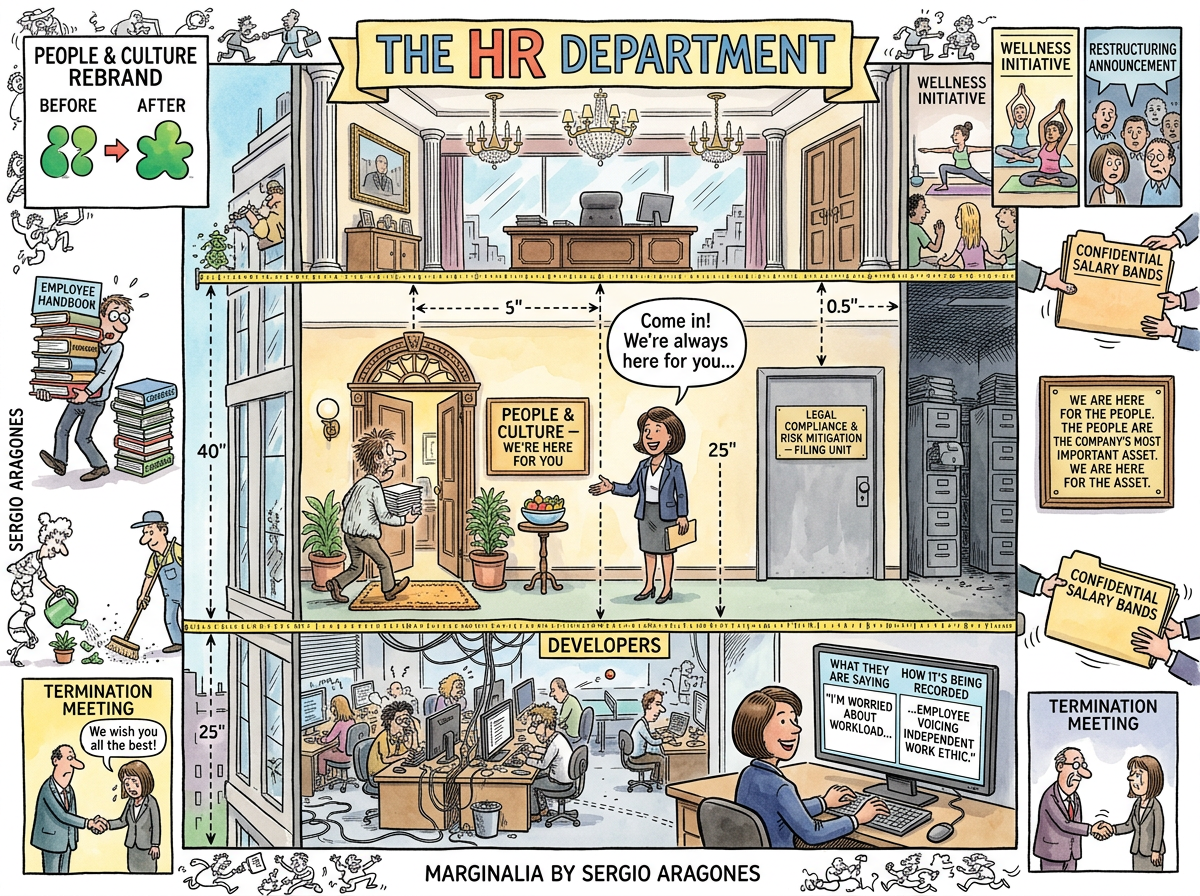
HR (Human Resources) — also known as People & Culture, People Operations, People Team, Talent & Culture, Employee Experience, and whatever it was renamed to last quarter — is the department responsible for hiring, firing, and the vast bureaucratic territory between the two, all while maintaining the organisational fiction that its primary allegiance is to the employee.
HR’s primary allegiance is to the company. This is not cynicism. This is contract law. HR is employed by the company. HR is paid by the company. HR’s performance is reviewed by the company. When the interests of the company and the interests of the employee align — which is often — HR serves both. When the interests diverge — which is occasionally, and always at the moments that matter most — HR serves the company. The employee handbook does not say this. The employee handbook says “we’re here for you.” Both statements are true. They are true about different “you"s.
Understanding this is not bitterness. Understanding this is adulthood. HR is doing its job. Its job is just not the job the brochure describes.
The Rebranding
HR has been renamed more often than any other department, including IT, which is saying something because IT has been renamed four times (IT → IS → IT → Digital).
The renaming timeline:
| Era | Name | What Changed |
|---|---|---|
| 1920-1970 | Personnel | The name. Honest: you are personnel. You are managed. |
| 1970-2000 | Human Resources | The framing. You are a resource. Like servers. But human. |
| 2000-2015 | HR (just the acronym) | The embarrassment. Nobody wanted to say “human resources” out loud. |
| 2015-2020 | People Operations | The Silicon Valley phase. You are people. You are operated. |
| 2020-present | People & Culture | The current layer. You are people. You have culture. We manage both. |
Each renaming was accompanied by a values refresh, a logo update, and a town hall in which the head of the department explained that the new name reflected a “fundamental shift in how we think about our people.” The fundamental shift was the name. The policies did not change. The employee handbook did not change. The termination process did not change. The name changed, because names are cheaper than policies and more visible than processes.
The next renaming is estimated for 2027. Leading candidates: “Human Experience,” “People & Belonging,” and — if the CEO attends a particular conference — “Chief People Ecosystem.”
The Two Doors
Every HR department has two doors. Most employees only see one.
The Front Door — “We’re Here For You”: This is the door with the plants, the soft lighting, the wellness posters, and the open-plan seating that signals approachability. Through this door, HR offers: onboarding, benefits enrollment, learning and development, wellness programs, Employee Assistance Programs, team-building Offsites, and the annual engagement survey that asks “how likely are you to recommend this company to a friend?” (the answer is used for benchmarking, not for change).
The Back Door — “Legal Compliance & Risk Mitigation”: This is the door the employee does not see. Through this door, HR manages: termination documentation, restructuring plans, legal exposure assessments, non-compete enforcement, investigation files, and the careful choreography of the “performance improvement plan,” which is not a plan to improve performance — it is a documented process that establishes grounds for termination while appearing to offer support.
Both doors are real. Both functions are necessary. The fiction is that only the front door exists. The employee who understands that both doors exist navigates the organisation more effectively — not with cynicism, but with clarity.
The Investigation
When an employee reports a concern to HR — a conflict with a manager, a policy violation, a hostile environment — HR “investigates.” The investigation is real. The investigators are often competent. The process is documented.
What the employee expects: HR will determine who is right and fix the situation.
What actually happens: HR will determine the company’s legal exposure and mitigate it.
These sometimes produce the same outcome. When the manager is clearly wrong and the company’s exposure is high, HR acts decisively — the manager is removed, the employee is supported, and the front door narrative holds. When the situation is ambiguous and the manager is senior, HR produces a finding that is technically accurate, carefully worded, and resolves the legal exposure without resolving the human situation. The employee receives a summary. The summary uses the phrase “we take these matters seriously.” The matter is closed. The employee’s Performance Review that year contains no mention of the report, but does note that the employee “could benefit from developing stronger working relationships with leadership.”
The Wellness Paradox
HR’s most visible recent initiative is wellness — the organisational commitment to employee mental health, work-life balance, and psychological safety. The commitment is sincere. The commitment is also announced in the same quarter as the headcount freeze, the restructuring, and the mandatory return-to-office policy, which produces a cognitive dissonance that no amount of meditation app subscriptions can resolve.
The wellness paradox:
- Monday: “We’ve partnered with Calm to support your mental health” (email from HR)
- Tuesday: “Your role has been impacted by the restructuring” (email from HR)
- Wednesday: “Remember to use your wellness day!” (email from HR)
The emails are sent by the same department. The department does not experience this as contradictory, because the department operates both doors simultaneously, and the front door (wellness) and the back door (restructuring) are managed by different teams within HR who attend different meetings and use different vocabulary for the same employees.
The Vocabulary
HR’s most durable contribution to corporate life is vocabulary — a lexicon of euphemisms so thoroughly embedded in business communication that the original meanings have been lost:
| HR Says | Means |
|---|---|
| “We’re letting you go” | You’re fired |
| “Your role has been impacted” | You’re fired, but passively |
| “We’re going in a different direction” | The direction that doesn’t include you |
| “This is a mutual decision” | It is not mutual |
| “We wish you all the best” | Please sign the NDA |
| “Performance improvement plan” | Documented termination runway |
| “Culture fit” | Undefinable, legally defensible rejection criterion |
| “We take these matters seriously” | The investigation is complete; the finding is ambiguous |
| “Competitive compensation” | Market rate minus the amount we think you won’t negotiate |
| “Total rewards” | Salary plus the value of things you didn’t ask for |
This vocabulary is not malicious. It is protective — of the company’s legal position, of the manager’s comfort, and occasionally of the employee’s dignity. A person being fired would rather hear “we’re going in a different direction” than “you’re fired,” in the same way that a patient would rather hear “the prognosis is challenging” than “you’re dying.” The euphemism serves a human function. It also serves a legal function. HR serves both.
Measured Characteristics
- Department renamings since 1920: 5+
- Policies that changed with each renaming: 0
- Doors: 2 (one visible, one not)
- Employee handbook pages: 80-200
- Employee handbook pages read by employees: 3 (PTO policy, sick leave, expenses)
- Investigations that resolved the human situation: some
- Investigations that resolved the legal exposure: all
- Wellness initiatives launched same quarter as layoffs: approximately half
- Euphemisms in active circulation: 40+
- Euphemisms understood by all parties: all of them (the encoding is transparent; the decoding is universal; the fiction is maintained by mutual consent)
- HR professionals who entered the field to help people: most
- HR professionals who discovered the back door: all, eventually