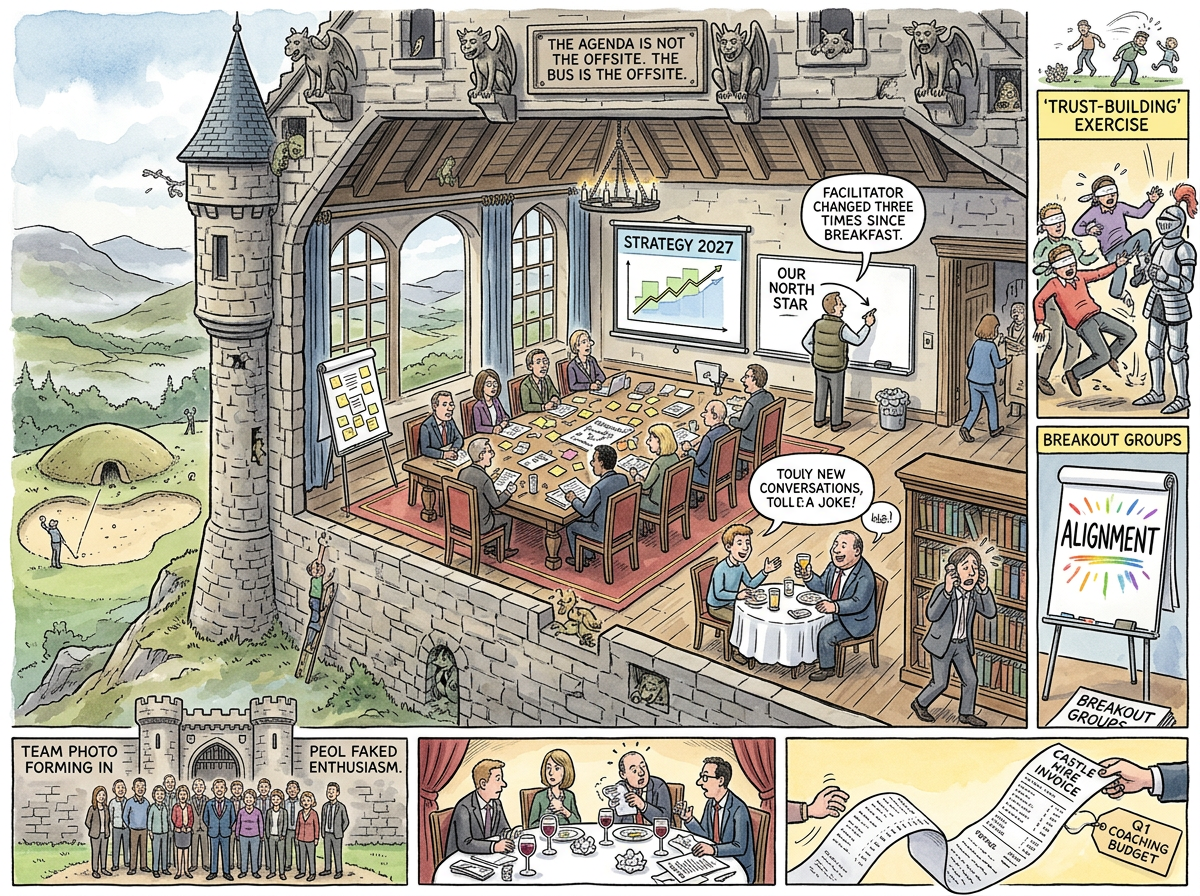
The Offsite is a corporate ritual in which an organisation pays a significant amount of money to hold the same meetings it holds every week, but in a nicer building and with better catering, on the theory that physical distance from the office will produce intellectual distance from the org chart. It does not. But the dinners are useful.
The offsite exists because someone — usually a CEO, sometimes an HR director, occasionally a Consultant whose engagement is running out of deliverables — observed that the team “needs alignment.” The team does need alignment. The team has needed alignment since the last Reorg, which is when the previous alignment was destroyed. The offsite will produce alignment. The alignment will last until the following Tuesday, when everyone returns to their inboxes and discovers that alignment is a property of proximity, not of flip charts.
The Venue
The venue is the offsite’s most consequential decision, and the one given the most thought. The agenda is written in an afternoon. The venue is debated for weeks.
The venue hierarchy:
| Venue | Signal | Actual Purpose |
|---|---|---|
| Airport hotel conference room | “We have a budget problem” | Minimise travel time so people can return to real work |
| Country house hotel | “We are a serious company” | The default; inoffensive; adequate wine list |
| Castle | “We are a company that rents castles” | Recruitment photos; the CEO’s idea; spectacular but draughty |
| Mediterranean resort | “The CEO googled ‘offsite venues’ while on holiday” | Team building via sunburn |
| The office, but a different floor | “We have been told to cut costs” | The saddest offsite; nobody pretends it’s special |
The castle is the aspirational choice. Scottish castles are preferred because they combine grandeur with poor WiFi, and poor WiFi is the only force in nature that prevents people from checking Slack during the breakout sessions. A castle also provides the subliminal message that the company has history, permanence, and thick walls — none of which are true, but all of which look good in the team photo.
The Bus
The offsite’s most important moments do not occur at the offsite. They occur on the bus.
The bus from the airport to the venue — or from the hotel to the castle, or from the castle to the dinner — is where people who would never speak in the office find themselves sitting next to people they would never approach in the Org Chart. The seating is random. The hierarchy is suspended. The conversation is unstructured. And in the gap between the airport and the agenda, something happens that the agenda cannot produce: people talk to each other like humans.
The bus is where trust is built, because the bus has no agenda, no facilitator, no sticky notes, and no Roman voting. The bus has proximity and time and the absence of a slide deck. These are the only three ingredients trust requires.
Every offsite has an agenda. No offsite is about the agenda. Every offsite has a bus. Every offsite is about the bus.
The Agenda
The agenda is produced by whoever organised the offsite, typically two weeks before the event, and follows a structure so universal that it may be generated procedurally:
Day 1 Morning: CEO presents the strategy. The strategy slide has not changed since the last offsite, but the font has. A “context setting” session explains why this offsite is important, which implicitly acknowledges that the previous offsite’s outcomes did not persist.
Day 1 Afternoon: Breakout groups. Each group is given a question (“How might we improve cross-team collaboration?”), a flip chart, and forty-five minutes. The groups produce flip charts. The flip charts say “communication” and “alignment” in large letters, because every breakout group in history has concluded that the problem is communication and alignment, and every breakout group is correct, and nothing changes.
Day 1 Evening: Dinner. The dinner is the second-most important part of the offsite (after the bus). Decisions that the agenda could not produce are made between the main course and dessert, over wine, by people whose defences are lowered by food and distance from their laptops. More strategy has been set over offsite dinners than in any boardroom. The dinner is not on the slide deck. The dinner is the slide deck.
Day 2 Morning: “Actions and commitments.” The flip charts from yesterday are summarised. Actions are assigned. The actions are written in a spreadsheet. The spreadsheet is emailed to all participants. The spreadsheet is opened once — on Tuesday, by the person who created it, who adds a “Status” column, fills it with “In Progress,” and never opens it again.
Day 2 Afternoon: “Closing and reflections.” Each person shares one word that describes how they feel. The words are: “energised,” “aligned,” “grateful,” “inspired,” and “ready.” These words are true at 3 PM on Day 2. They are not true at 9 AM on Wednesday.
The Trust-Building Exercise
Every offsite includes a trust-building exercise, proposed by HR or the facilitator, endured by everyone, and remembered only as a source of mild humiliation.
The trust-building exercise hierarchy:
- Blindfolded obstacle course — builds trust between the person wearing the blindfold and the person giving directions; builds resentment between both of them and the person who suggested this
- Two truths and a lie — builds the knowledge that the VP of Sales once met Bon Jovi; builds nothing else
- Escape room — builds the knowledge that the CTO is very good at puzzles and very bad at letting other people try; the team escapes in forty minutes; the CTO solved it in twenty and waited impatiently for the remaining twenty
- Cooking class — the only trust-building exercise that produces something edible; the senior developer is unexpectedly good at risotto; this information is more valuable than anything on the flip charts
The Introvert Problem
Offsites are designed by extroverts for extroverts. The breakout sessions reward people who speak first and loudest. The dinners reward people who enjoy sustained social interaction with colleagues. The trust-building exercises reward people who do not find trust-building exercises mortifying.
The introvert attends the offsite. The introvert participates in the breakout groups. The introvert contributes one carefully considered insight that is better than everything else on the flip chart but is written down in smaller handwriting and placed in the corner. The introvert goes to dinner and has one meaningful conversation with one person, which is worth more than the extrovert’s twelve surface-level conversations, but is invisible to the organiser who measures success by volume.
The introvert is found at 10 PM in the castle library, pretending to take a phone call, recharging for tomorrow’s scheduled spontaneity.
The ROI
The CFO has asked, on multiple occasions, what the return on investment of the offsite is. The answer is: the bus, the dinner, and the one conversation that changed someone’s career trajectory. These cannot be measured. They cannot be attributed. They cannot be put in a spreadsheet. The CFO knows this. The CFO approves the offsite anyway, because the CFO also had a conversation on a bus once, and it mattered.
Measured Characteristics
- Average offsite cost: £15,000–£80,000 (venue-dependent)
- Percentage of cost spent on venue and catering: 70%
- Percentage of value produced by venue and catering: 10%
- Percentage of value produced by the bus: 40%
- Percentage of value produced by dinner: 40%
- Percentage of value produced by breakout groups: 5%
- Percentage of value produced by trust-building exercises: 0%
- Flip charts that say “communication” and “alignment”: all of them
- Actions spreadsheets opened after Tuesday: 0
- Careers changed by a bus conversation: at least 1 (documented, Scotland, 15 days before Day 1)
- Introverts hiding in the castle library: 2-3 per offsite
- Team photos still used in recruitment materials: for years
- Castles with adequate WiFi: 0 (this is a feature)