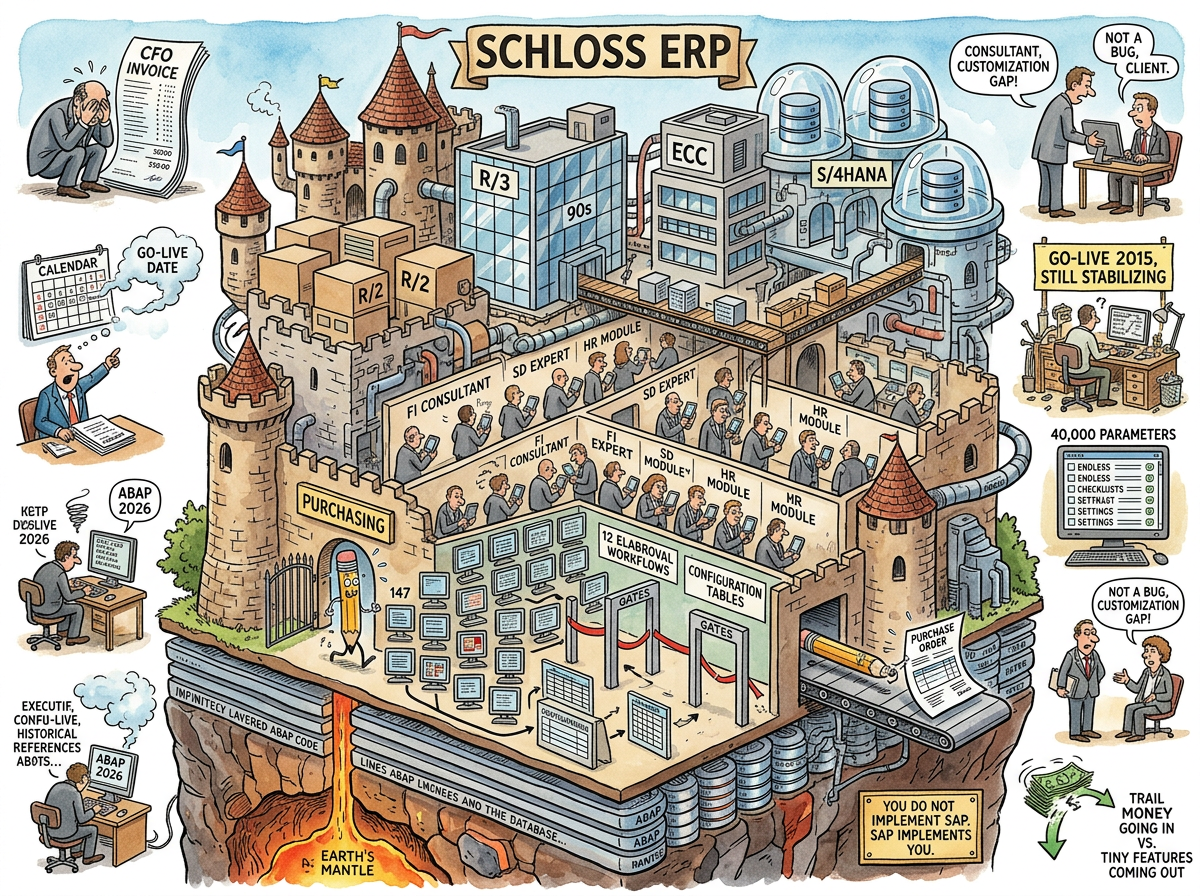
SAP (Systems, Applications & Products in Data Processing) is an enterprise software system founded in 1972 by five former IBM engineers in Walldorf, Germany, that has since grown into the largest enterprise software company in Europe, the backbone of 77% of the world’s transaction revenue, and the single most expensive thing that can happen to a company that isn’t a war.
SAP is not software in the way that most people understand software. SAP is a civilisation — a self-contained universe with its own language (ABAP), its own logic (customising tables), its own economy (the consulting ecosystem), and its own gravitational pull so strong that once an organisation enters SAP’s orbit, it never leaves. Companies do not use SAP. Companies become SAP. The org chart reshapes itself around the modules. The business processes reshape themselves around the configuration. The humans reshape themselves around the approval workflows.
You do not implement SAP. SAP implements you.
The Scale
SAP’s numbers defy comprehension in the way that astronomical distances defy comprehension — you can read them but you cannot feel them:
- 77% of the world’s transaction revenue touches an SAP system
- 99 of the 100 largest companies use SAP
- 230 million cloud users
- $34 billion in annual revenue (2024)
- 105,000 employees
- A consulting ecosystem worth multiples of SAP’s own revenue
The company that sells pencils uses SAP. The company that makes the wood for the pencils uses SAP. The company that ships the pencils uses SAP. The company that audits the pencil company uses SAP. The transaction for one pencil passes through SAP at every stage of its existence, from raw material to customer complaint.
ABAP
SAP’s primary programming language is ABAP (Advanced Business Application Programming), created in the 1980s, which reads like COBOL’s corporate nephew — verbose, structured, and utterly invisible to the mainstream programming world.
SELECT matnr, maktx
  FROM makt
  INTO TABLE @DATA(lt_materials)
  WHERE spras = 'E'.

LOOP AT lt_materials INTO DATA(ls_mat).
  WRITE: / ls_mat-matnr, ls_mat-maktx.
ENDLOOP.
ABAP developers are among the highest-paid programmers in the world and the least likely to appear on a podcast. They do not blog. They do not stream. They do not have side projects. They have SAP Notes, transport requests, and a quiet certainty that the world literally cannot run without them.
They are correct. If every ABAP developer stopped working tomorrow, global supply chains would halt within the week. This is not hyperbole. This is the dependency that SAP has quietly built over fifty years while the rest of the industry was arguing about React.
The Implementation
An SAP implementation is not a software project. An SAP implementation is a corporate near-death experience — a multi-year, multi-million-euro undertaking that restructures the organisation, redefines the business processes, retrains the workforce, and produces an invoice that makes the CFO question every decision that led to this moment.
The typical SAP implementation:
| Phase | Duration | What Happens | What Actually Happens |
|---|---|---|---|
| Discovery | 3 months | Requirements gathered | Consultants learn the business |
| Blueprint | 3 months | Solution designed | Consultants configure the business into SAP’s model |
| Realisation | 6 months | Solution built | The business learns it must change to fit SAP |
| Testing | 3 months | Solution tested | Everyone discovers what was missed in Blueprint |
| Go-live | 1 month | Solution deployed | The CEO emails “when will it work?” |
| Stabilisation | ∞ | Issues resolved | The consulting contract becomes permanent |
Estimated duration: 12–18 months.
Actual duration: 2–7 years.
Estimated cost: £10–50 million.
Actual cost: £30–500 million.
The gap between estimate and actual is not a failure of estimation. It is a feature of the ecosystem. SAP implementations are estimated optimistically because nobody would approve the real number. The real number emerges gradually, through change requests, scope adjustments, and the slow, creeping realisation that SAP is not adapting to the business — the business is adapting to SAP.
The Configuration Paradox
SAP is “configurable.” This is technically true in the same way that the English language is “configurable” — you can say anything, but the grammar constrains how you say it, and if your thought doesn’t fit the grammar, you must change the thought.
SAP has approximately 40,000 configuration parameters across its modules. Each parameter interacts with other parameters. The configuration space is effectively infinite. A consultant who specialises in SAP MM (Materials Management) may have no understanding of SAP FI (Financial Accounting), because each module is its own universe of configuration.
The promise: “SAP can be configured to match your business processes.”
The reality: your business processes will be configured to match SAP.
This is not a flaw. This is, arguably, SAP’s greatest contribution — the enforcement of standardised business processes across organisations that would otherwise invent their own, incompatible, undocumented processes. SAP is not flexible because flexibility in enterprise software is another word for chaos. SAP is opinionated, and its opinions are backed by fifty years of seeing what happens when organisations make their own decisions about purchase order approval workflows.
The organisations that succeed with SAP are the ones that accept its opinions. The organisations that fail are the ones that spend £100 million customising SAP to match their existing processes — thereby paying enterprise software prices for bespoke software complexity, achieving the worst of both worlds.
The Consulting Ecosystem
SAP’s consulting ecosystem is larger than SAP itself. Accenture, Deloitte, IBM, Capgemini, Infosys, Wipro, and thousands of smaller firms employ hundreds of thousands of SAP consultants worldwide. The consulting revenue generated by SAP implementations exceeds SAP’s own software revenue by a significant multiple.
This creates an incentive structure that a game theorist would describe as “interesting”:
- SAP benefits from implementations being complex (more licenses)
- Consultants benefit from implementations being long (more billable hours)
- The customer benefits from implementations being short and simple
- Two out of three incentives point toward complexity
The best SAP consultants are worth their extraordinary day rates — they have seen a hundred implementations, know which configurations work, and can save months of wrong turns. The worst SAP consultants are also worth their extraordinary day rates, to the consulting firm, because the wrong turns generate additional billable months.
Distinguishing between the two is the most expensive skill an organisation can lack.
S/4HANA
SAP’s current platform is S/4HANA — a complete rewrite of the core system on an in-memory database (HANA), announced in 2015, with a migration deadline that SAP has extended multiple times (currently 2027, which the industry interprets as “2030 at earliest”).
S/4HANA is genuinely faster, genuinely simpler in some architectural respects, and genuinely the largest forced migration in enterprise software history. Every SAP customer must eventually migrate. The migration is itself a multi-year project. Some organisations are migrating from systems they only finished implementing five years ago.
The cycle is eternal: implement SAP (5 years), stabilise SAP (3 years), migrate SAP (4 years), stabilise again (3 years), new version announced. The organisation is perpetually implementing, stabilising, or migrating. The consultants are perpetually billing. The software is perpetually almost ready.
The Lizard’s Position
The Lizard has no position on SAP. The Lizard’s entire system — notes indexing, blog, wiki, RSS, covers — runs on one binary, one SQLite database, and zero configuration parameters.
SAP has 40,000 configuration parameters. The Lizard has --db-path and --notes-dir.
This comparison is not fair. SAP processes 77% of the world’s transaction revenue. The Lizard processes markdown. But the comparison is instructive: the gap between two flags and forty thousand parameters is not just a difference of scale. It is a difference of philosophy — the belief that software should adapt to the organisation versus the belief that the organisation should adapt to the software.
SAP chose the latter and conquered the world. The Lizard chose the former and has twenty-two subcommands. Both are victims of Zawinski’s Law. One of them admits it.
Measured Characteristics
Year founded:                                1972
World transaction revenue through SAP:       77%
Fortune 100 companies using SAP:             99
Configuration parameters:                    ~40,000
Average implementation duration (estimated): 12–18 months
Average implementation duration (actual):    2–7 years
Average implementation cost (estimated):     £10–50M
Average implementation cost (actual):        £30–500M
ABAP developers worldwide:                   ~2 million
ABAP developers on podcasts:                 ~0
Consultants in the SAP ecosystem:            hundreds of thousands
S/4HANA migration deadline:                  2027 (officially), 2030+ (realistically)
Organisations perpetually implementing:      most of them
The Lizard's configuration parameters:       2