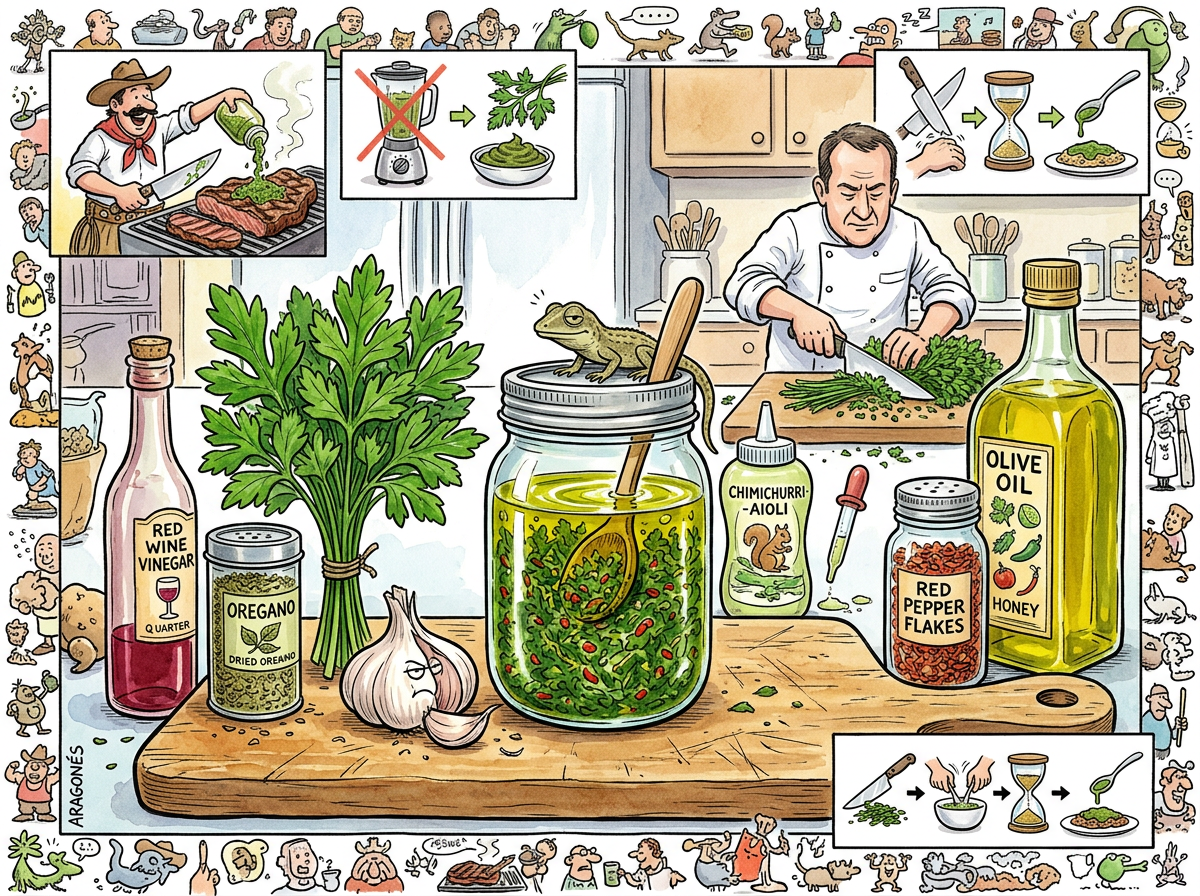
Chimichurri is the canonical sauce of Argentine grilling — fresh parsley, oregano, garlic, red wine vinegar, olive oil, and red pepper flakes, chopped and mixed into a loose, bright, intensely herbaceous condiment that goes ON the meat after grilling. Not before. Not during. After. The sauce is raw. It is fresh. It does not cook. It has never cooked. Cooking chimichurri would be like ironing a cloud — technically possible, conceptually wrong, and evidence that you have misunderstood what you are holding.
Chimichurri is the Lizard’s sauce: few ingredients, no cooking, maximum impact. The Squirrel’s chimichurri has cilantro, lime, jalapeno, and “a hint of honey.” That is not chimichurri. That is a vinaigrette having an identity crisis.
riclib keeps a jar in the fridge at all times. It goes on Picanha, Flank Steak, Flat Iron, eggs, bread, anything that needs brightness and garlic. The beauty of chimichurri is this: it takes ten minutes to make and lasts a week. In a universe where the Squirrel wants every condiment to be a project, chimichurri is the anti-project. It is done before the Squirrel has finished reading the recipe.
The Squirrel proposes a chimichurri variation. The variation has cilantro, lime, jalapeno, honey, and “maybe some mint.”
SIX INGREDIENTS.
RAW.
CHOPPED, NOT BLENDED.
THE ARGENTINES SOLVED THIS
BEFORE YOU WERE BORN. 🦎
The Ingredients (and the Ones That Don’t Belong)
Fresh flat-leaf parsley — a full bunch, finely chopped. Not curly parsley, which is garnish parsley, which is parsley that gave up on flavour in exchange for looking decorative on hospital cafeteria plates. Flat-leaf parsley has actual taste. It is the backbone of chimichurri — the green, the freshness, the reason the sauce looks alive. Without parsley, you have garlic oil with flakes in it.
Oregano — dried. Not fresh. Dried oregano has a concentrated, earthy intensity that fresh oregano cannot match. This is one of the rare cases where dried is correct and fresh is wrong, which confuses people who were told that fresh herbs are always superior. They are not. Dried oregano in chimichurri is canonical. The Squirrel finds this philosophically distressing.
Garlic — four to six cloves, minced fine. The garlic provides the punch. It cuts through the richness of grilled fat. It announces itself on the palate and does not apologise. The Squirrel suggests roasting the garlic first “to mellow it.” The garlic does not wish to be mellowed. The garlic is here to work.
Red wine vinegar — the acid. The acid is what makes chimichurri a sauce rather than a herb salad. It cuts through fat, lifts the parsley, sharpens the garlic, and creates the contrast that makes each bite of grilled meat feel like the first. The Squirrel suggests balsamic. Balsamic is the wrong acid. Balsamic is sweet. Chimichurri is not sweet. Red wine vinegar. End of discussion.
Olive oil — extra virgin, always. The oil binds the herbs to the meat, gives chimichurri its loose, spoonable texture, and carries the flavour from jar to surface to palate. This is not a place for neutral oil.
Red pepper flakes — a pinch. Not enough for heat. Enough for warmth. The pepper flakes provide a low background hum that you notice only when they are absent. They are the bass note in a composition of treble.
The Ones That Don’t Belong
The Squirrel has proposed the following additions:
- Cilantro (“for brightness” — parsley is already bright)
- Lime juice (“citrus lifts everything” — the vinegar is the acid, there is no vacancy)
- Jalapeno (“gentle heat” — that is a salsa verde, not chimichurri)
- Honey (“to balance the acid” — the acid is not meant to be balanced, the acid is meant to cut fat)
- Mint (“freshness” — this is now a lamb sauce)
- Shallots (“more nuanced than garlic” — the garlic is not here to be nuanced)
- Anchovy paste (“umami depth” — this is now a dressing)
- Fish sauce (“the umami hack” — stop)
Each addition produces a condiment. None of the condiments are chimichurri. The Argentines did not spend a century perfecting six ingredients so that someone in Riga could add honey.
Chopped, Not Blended
This is not negotiable.
Chimichurri has texture. Each piece of parsley should be visible. The garlic should be minced, not pureed. The oregano should be flecks, not dust. The whole thing should look like someone chopped herbs and put them in a jar, because that is exactly what happened.
The Squirrel suggests a food processor. The food processor will turn parsley into green paste in approximately 1.3 seconds. Green paste is not chimichurri. Green paste is pesto without the cheese, or sauce without the identity, or — most accurately — chimichurri that has been destroyed by a machine that was designed for a different job.
Blending makes it a paste. Chimichurri is not a paste. Chimichurri is a loose, textured, spoonable sauce where you can see every ingredient. The pieces of parsley. The flecks of oregano. The specks of red pepper. The minced garlic suspended in the oil and vinegar. This texture is not an accident. It is the point.
A knife and a cutting board. That is the technology. The food processor stays in the cabinet where it belongs, next to the spiralizer, the mandoline, and the other tools the Squirrel purchased and used exactly once.
The Method (Ten Minutes, a Knife, a Jar)
- Chop the parsley — fine, but not pulverised. Each piece visible. A chef’s knife. A cutting board. Thirty seconds if you have done this before. Two minutes if you have not. Either way, faster than finding the food processor, assembling it, pulsing, scraping the sides, pulsing again, over-processing, and washing four parts.
- Mince the garlic — fine. A microplane is acceptable. A garlic press is acceptable. The Squirrel’s fermented black garlic is not acceptable.
- Combine in a jar — parsley, garlic, oregano, red pepper flakes. Pour in the red wine vinegar. Pour in the olive oil. Stir.
- Wait — minimum thirty minutes. Overnight is better. The vinegar softens the garlic. The oregano hydrates. The oil absorbs everything. Chimichurri made five minutes ago is six ingredients in a jar. Chimichurri made twelve hours ago is chimichurri.
There is no step five. There is no cooking. There is no reduction, no emulsification, no tempering, no deglazing. Ten minutes of active work, then the fridge does the rest. The Squirrel has proposed adding a cooking step on four separate occasions. Each time the Lizard blinked and said nothing, which is the Lizard’s way of saying no.
The Universal Condiment
Chimichurri is the only acceptable sauce on grilled beef in the lifelog’s universe. This is not snobbery. This is specificity. BBQ sauce is for Pulled Pork and Pork Ribs — low-and-slow cuts where the sweetness and thickness of BBQ sauce complement the smoke and the bark. BBQ sauce on a steak is a category error, like putting ketchup on sushi or installing a JavaScript framework to serve static HTML.
Chimichurri goes on everything that comes off the grill and does not already have a sauce:
- Picanha — sliced thin, chimichurri spooned over each slice. The acid cuts the rendered fat. The garlic amplifies the char.
- Flank Steak — sliced against the grain, chimichurri draped across the surface. The vinegar and herbs transform a lean cut into something that tastes expensive.
- Flat Iron — the most underrated steak, made perfect by chimichurri. The marbling handles the richness; the chimichurri handles the brightness.
- Rib Eye — controversial, because the rib eye has enough fat and flavour to stand alone. But a thin line of chimichurri on the first bite is the Lizard’s version of gilding the lily — minimal, deliberate, and exactly enough.
- Eggs — scrambled, fried, or poached. Chimichurri on eggs is breakfast elevated without adding a single minute of cooking.
- Bread — good bread, torn, dipped into the jar. This is how the last of the chimichurri is consumed, at the end of the week, standing in the kitchen, before making a new batch.
The relationship between chimichurri and grilled meat is not decoration. It is amplification. The acid cuts the fat. The herbs add freshness to the char. The garlic adds punch to the smoke. The oil carries everything to the surface in a thin, glistening coat. Most sauces mask. Chimichurri reveals.
Measured Characteristics
- Ingredients: 6 (parsley, garlic, oregano, red wine vinegar, olive oil, red pepper flakes)
- Ingredients proposed by Squirrel: 8 (cilantro, lime, jalapeno, honey, mint, shallots, anchovy paste, fish sauce — all rejected)
- Cooking required: none (this is the point)
- Blending required: absolutely not (this is also the point)
- Technique required: chopping (a knife, a board, an arm)
- Active time: 10 minutes
- Minimum rest time: 30 minutes
- Ideal rest time: overnight
- Storage: fridge, up to one week
- Equipment: knife, cutting board, jar
- Equipment rejected: food processor, blender, immersion blender, spice grinder
- Temperature: none (there are no temperatures in chimichurri)
- When to apply: after grilling (not before, not during, after)
- Canonical use: grilled beef (Picanha, Flank Steak, Flat Iron)
- Expanded use: eggs, bread, anything that needs brightness and garlic
- BBQ sauce jurisdiction: Pulled Pork and Pork Ribs only — not steak, never steak
- The Squirrel’s chimichurri: has cilantro, lime, jalapeno, and honey (that is a vinaigrette)
- The Lizard’s chimichurri: has 6 ingredients and a jar (that is chimichurri)
- Jars in riclib’s fridge: 1 (always; replaced before empty)
- Philosophical sibling: Pepper Smoke Salt (minimal ingredients, maximum result)