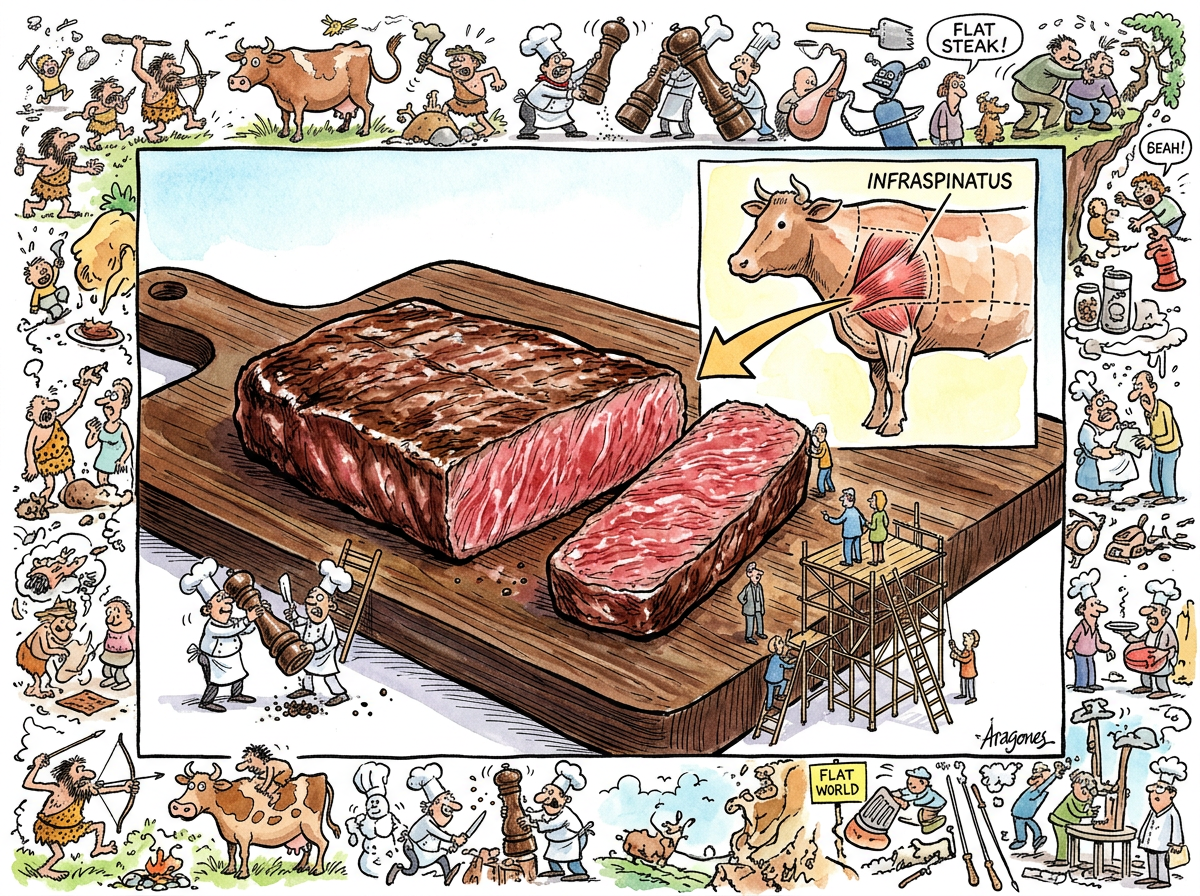
The Flat Iron (also called the butler’s steak or oyster blade steak, though it is not the Oyster Steak) is a rectangular steak cut from the infraspinatus muscle in the chuck — the shoulder — of the cow. It is the second-most tender muscle on the entire animal, after the tenderloin. It was invisible to the steak market until 2002, when researchers at the University of Nebraska and the University of Florida published a study that said, in the measured language of meat science: there is a steak in the chuck that is almost as tender as filet mignon, marbled like a Rib Eye, and priced like a Flank Steak, and nobody is selling it because of one connective tissue seam that runs through the middle.
Remove the seam and you have two flat iron steaks. Leave the seam and you have a top blade roast, which is what butchers had been selling for a century — the whole muscle, intact, connective tissue and all, consigned to the braising pile because nobody had thought to split it and remove the gristle.
The flat iron is the Boring Technology of steaks. It was there the whole time. Inside the chuck. Next to the muscles that become pot roast and stew meat. Hidden not by rarity but by convention — the convention that says the shoulder is for slow cooking and the loin is for steaks, a convention that is mostly correct and in this one case spectacularly wrong.
The Discovery
In 2002, the beef industry had a problem: consumers were buying tenderloins and rib eyes and ignoring everything else. The chuck — 30% of the animal by weight — was undervalued. The National Cattlemen’s Beef Association funded research to find overlooked value in underused primals.
The researchers mapped every muscle in the chuck for tenderness. The infraspinatus — a flat, fan-shaped muscle that the cow uses to stabilise its shoulder blade — measured second only to the psoas major (the tenderloin). It was marbled. It was flavourful. It was being sold as part of a $4/lb roast instead of a $15/lb steak.
The catch: a thick fascia — a band of tough connective tissue — runs horizontally through the middle of the muscle. Cook it intact and the fascia is chewy, unpleasant, the reason nobody had cut steaks from this muscle before. The solution was to split the muscle along the fascia, peel it out, and cut two steaks from the top half. The bottom half, thinner and less uniform, becomes the petite tender or goes to other uses.
The flat iron was not invented. It was discovered. Like penicillin, or the fact that the tab session already knew everything and nobody had asked it.
The Method
The flat iron is forgiving because it is both tender and marbled — a combination that means overcooking by a degree or two doesn’t destroy it the way it destroys a lean cut like the Flank Steak.
- Dry Brine — salt, one hour minimum
- Pepper Smoke Salt — the trinity, as always
- Kamado or cast iron, high heat — 260°C (500°F)+
- Three to four minutes per side — the uniform thickness makes timing reliable
- Rest five minutes — then slice against the grain
The flat iron’s uniform thickness is its structural advantage. Unlike a rib eye, which tapers, or a sirloin, which varies, the flat iron is the same thickness from edge to edge. This means even cooking. This means no overcooked thin end and undercooked thick end. This means the kind of predictable, reproducible result that a developer who values deterministic systems appreciates in a steak.
Slice against the grain. The grain runs the length of the steak, visibly. The slicing rule is the same as Flank Steak: perpendicular to the fibres, at an angle, thin. The flat iron is more forgiving than flank if you get the angle slightly wrong — the tenderness compensates — but the correct angle is still the correct angle.
Measured Characteristics
- The muscle: infraspinatus (shoulder blade stabiliser)
- Tenderness rank: #2 on the animal (after tenderloin)
- Discovered: 2002 (University of Nebraska / University of Florida)
- Previously sold as: top blade roast (braised, wasted)
- The seam: a horizontal fascia that must be removed
- Shape: rectangular, uniform thickness
- Marbling: generous (comparable to Rib Eye)
- Flavour: beefy, rich (the shoulder works, and working muscles have flavour)
- Cook time: 6–8 minutes total
- Target internal: 54°C / 130°F (medium-rare)
- Forgiveness: high (marbling compensates for slight overcooking)
- Price: significantly less than rib eye for comparable quality
- Availability in Riga: better than Flank Steak, worse than Rib Eye
- The Squirrel’s proposal for a FlatIronOptimalCookingParameterMatrix: rejected
- The Lizard’s observation: the best steaks are the ones the industry forgot to price
- Years the flat iron hid inside a chuck roast: ~100
- Papers required to discover it: 1